
Explore the essentials of stellar luminosity: its measures, effects on planetary systems, current research trends, and its role in understanding the universe.
Understanding Stellar Luminosity
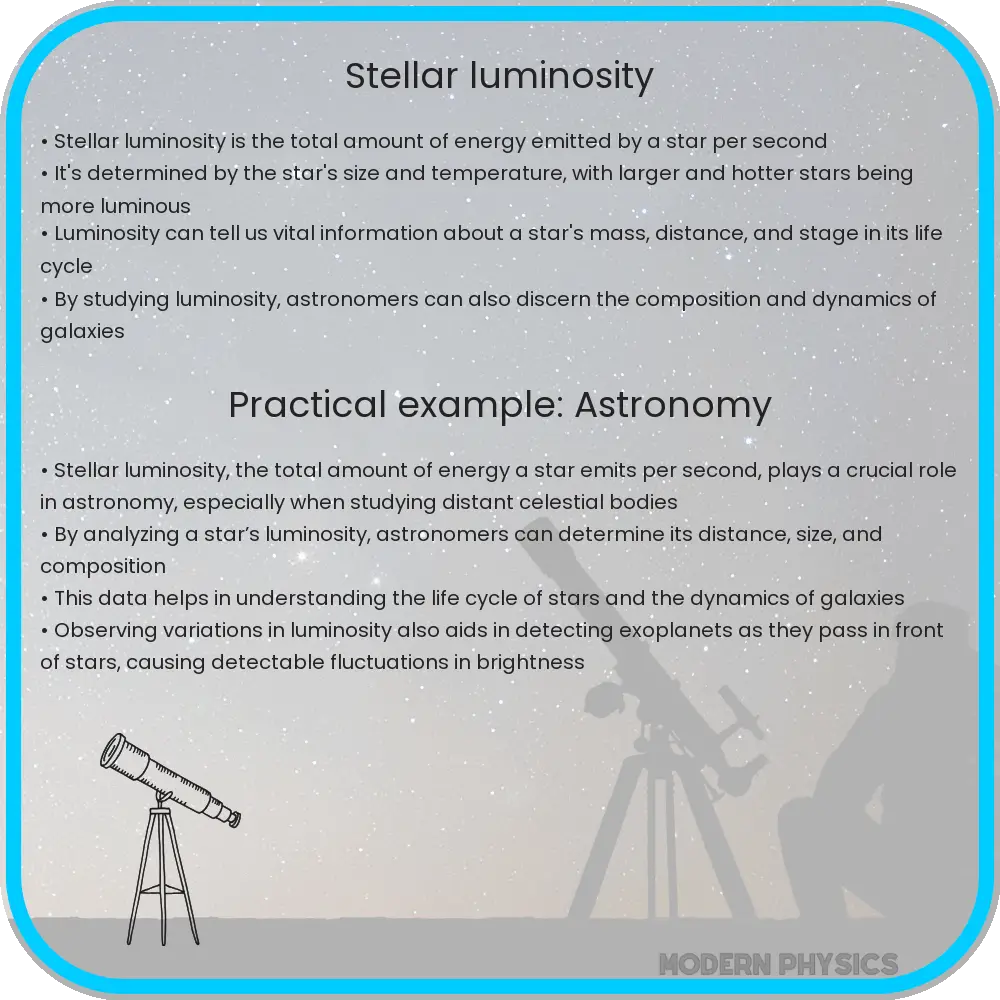
Stellar luminosity, a fundamental concept in astrophysics, measures the total amount of energy emitted by a star per unit time. It is a critical parameter in understanding a star’s life cycle, temperature, size, and distance from Earth. Luminosity is often expressed in terms of the Sun’s luminosity, denoted as \(L_{\odot}\), providing a baseline for comparing the brightness of other stars.
Key Measures of Stellar Luminosity
The luminosity of a star is primarily determined by two factors: its surface area and its surface temperature. According to the Stefan-Boltzmann law, the luminosity (\(L\)) is directly proportional to the fourth power of the star’s surface temperature (\(T\)) and its surface area. Mathematically, it is expressed as:
\[L = 4 \pi R^{2} \sigma T^{4}\]
where \(R\) is the radius of the star and \(\sigma\) is the Stefan-Boltzmann constant. This equation shows that even a small increase in the star’s temperature can significantly increase its luminosity.
Effects of Stellar Luminosity
Stellar luminosity has profound effects on the characteristics of planetary systems, including the habitable zone—the region around a star where conditions might be right for liquid water and life. A higher luminosity increases the range of this zone, while a lower luminosity narrows it. Furthermore, luminosity influences the lifecycle of stars, from their birth in nebulous gas clouds to their ultimate fate as white dwarfs, neutron stars, or black holes.
Current Trends in Luminosity Research
Recent trends in luminosity research focus on understanding the variability of stellar brightness and its impact on exoplanet detection and characterization. Variations in luminosity can indicate the presence of exoplanets or stellar companions. Additionally, advancements in telescopic technology and space exploration have enabled astronomers to measure the luminosities of stars more accurately and over a broader range of distances, enhancing our understanding of the universe’s structure and evolution.
Measuring Stellar Luminosity
The measurement of stellar luminosity is a complex process that involves various observational techniques and instruments. Astronomers often use photometry to measure the intensity of light from a star and spectroscopy to determine its distance and temperature. By applying the inverse-square law, which states that luminosity decreases with the square of the distance from the observer, scientists can estimate a star’s true luminosity from Earth.
Additionally, the use of space-based telescopes and observatories has significantly improved the accuracy of these measurements, allowing for a more detailed understanding of stars beyond our solar system. These advancements have also led to the discovery of new celestial phenomena and the refinement of models predicting stellar evolution.
Implications of Stellar Luminosity
The study of stellar luminosity extends beyond the academic realm, influencing our understanding of the cosmos and our place within it. For instance, by studying the luminosity of distant stars, astronomers can infer the age, composition, and motion of galaxies. This information is crucial for our understanding of cosmic phenomena such as dark matter, dark energy, and the expansion of the universe.
Moreover, understanding stellar luminosity contributes to our knowledge of potential extraterrestrial environments. By examining the luminosity and temperature of stars, scientists can identify exoplanets within habitable zones and assess their potential for supporting life.
Conclusion
Stellar luminosity remains a cornerstone of astrophysical research, providing critical insights into the lifecycle of stars, the dynamics of galaxies, and the potential for life in the universe. As observational technologies continue to advance, our understanding of stellar luminosity and its implications will expand, further unraveling the mysteries of the cosmos. This ongoing research not only enriches our scientific knowledge but also deepens our appreciation for the intricate and majestic nature of the universe.