
Spintronics, an advanced field in nanoscale electronics, leverages the electron’s spin and charge to enhance device efficiency and speed.
Understanding Spintronic Devices: A Leap Towards Highly Efficient Technologies
Spintronics, or spin electronics, represents an evolving field of nanoscale electronics that exploits not only the electrical charge of electrons but also their spin — the tiny magnetic moments associated with electrons due to their angular momentum. This approach can lead to electronic devices that are more versatile, efficient, and faster than their purely charge-based counterparts.
The Basics of Electron Spin in Spintronics
Traditional electronics rely on the charge of the electron to perform computations and store information. However, each electron also possesses a property known as ‘spin’, which can be thought of as a tiny bar magnet with a north and south pole. In the realm of spintronics, this spin property is utilized in conjunction to the charge of the electrons.
The two fundamental spin states of an electron are “up” and “down”, which can be aligned or oriented in different directions when subjected to magnetic fields. This characteristic enables spintronic devices to operate in a binary fashion similar to traditional electronic devices but with a crucial difference. Spin-based devices have the potential to process vast amounts of data more efficiently due to their ability to exploit both the charge and spin of electrons.
Advanced Materials in Spintronics
The success of spintronic devices heavily relies on the materials used to create them. Materials that exhibit strong magnetic properties are crucial, as the spin of electrons in these materials can be more easily manipulated. Ferromagnetic metals like iron, nickel, and cobalt have traditionally been used. More recently, the focus has shifted towards complex compounds such as:
- Heusler alloys, known for their tunable magnetic properties,
- Magnetic topological insulators which support surface states conducive to spin manipulation,
- Two-dimensional materials such as graphene, which might host long spin lifetimes essential for effective spin transport.
Efficiency and Innovation in Spintronic Devices
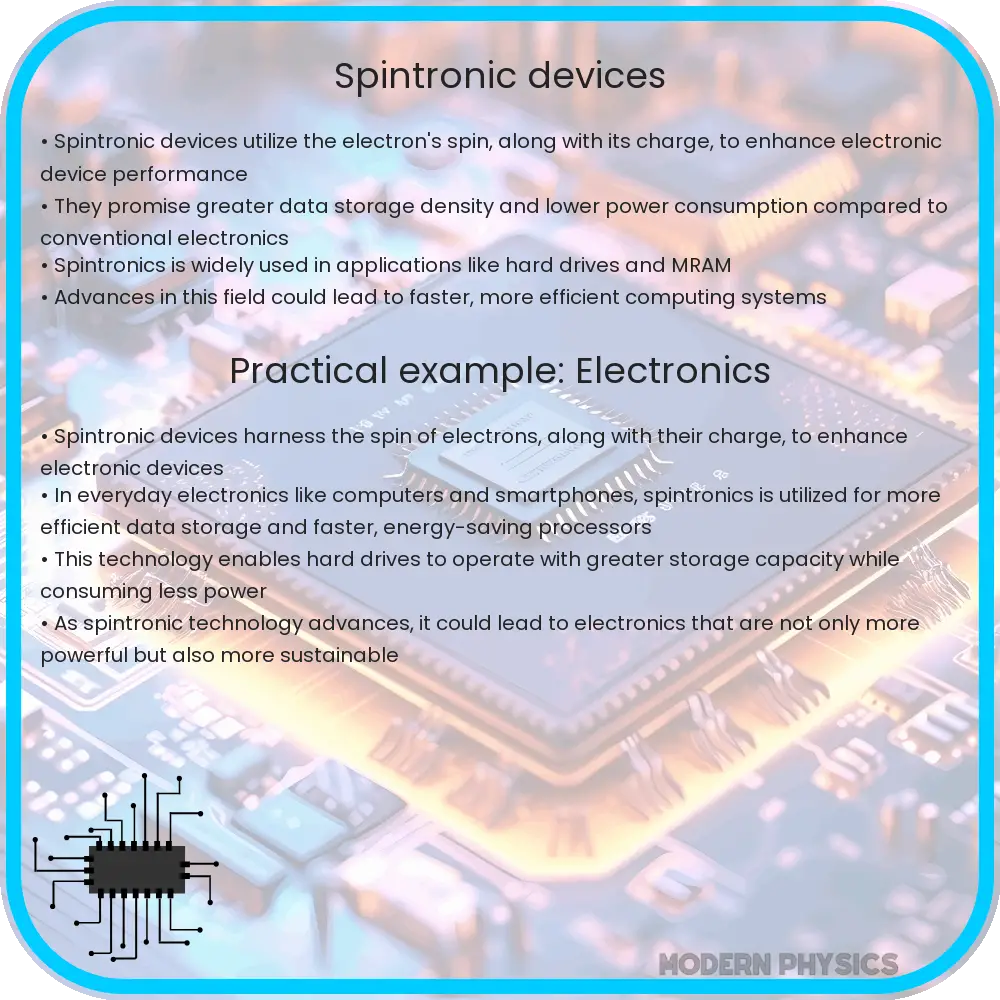
One of the defining advantages of spintronic devices is their energy efficiency. Since spintronic devices can operate at lower voltages and sustain data integrity without a constant power supply, they are ideally suited for applications where power consumption is a critical concern, such as in mobile devices and remote sensors. Moreover, the ability of these devices to handle data in both the digital and analog forms expands their utility in various technological fields.
Innovations in spintronic technology have also led to significant advancements in data storage. For instance, Magnetic Random Access Memory (MRAM) uses magnetic states to store data bits instead of electric charge, offering higher speed and endurance compared to traditional flash memory. Furthermore, the development of spin-transfer torque (STT) technology allows MRAM devices to operate with even greater efficiency, demonstrating the practical applications of spintronics in modern computing.
Challenges and Future Directions in Spintronics
Despite the numerous advantages, there are challenges that need addressing to further the development of spintronic devices. One of the primary issues is the integration of spintronic elements into existing semiconductor technologies, which primarily use non-magnetic materials. Also, understanding and controlling the spin of electrons at room temperature remains a technical challenge due to thermal fluctuations that can disrupt the spin orientation.
Future research in spintronics is geared towards overcoming these obstacles by exploring more robust materials and innovative device architectures. For instance, the development of spin-based quantum computing could vastly improve computational speeds and efficiency by utilizing the principles of quantum mechanics in conjunction with electron spin. Continued advancements in nanofabrication techniques and theoretical modeling are also critical to enhance the practicality and functionality of spintronic technologies.
Conclusion
Spintronics marks a significant evolution in electronic technology, capitalizing on the inherent spin property of electrons in addition to their charge. This field offers promising prospects for creating faster, more efficient, and versatile devices that could transform current technologies. With ongoing research addressing the integration challenges and exploring new materials, the future of spintronics looks promising. As we continue to unravel the complexities of electron spin and its applications, we edge closer to a new era of technological advancement that could redefine what is possible with electronic devices.