
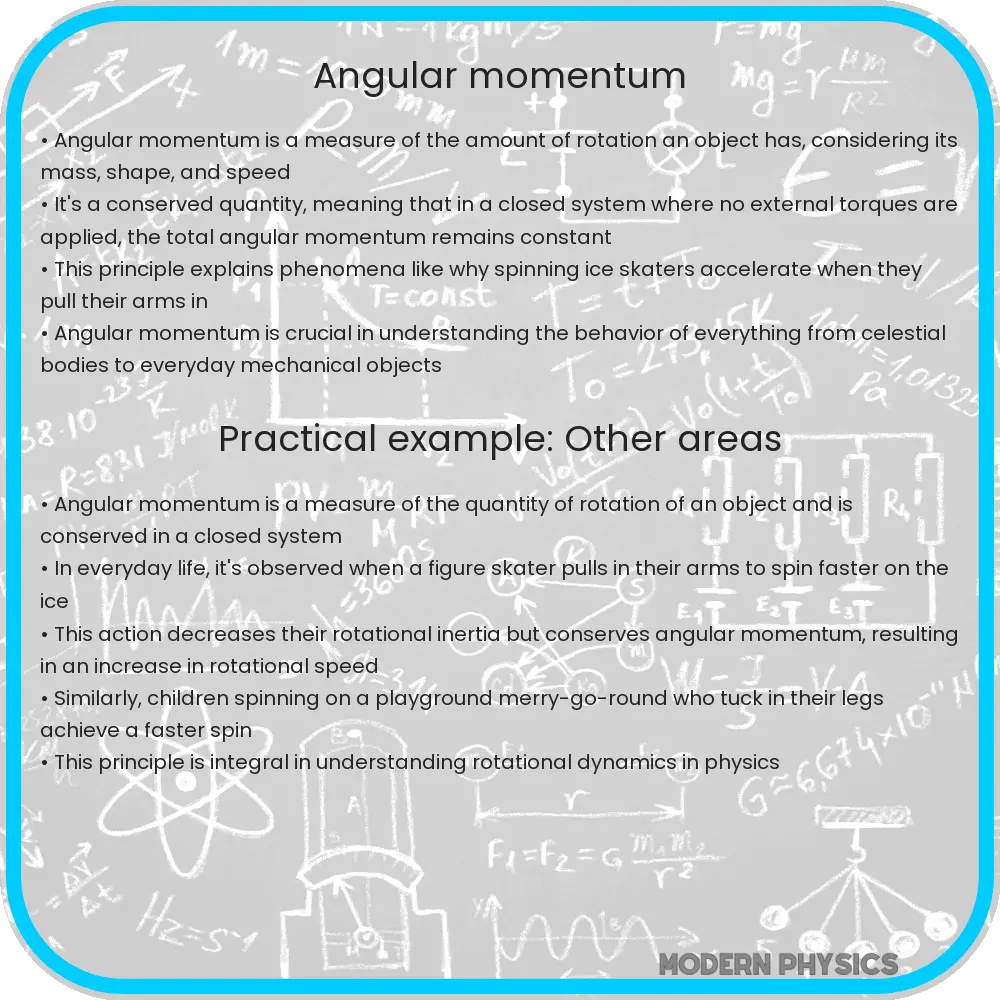
Angular momentum quantifies the rotational motion of an object, considering its mass distribution and rotational speed.
Understanding Angular Momentum
Angular momentum is a fundamental concept in physics that describes the rotational motion of an object. It plays a critical role in understanding how objects behave when they rotate around an axis. This concept is not only pivotal in classical mechanics but also in quantum mechanics and is crucial in disciplines ranging from astronomy to engineering.
What is Angular Momentum?
Angular momentum, often symbolized as \(\vec{L}\), is the rotational equivalent of linear momentum. While linear momentum is a measure of an object’s tendency to move in a straight line at a constant speed, angular momentum quantifies the amount of rotation an object has, taking into account its mass distribution and rotational speed.
The angular momentum of an object is defined as the cross product of the position vector (\(\vec{r}\)) and the linear momentum vector (\(\vec{p}\)), mathematically represented as:
\[ \vec{L} = \vec{r} \times \vec{p} \]
Where:
- \(\vec{r}\) is the radius vector that connects the axis of rotation to the point of interest on the object.
- \(\vec{p}\) is the linear momentum of the object, given by the product of its mass (m) and its velocity (\(\vec{v}\)), i.e., \(\vec{p} = m \vec{v}\).
Formula and Calculation
For a point particle, the magnitude of angular momentum can be calculated using the following formula:
\[ L = r \cdot m \cdot v \cdot \sin(\theta) \]
Here, \( \theta \) is the angle between the position vector (\(\vec{r}\)) and the velocity vector (\(\vec{v}\)). The term \(\sin(\theta)\) indicates that the maximum angular momentum is achieved when the movement is perpendicular to the radius vector.
For extended bodies, the calculation of angular momentum becomes a bit more complex, as one has to integrate the angular momenta of all differential mass elements that make up the object:
\[ \vec{L} = \int \vec{r} \times d\vec{p} \]
This integral considers all the mass elements in the body, each contributing to the overall angular momentum depending on their distance from the axis of rotation and their respective velocities.
Conservation of Angular Momentum
The principle of conservation of angular momentum states that the total angular momentum of a closed system remains constant unless acted upon by an external torque. This concept is analogous to the conservation of linear momentum and is vital for analyzing systems where rotational motion is prominent.
For instance, figure skaters leverage this principle to control their spin speed. By pulling their arms in, they reduce their body’s moment of inertia, leading to an increase in spinning speed to conserve angular momentum. Similarly, celestial dynamics, such as the orbits of planets and the rotation of galaxies, are governed by the conservation of angular momentum.
Applications of Angular Momentum
Understanding angular momentum has practical applications in various fields such as engineering, astronomy, and even sports. In mechanical engineering, the principles of angular momentum are critical for designing rotating machinery like turbines, engines, and gyroscopes. Gyroscopes, for example, use angular momentum to maintain orientation and are widely used in aircraft navigation systems, smartphones, and more.
In sports, athletes often use the concept of angular momentum to enhance their performance. Divers and gymnasts manipulate their body’s momentum to achieve complex spins and flips. By understanding how to control their body’s angular momentum, they can perform these maneuvers with precision and grace.
In the realm of astronomy, angular momentum is crucial for understanding the rotational dynamics of celestial objects. It explains phenomena such as the flattening of the Earth at the poles due to its rotation, the formation of accretion disks around black holes, and why planets in our solar system orbit in the same direction.
Challenges in Manipulating Angular Momentum
While the conservation of angular momentum is a powerful tool in physics, manipulating it can be challenging in practical scenarios. For example, in aerospace engineering, controlling the angular momentum of satellites and space stations is critical for maintaining their correct orientation in space. This often requires complex systems of gyroscopes and reaction wheels to manage the distribution of angular momentum in response to external disturbances like gravitational pulls or pressure from solar radiation.
In robotics, managing angular momentum is essential for creating more stable and efficient robots. For researchers and engineers, the challenge lies in designing robots that can change their angular momentum rapidly in response to their environment, leading to better balance and functionality in uneven terrains or when performing complex tasks.
Conclusion
Angular momentum is more than just a theoretical concept in physics—it is a fundamental principle that influences a wide range of practical applications across various fields. From enabling astronauts to maintain control of spacecraft to allowing athletes to perform breathtaking maneuvers, the implications of angular momentum are pervasive and impactful. By further exploring and harnessing this intriguing aspect of rotational motion, we can continue to advance our technological capabilities and deepen our understanding of the universe. Whether in the vast reaches of space or the minutiae of daily technological devices, angular momentum continues to spin the wheels of innovation and discovery.