
Explore the fascinating world of spin ice materials and fractionalization, where quantum states and magnetism defy traditional rules, offering insights into future tech.
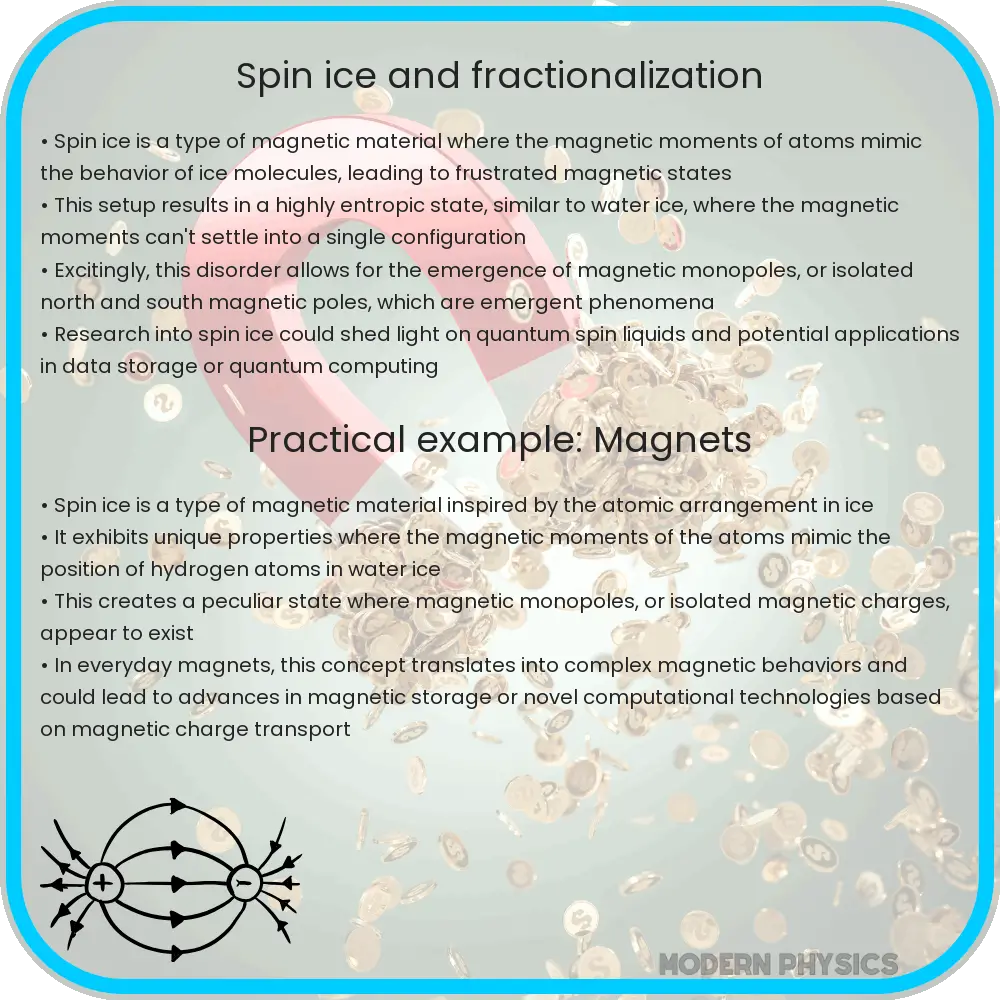
Exploring the Intriguing World of Spin Ice and Fractionalization
The realm of quantum physics and magnetism introduces a plethora of fascinating phenomena that challenge our conventional understanding of the physical world. Among these, spin ice and the concept of fractionalization in quantum states stand out, offering profound insights into the behavior of magnetic materials at the quantum level. This article delves into the intricacies of spin ice materials and how fractionalization plays a pivotal role in understanding their quantum states.
Understanding Spin Ice
Spin ice materials, such as Dysprosium titanate (Dy2Ti2O7) and Holmium titanate (Ho2Ti2O7), exhibit a unique magnetic behavior that mimics the properties of water ice. In water ice, the hydrogen atoms are positioned in a way that they satisfy the “ice rules”, leading to a residual disorder even at the lowest temperatures. Similarly, in spin ice materials, the magnetic moments or “spins” of the ions behave like the hydrogen atoms, arranging themselves in a frustrated lattice structure that prevents the system from reaching a state of minimal energy, thus creating a disordered state akin to that of water ice.
Fractionalization in Quantum States
Fractionalization is a remarkable quantum phenomenon where collective excitations in a material behave as if they carry a fraction of the elementary particle’s charge or quantum numbers. In the context of spin ice, this phenomenon is manifested through the emergence of magnetic monopoles. Despite being a concept once confined to theoretical physics, magnetic monopoles in spin ice materials provide a tangible example of fractionalization. These monopoles are not particles in the traditional sense but are emergent excitations that behave as if carrying a net magnetic charge, a fractional aspect of the spin’s quantum state. This is a groundbreaking discovery, as it challenges the long-held belief in the indivisibility of magnetic charges and opens up new avenues for research in magnetic monopoles and quantum magnetism.
The exploration of spin ice and fractionalization not only enriches our understanding of quantum magnetism but also paves the way for innovative technological advancements. By harnessing the unique properties of spin ice materials and the phenomena of fractionalization, scientists and engineers can develop new magnetic materials and devices, potentially revolutionizing the field of quantum computing and information storage.
Exploring Spin Ice and Fractionalization
Spin ice materials, such as dysprosium titanate (Dy2Ti2O7) and holmium titanate (Ho2Ti2O7), present a fascinating playground for the study of quantum states and magnetism. These exotic substances exhibit a magnetic frustration due to their crystal structure, leading to a highly degenerate ground state reminiscent of the proton disorder in water ice. This peculiar arrangement prevents the system from freezing into a single, ordered state, even at temperatures near absolute zero, hence the name “spin ice.
The concept of fractionalization in spin ice materials involves the emergence of quasiparticle excitations that carry a fraction of the electron’s charge. These magnetic monopoles, or emergent particles, arise from the flipping of a spin in the lattice, distorting the magnetic field and creating pairs of magnetic charges of opposite polarity. This phenomenon is a striking example of how complex behaviors emerge from simple rules in condensed matter physics.
Quantum States and Magnetism in Spin Ice
In the realm of quantum mechanics, the behavior of spin ice materials challenges traditional understandings of magnetism. The spins in these materials obey the ice rules, which dictate that two spins must point in and two must point out of every tetrahedron in the lattice, leading to a macroscopically degenerate ground state. This degeneracy is a key factor in the emergence of fractionalized excitations, as it allows for the existence of low-energy configurations that can be excited into monopole-like entities.
The study of these materials not only deepens our understanding of magnetic frustration and quantum states but also holds potential for applications in quantum computing and information storage. The ability to manipulate and control fractionalized excitations could lead to new ways of processing and storing information at the quantum level.
Conclusion
Spin ice materials and the concept of fractionalization represent a cutting-edge frontier in condensed matter physics. The peculiar properties of dysprosium and holmium titanates provide a unique insight into the quantum realm, where the conventional rules of magnetism are defied, and new quantum states emerge. The ongoing exploration of these materials could pave the way for revolutionary advancements in technology, particularly in the domains of quantum computing and magnetic storage. As researchers continue to unravel the mysteries of spin ice, the potential for discovering novel quantum phenomena and harnessing them for technological applications appears more promising than ever.