
Explore the pivotal role of RKKY interaction in nanosystems, its influence on spintronics, quantum computing, and the future of nanotechnology.
RKKY Interaction in Nanosystems: Unveiling Its Significance and Applications
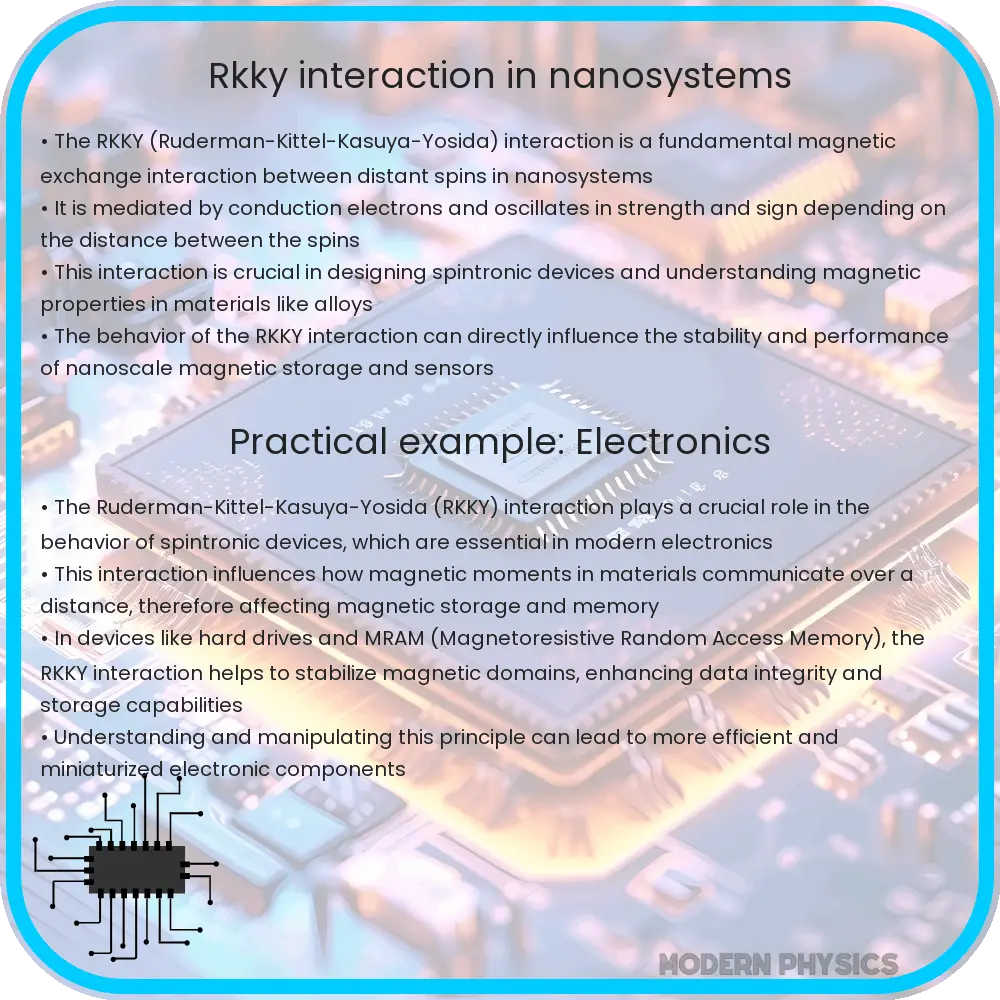
The Ruderman–Kittel–Kasuya–Yosida (RKKY) interaction plays a pivotal role in the magnetic properties of nanoscale systems, influencing the behavior of spintronic devices, magnetic storage media, and quantum computing materials. This quantum mechanical phenomenon arises from the indirect exchange interaction between localized magnetic moments through the conduction electrons in a material. Understanding the RKKY interaction is essential for advancing nanotechnology and developing novel applications in information storage and quantum computing.
Key Factors Influencing RKKY Interaction
The strength and nature of RKKY interaction in nanosystems are governed by several key factors, including:
- Distance between magnetic impurities: The interaction oscillates with the distance between magnetic moments, showing ferromagnetic or antiferromagnetic behavior based on their separation.
- Carrier density: The density of conduction electrons significantly affects the RKKY range function, altering the interaction’s magnitude and sign.
- Dimensionality of the system: The RKKY interaction exhibits different decay rates and oscillation patterns in one-dimensional, two-dimensional, and three-dimensional systems.
- Material properties: The type of host material, including its electronic structure and magnetic properties, also plays a crucial role in determining the RKKY interaction.
Applications in Nanotechnology
The manipulation of RKKY interaction has led to groundbreaking applications in several fields:
- Magnetic storage: By controlling the RKKY interaction, researchers can design high-density storage devices with improved data stability and retrieval speed.
- Spintronics: Spintronic devices, which utilize the spin of electrons in addition to their charge, benefit from the tunable magnetic coupling provided by RKKY interactions for enhanced performance and lower power consumption.
- Quantum computing: The RKKY interaction is fundamental in creating qubits for quantum computing by enabling controlled entanglement of spins in quantum dots and other nanoscale magnetic systems.
These applications highlight the RKKY interaction’s critical role in shaping the future of nanotechnology and information processing technologies. By delving deeper into the mechanisms and effects of this interaction, scientists and engineers can unlock new possibilities in material science and electronics, pushing the boundaries of what’s possible at the nanoscale.
Challenges and Future Directions
Despite its promising applications, harnessing the RKKY interaction in nanosystems presents several challenges. Precisely controlling the interaction requires intricate manipulation of material properties and system dimensions, which can be difficult at the nanoscale. Additionally, thermal fluctuations and disorder in nanomaterials can diminish the effectiveness of RKKY-based devices, necessitating advanced fabrication and material engineering techniques.
Future research aims to overcome these obstacles by exploring new materials with tailored electronic and magnetic properties, such as topological insulators and graphene-based systems. Moreover, advancements in nanofabrication and characterization techniques will enable more precise control and understanding of RKKY interactions, opening the door to more efficient and scalable applications.
Conclusion
The Ruderman–Kittel–Kasuya–Yosida (RKKY) interaction is a cornerstone of magnetic phenomena in nanosystems, underpinning the functionality of a wide range of technologies, from high-density magnetic storage to spintronics and quantum computing. The interaction’s dependency on factors such as distance between magnetic impurities, carrier density, system dimensionality, and material properties offers a rich parameter space for engineering innovative devices with enhanced performance. Despite the challenges posed by thermal fluctuations and material disorder, ongoing research and technological developments hold the promise of harnessing RKKY interactions more effectively, paving the way for the next generation of nanoscale devices. As we continue to unlock the secrets of RKKY interactions, the potential for revolutionary advancements in computing, data storage, and beyond remains vast and largely untapped, promising an exciting future for nanotechnology and material science.