
Explore the world of Spin Ice, its unique magnetostatic properties, and potential in data storage, quantum computing, and materials science.
Exploring the Fascinating World of Spin Ice: Unveiling Magnetostatics and Properties
Spin ice, a unique state of matter, offers a window into the complex interplay of physics at the microscopic level. Residing in the realm of condensed matter physics, spin ice materials, such as Dysprosium Titanate (Dy2Ti2O7) and Holmium Titanate (Ho2Ti2O7), display magnetic properties that defy conventional understanding, leading to profound insights into magnetostatics and emergent phenomena.
Magnetostatic Insights in Spin Ice
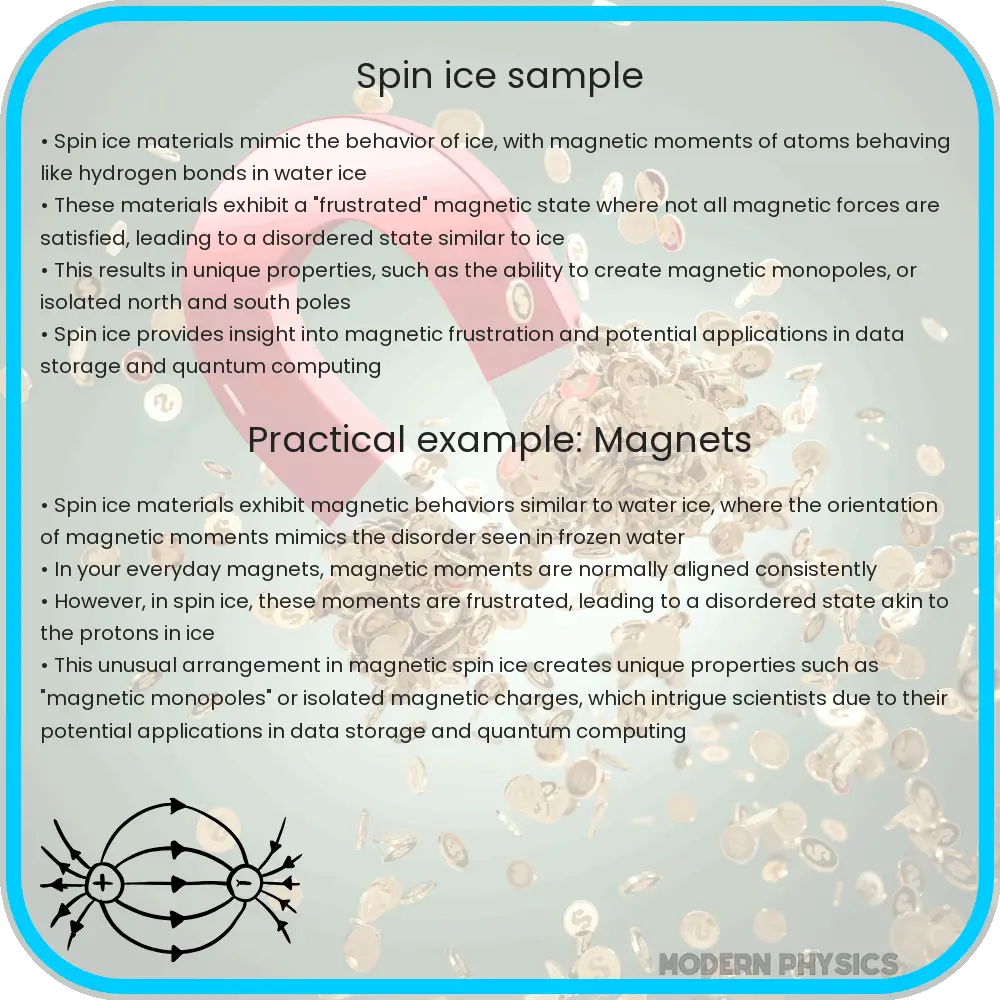
At the heart of spin ice’s unique properties lies its magnetostatic behavior. Unlike typical magnetic materials where spins align uniformly in response to magnetic fields, spin ice materials exhibit a “frustrated” magnetic state. This frustration arises due to the geometry of the crystal lattice, which is based on the tetrahedral arrangement of atoms. In such a structure, it becomes energetically impossible for all magnetic spins to simultaneously align or anti-align, leading to a highly disordered state.
This disorder manifests in what is known as the “ice rules”, a concept borrowed from the proton arrangement in water ice. In spin ice, each vertex of the tetrahedral lattice has two spins pointing inwards and two spins pointing outwards, mimicking the two hydrogen atoms close to and two hydrogen atoms away from the oxygen atom in ice. This configuration minimizes the local energy, but the global spin configuration remains disordered, a state termed as residual entropy.
Properties of Spin Ice
The exotic magnetostatic properties of spin ice give rise to several fascinating phenomena. One such phenomenon is the emergence of magnetic monopoles. In spin ice, the flipping of a single spin can create a pair of effective magnetic charges, analogous to the concept of electric charges. These monopoles are not fundamental particles but emergent excitations within the spin ice lattice, representing a groundbreaking concept in magnetic materials.
Furthermore, spin ice materials exhibit a strong response to external magnetic fields. At low temperatures, these materials enter a phase where the spins are partially ordered, displaying behavior akin to that of a magnetically ordered material, yet retaining some level of disorder characteristic of the spin ice state. This duality underscores the complex interplay between order and disorder in these systems.
Another remarkable property is the “magnetocaloric effect”. Spin ice materials demonstrate a change in temperature under the application of a changing magnetic field. This property is of significant interest for applications in magnetic refrigeration, a technology that offers an energy-efficient alternative to conventional gas-compression refrigeration methods.
In addition to these, the study of spin ice has implications for understanding quantum mechanical phenomena at a macroscopic scale. The intricate balance between order and disorder in these materials provides insights into the quantum realm, potentially paving the way for new discoveries in quantum computing and other advanced technologies.
Advanced Applications and Future Perspectives of Spin Ice
The unique properties of spin ice materials are not only of academic interest but also hold immense potential for practical applications. One of the most promising areas is in the field of information technology. The ability of spin ice systems to simulate magnetic monopoles offers a novel approach for data storage and manipulation. By utilizing the movement and interaction of these monopoles, it is possible to conceive of new types of memory devices that are faster, more efficient, and have higher capacities than current technologies.
Moreover, the quantum mechanical nature of spin ice opens new avenues in the realm of quantum computing. The complex states of order and disorder in spin ice can be harnessed to develop qubits, the fundamental units of quantum computers. These qubits, based on the magnetic states of spin ice, could potentially operate at higher temperatures than current superconductor-based qubits, making quantum computing more accessible and feasible.
Spin ice also contributes significantly to the field of materials science. The study of its unique lattice structure and magnetic properties informs the synthesis and design of new materials with tailored magnetic properties. This could lead to the development of advanced magnetic materials for various applications, ranging from medical imaging to environmental sensing technologies.
Conclusion
In conclusion, spin ice represents a fascinating and rich area of study in condensed matter physics. Its unusual magnetostatic properties, characterized by frustrated magnetic states and the emergence of magnetic monopoles, challenge our traditional understanding of magnetic materials. The insights gained from studying spin ice have profound implications not only for theoretical physics but also for a wide range of practical applications. From advanced data storage solutions and quantum computing to innovative materials design, the potential of spin ice is vast and still largely untapped. As research continues to unravel the mysteries of spin ice, we can expect to see groundbreaking developments that will transform technology and deepen our understanding of the quantum world.