
Explore how spatial filters enhance laser beam quality for precision, clarity, and control in optics, crucial for scientific and industrial applications.
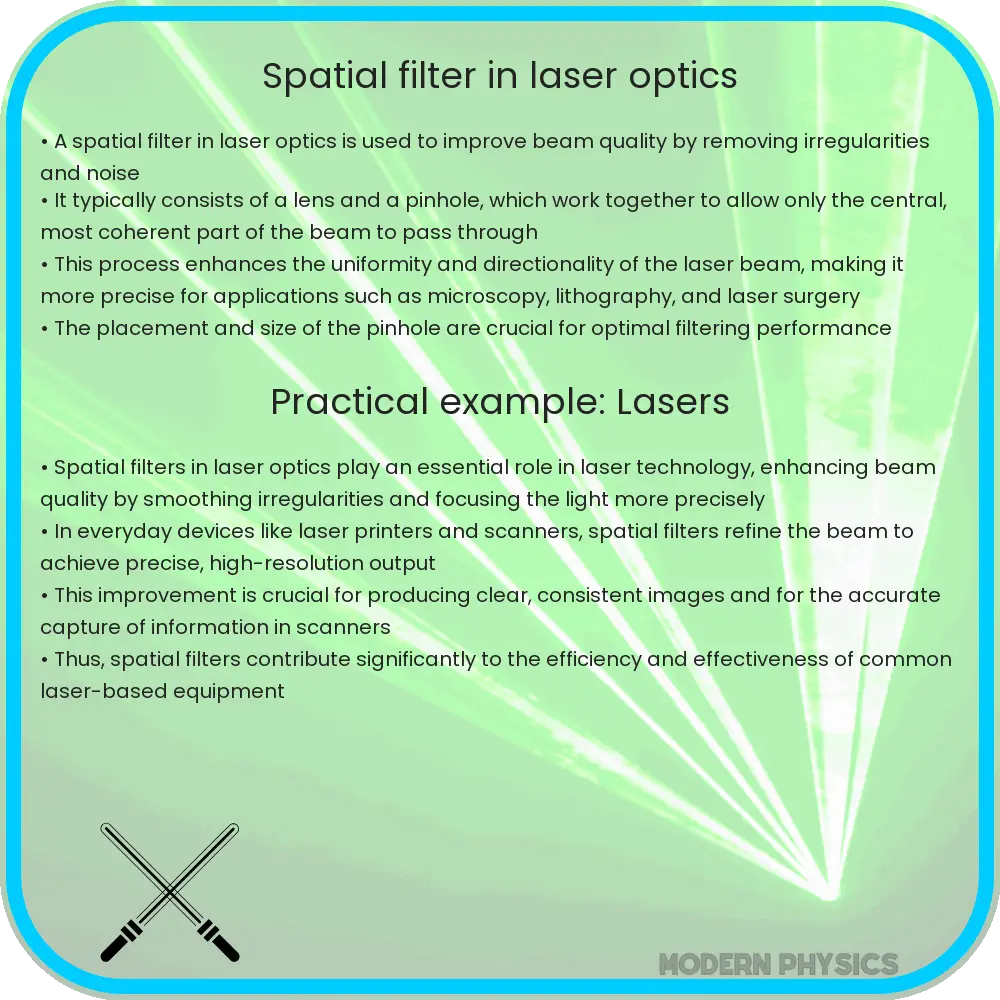
Understanding Spatial Filters in Laser Optics
Spatial filtering is a pivotal technique in laser optics, employed to enhance the precision, clarity, and control of laser beams. This process involves modifying the spatial distribution of a light beam’s intensity to improve its quality for various applications, from microscopy to laser printing. By selectively blocking or transmitting parts of the beam, spatial filters can remove unwanted noise and artifacts, resulting in a cleaner, more uniform output.
The Role of Spatial Filters
Spatial filters play a crucial role in refining the beam profile of lasers. They are particularly useful in eliminating mode structures and speckle patterns that can degrade the performance of optical systems. Through the use of spatial filters, lasers can achieve a Gaussian beam profile, which is ideal for focusing to a small spot size, thus enhancing the system’s resolution and efficiency.
Components of Spatial Filters
The core components of a spatial filter include a focusing element, typically a lens, and a pinhole or other filtering aperture. The lens focuses the laser beam onto the pinhole, which only allows the central, most coherent part of the beam to pass through. This selection process effectively removes the outer, less uniform portions of the beam, resulting in a cleaner output.
- Lens: The lens concentrates the laser beam, directing it towards the pinhole. The focal length of the lens determines the degree of beam convergence, affecting the filter’s effectiveness.
- Pinhole: The pinhole is the critical element that performs the spatial filtering. Its size must be carefully chosen to balance between removing unwanted noise and retaining the maximum amount of useful light.
Applications of Spatial Filtering
Spatial filters are integral to a wide range of optical systems, enabling high-precision tasks such as laser engraving, lithography, and high-resolution imaging. In microscopy, spatial filtering is used to enhance image contrast and resolution by removing out-of-focus light. This capability is essential for observing fine details in biological specimens and materials science samples.
Moreover, in laser projection and printing technologies, spatial filters ensure the delivery of sharp, clear images by improving beam quality. Their ability to produce uniform illumination also makes them invaluable in holography and interferometry, where beam coherence and uniformity are paramount.
Spatial Filters in Laser Optics: Enhancing Precision, Clarity, and Control
Spatial filtering is a fundamental optical technique used in laser optics to improve the quality of a laser beam. This technique involves manipulating the spatial properties of the light to enhance its coherence, eliminate noise, and achieve a uniform intensity distribution. The essence of spatial filtering lies in its ability to selectively transmit specific parts of the beam while blocking others, thus ensuring only the desired beam characteristics are preserved.
Components and Working Principle
The key components of a spatial filter include a focusing lens and a pinhole or spatial filter aperture. The lens focuses the laser beam onto the pinhole, which acts as a high-pass spatial frequency filter. Only the central, most coherent part of the beam passes through the pinhole, while the divergent, less coherent light is blocked. This process effectively removes aberrations and produces a diffraction-limited spot of light with improved beam quality.
Applications in Precision and Clarity
Spatial filters are crucial in applications requiring high precision and clarity, such as holography, microscopy, and laser-based measurement systems. By cleaning up the beam profile, spatial filters enable the generation of sharp, high-contrast images and precise focal points, essential for accurate measurements and detailed imaging. Furthermore, in optical systems where beam quality directly influences performance, spatial filters serve as a vital tool for ensuring reliability and effectiveness.
Control and Flexibility
Beyond enhancing beam quality, spatial filters offer unparalleled control over the laser beam’s characteristics. By adjusting the size of the pinhole, users can fine-tune the balance between beam intensity and spatial coherence, allowing for customization according to specific application requirements. This flexibility makes spatial filters an indispensable component in the development and optimization of laser systems.
Conclusion
Spatial filtering represents a critical technique in the field of laser optics, offering a pathway to precision, clarity, and control over laser beams. Its ability to improve beam quality by removing noise and aberrations makes it essential for applications demanding high levels of accuracy and detail. Moreover, the adaptability provided by spatial filters facilitates the customization of laser systems to meet diverse requirements, enhancing their application across a wide range of scientific, industrial, and technological fields. By leveraging spatial filters, researchers and engineers can push the boundaries of laser optics, achieving remarkable advancements in precision and clarity that were once thought impossible.