
Explore the benefits of telecentric lens design for unparalleled precision, clarity, and consistency in imaging, crucial for industrial applications.
Understanding Telecentric Lens Design
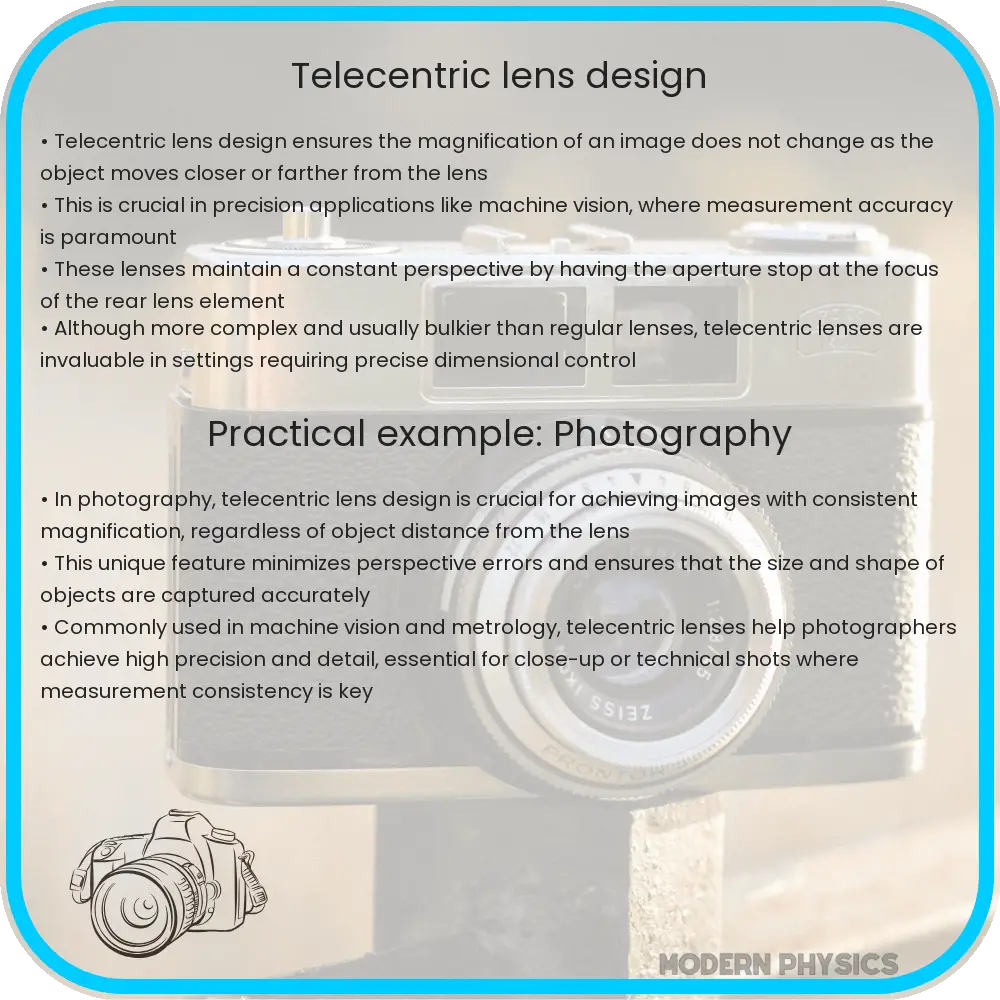
Telecentric lenses are pivotal in applications requiring high levels of precision, clarity, and consistency, such as machine vision, metrology, and optical inspection systems. Unlike conventional lenses, telecentric lenses maintain constant magnification when an object’s distance varies, ensuring accurate measurements and minimizing perspective errors. This unique attribute makes them indispensable in precision engineering and scientific research.
Key Features of Telecentric Lenses
The hallmark of telecentric lens design lies in its ability to provide orthographic projection, where the magnification does not change with object distance. This is achieved by positioning the aperture stop at the focal point of the lens, ensuring that only parallel rays from the object pass through the lens. The benefits of this design include:
- Constant Magnification: Essential for applications where precise scaling of the image is critical.
- Reduced Perspective Error: Ideal for measuring objects at different distances without the need for recalibration.
- High Resolution and Contrast: Delivers sharp images with excellent detail, crucial for inspection and analysis tasks.
Applications of Telecentric Lenses
Telecentric lenses are utilized across a wide range of industries. In machine vision systems, they ensure accurate part inspection and assembly verification. In metrology, they provide reliable measurements, while in microscopy, they enhance image quality and precision. The adaptability and performance of telecentric lenses make them a cornerstone in the development of advanced optical systems.
Challenges in Telecentric Lens Design
Designing telecentric lenses requires addressing several challenges, including chromatic aberration, where different wavelengths of light do not converge at the same point, leading to color fringing. Advanced optical designs often incorporate special glass types or apochromatic elements to minimize this effect. Additionally, maintaining telecentricity across the entire field of view can be complex, necessitating precise optical engineering and fabrication techniques.
The integration of telecentric lenses into optical systems demands careful consideration of factors such as lens size, weight, and compatibility with other optical components. As technology advances, telecentric lenses continue to evolve, offering greater precision and versatility for a wide range of applications.
Understanding Telecentric Lens Design
Telecentric lenses represent a pinnacle in optical engineering, offering unparalleled precision, clarity, and consistency in imaging applications. These lenses are uniquely designed to maintain the size of an object in an image as it moves away or towards the lens, a feature not found in conventional lenses. This property is crucial for applications requiring high levels of accuracy and precision, such as metrology, machine vision, and automated inspection systems.
The Principle Behind Telecentricity
At the heart of a telecentric lens design is its ability to capture light rays that are parallel to the optical axis. This is achieved through a specific arrangement of optical elements that ensure only the parallel rays are imaged onto the camera sensor. Unlike standard lenses, which capture diverging rays that lead to perspective errors, telecentric lenses eliminate this issue, resulting in images where the magnification does not change with object depth.
Components and Functionality
The construction of a telecentric lens involves several critical components, including an aperture stop placed at the focal point of the objective lens. This strategic placement is essential for ensuring that only parallel rays are passed through the lens system. Additionally, telecentric lenses often incorporate specialized glass and coatings to enhance image quality and minimize aberrations.
Benefits of Telecentric Lenses
- Precision: Telecentric lenses provide high precision in dimensional measurements, crucial for quality control in manufacturing.
- Clarity: The design minimizes optical aberrations and distortion, offering clearer, more consistent images.
- Consistency: Images maintain consistent size and focus across different object depths, essential for automated inspection systems.
Applications in Industry
Telecentric lenses have found their place in a myriad of industrial applications. Their precision and consistency make them ideal for measurement and inspection tasks in semiconductor manufacturing, automotive part inspection, and other sectors where accuracy is paramount. Furthermore, their ability to provide clear and consistent imaging across a range of object depths enhances their utility in complex imaging systems.
Conclusion
Telecentric lens design offers a solution to the limitations faced by traditional lens systems, especially in precision-demanding applications. By ensuring parallel light capture and minimizing perspective errors, these lenses facilitate accurate, clear, and consistent imaging. Whether in quality control, automation, or advanced research, the benefits of telecentric lenses underscore their critical role in advancing optical imaging technologies. As industries continue to push the boundaries of precision and efficiency, telecentric lenses stand as a testament to the importance of innovation in optical engineering.