
Explore the mysteries and applications of Space Plasma Physics, delving into cosmic phenomena, solar dynamics, and the theoretical foundations shaping our universe.
Exploring the Enigmatic Realm of Space Plasma Physics
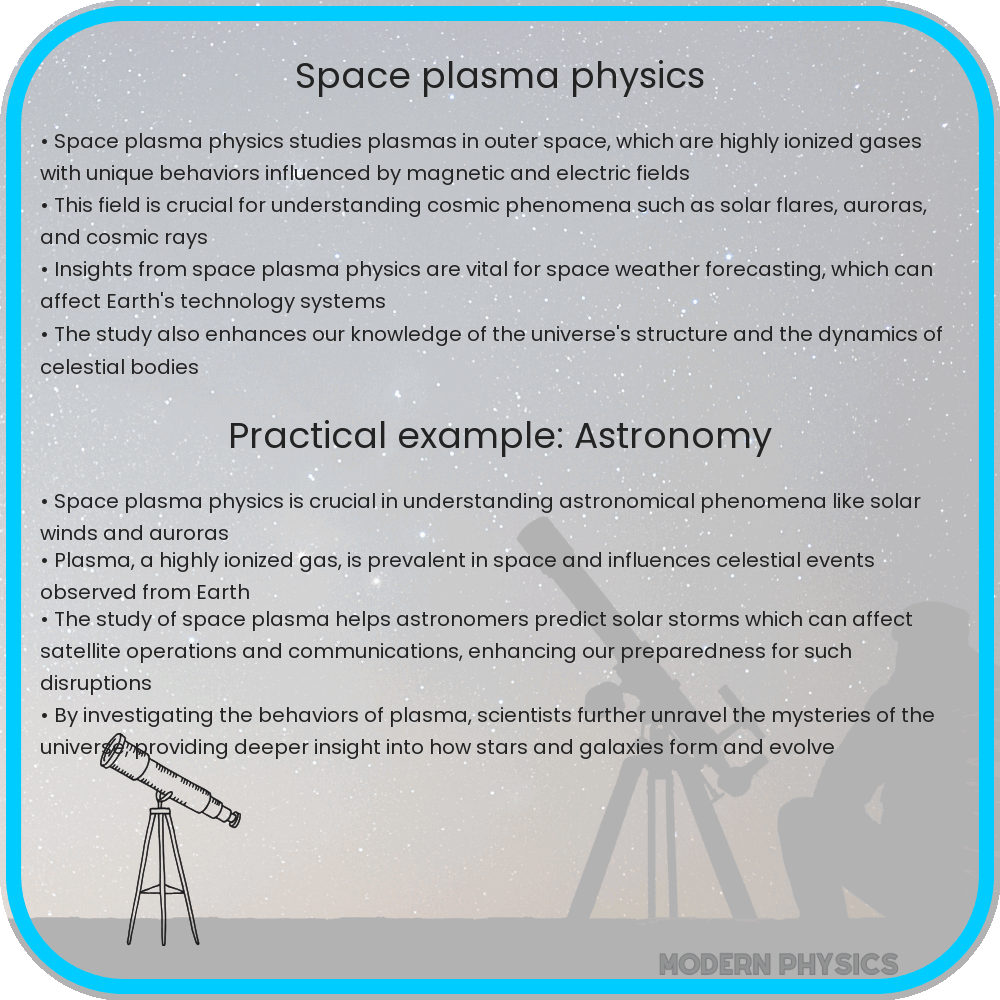
Space Plasma Physics, a vibrant field at the confluence of astronomy, physics, and space science, explores the state of plasma that pervades the universe. Constituting over 99% of the visible universe, plasma is a partially ionized gas composed of ions, electrons, and neutral particles, exhibiting unique behaviors distinct from solid, liquid, or gas. This discipline delves into the mysteries of cosmic plasma, its fundamental properties, and its implications for our understanding of the cosmos.
Unraveling the Mysteries of Space Plasma
The study of space plasma physics is riddled with enigmas, from the dynamics of the solar wind that sweeps through the solar system to the mechanisms driving the auroras on Earth and other planets. One of the most captivating puzzles is the heating of the solar corona, where temperatures soar millions of degrees higher than the solar surface, defying conventional wisdom. Similarly, the acceleration of cosmic rays, particles traveling near the speed of light across the galaxy, remains a profound mystery, challenging scientists to decipher the processes that impart such immense energies.
Applications That Shape Our World
The practical applications of space plasma physics are as vast as space itself, influencing technology, telecommunications, and even climate science. Understanding space weather, particularly solar storms and their interaction with Earth’s magnetosphere, is crucial for protecting satellites, power grids, and communication networks from disruptive electromagnetic interference. Additionally, insights into plasma physics are pivotal for advancing fusion energy research, offering the tantalizing prospect of a clean, virtually limitless energy source.
Theoretical Foundations and Computational Models
At the heart of space plasma physics lies a robust theoretical framework, encompassing the fundamental equations of magnetohydrodynamics (MHD) and kinetic theory. These theories provide the scaffolding for understanding the complex interactions within plasmas, from large-scale phenomena like magnetic reconnection, which powers solar flares, to the intricate dance of particles in plasma waves and instabilities. Advanced computational models and simulations play a critical role, enabling scientists to probe the unobservable, predict celestial events, and validate theoretical predictions against observations from spacecraft and ground-based observatories.
Frontiers of Research and Exploration
The frontier of space plasma physics is ever-expanding, driven by cutting-edge research and technological advancements. Missions like the Parker Solar Probe and the Solar Orbiter are pushing the boundaries of human knowledge, venturing closer to the Sun than any spacecraft before to study the solar corona and solar wind in unprecedented detail. These missions aim to unravel the mysteries of solar phenomena and their impact on space weather, providing crucial data that enhances our understanding of the Sun-Earth connection.
Interstellar and Intergalactic Plasma
Beyond our solar system, the study of interstellar and intergalactic plasma opens new vistas on the cosmic scale. Investigating the properties and dynamics of plasma in these vast regions helps astronomers decode the structure of the universe, the formation of galaxies, and the behavior of cosmic magnetic fields. Such research not only sheds light on the fundamental processes governing the cosmos but also on the origins and evolution of galaxies, stars, and planetary systems.
Challenges and Opportunities Ahead
Despite significant advances, space plasma physics faces numerous challenges. The inherent complexity of plasma, with its nonlinear interactions and vast range of scales, makes theoretical modeling and simulation exceedingly difficult. Moreover, direct measurement of space plasmas, especially beyond our solar system, poses formidable technical and logistical hurdles. However, these challenges also present opportunities for innovation in spacecraft technology, observational techniques, and computational methods, driving the field toward new discoveries and deeper understanding.
Conclusion
Space Plasma Physics stands at the forefront of unraveling the universe’s mysteries, bridging the gap between theoretical physics and observational astronomy. Its contributions are not confined to the academic realm but extend to practical applications that safeguard and enhance our technological society. As we continue to explore the plasma-filled expanse of space, we not only unlock the secrets of the cosmos but also pave the way for future generations to harness the full potential of plasma physics. The journey through the enigmatic and dynamic universe of space plasma promises to illuminate the darkest corners of our universe, offering insights into the fundamental forces that shape our world and beyond.