
Explore the origins, impact, and insights of solar wind in astrophysics, understanding its effects on Earth, space weather, and interplanetary environment.
Solar Wind Studies: Unveiling the Mysteries of the Sun
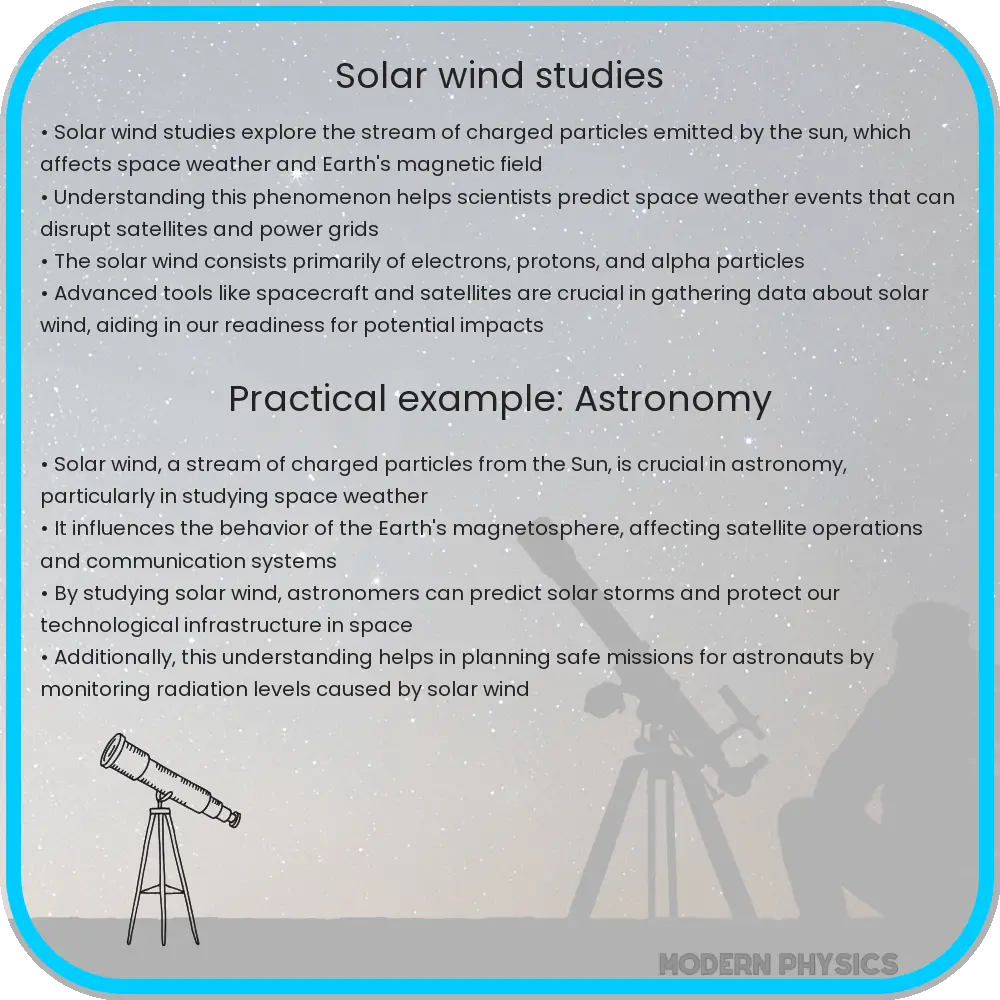
The study of solar wind stands as a pivotal aspect of astrophysics, offering profound insights into the workings of our closest star, the Sun, and its effects on the Solar System. Solar wind is a stream of charged particles, predominantly electrons and protons, that are continuously ejected from the Sun’s upper atmosphere, the corona. This phenomenon has significant implications, not just for the dynamics of the solar system, but also for space weather, affecting satellite operations, communications, and power grids on Earth.
The Origins of Solar Wind
The genesis of solar wind lies in the Sun’s corona, an outer layer that is surprisingly hotter than the surface. Temperatures in the corona can soar above 1 million degrees Celsius, a fact that remains one of the sun’s most baffling mysteries. At such extreme temperatures, the Sun’s gravity can no longer retain these highly energetic particles, allowing them to escape into space, thus forming the solar wind. The process involves complex magnetic fields and plasma physics, challenging scientists to develop sophisticated models to understand its mechanics fully.
Impact of Solar Wind on Earth and Beyond
The interaction between solar wind and Earth’s magnetosphere can lead to spectacular phenomena such as the auroras – the Northern and Southern Lights. However, solar wind can also pose a threat to our technology-dependent society. During intense solar events, such as solar flares and coronal mass ejections (CMEs), the solar wind can carry vast amounts of energy and charged particles towards Earth, potentially wreaking havoc on satellite operations, disrupting communications, and even causing power outages.
Insights from Solar Wind Studies
Research into solar wind not only helps in predicting space weather but also provides crucial insights into the life cycle of stars, the behavior of plasmas (a state of matter similar to gas but with charged particles), and the fundamental processes of magnetic field generation. By studying the solar wind, scientists can understand more about the Sun’s magnetic field, its effects throughout the solar system, and even the conditions necessary for life on planets.
Understanding Solar Wind: A Fundamental Astrophysical Phenomenon
The solar wind, a stream of charged particles released from the upper atmosphere of the Sun, known as the corona, plays a critical role in shaping the interplanetary environment. This plasma, primarily composed of electrons, protons, and alpha particles (helium nuclei), extends throughout the solar system, influencing planetary magnetospheres, forming the heliosphere, and contributing to space weather phenomena that can affect satellite operations and power grids on Earth.
Insights into Solar Wind Studies
Advancements in space technology and astrophysical research have deepened our understanding of solar wind. Observations from spacecraft like Ulysses, SOHO (Solar and Heliospheric Observatory), and the Parker Solar Probe have provided valuable data about the wind’s origins, composition, and variations. These studies reveal that the solar wind emanates from two primary sources: the fast solar wind from coronal holes and the slow solar wind from regions around the Sun’s equatorial belt. The differences in speed, density, and temperature between these two types of solar wind are subjects of ongoing research, with implications for understanding the Sun’s magnetic field and its dynamic processes.
Impact of Solar Wind on Earth and Beyond
The Earth’s magnetosphere, a protective magnetic bubble, interacts with the solar wind, which can lead to beautiful natural phenomena like the auroras, also known as the Northern and Southern Lights. However, intense solar wind streams and associated geomagnetic storms pose risks to astronauts, disrupt communications and navigation systems, and can even cause power outages. Understanding the characteristics and triggers of solar wind streams allows for better forecasting of space weather events, crucial for protecting technology and human activities in space.
Origins and Mechanisms of Solar Wind
The solar wind originates from the Sun’s hot corona, where high temperatures cause the Sun’s atmosphere to expand and escape the gravitational pull, flowing outward through the solar system. The mechanisms behind this process involve complex interactions between magnetic fields and plasma physics. Theories and models such as the Parker Solar Wind Model have been developed to explain how the solar wind accelerates from subsonic to supersonic speeds, a phenomenon still under intense study by the astrophysical community.
Conclusion
In conclusion, the study of solar wind is pivotal in astrophysics, offering insights into stellar processes, space weather, and the heliospheric environment. Ongoing research and space missions continue to unveil the mysteries of the solar wind, improving our understanding and forecasting abilities of space weather phenomena. By studying the solar wind, scientists can not only predict the impacts on Earth and technological systems but also gain fundamental insights into the behavior of other stars and planetary systems, expanding our knowledge of the universe.