
Explore the principles of non-neutral plasma traps, their stability and confinement techniques, and diverse applications in fusion energy, material science, and quantum computing.
Introduction to Non-Neutral Plasma Traps
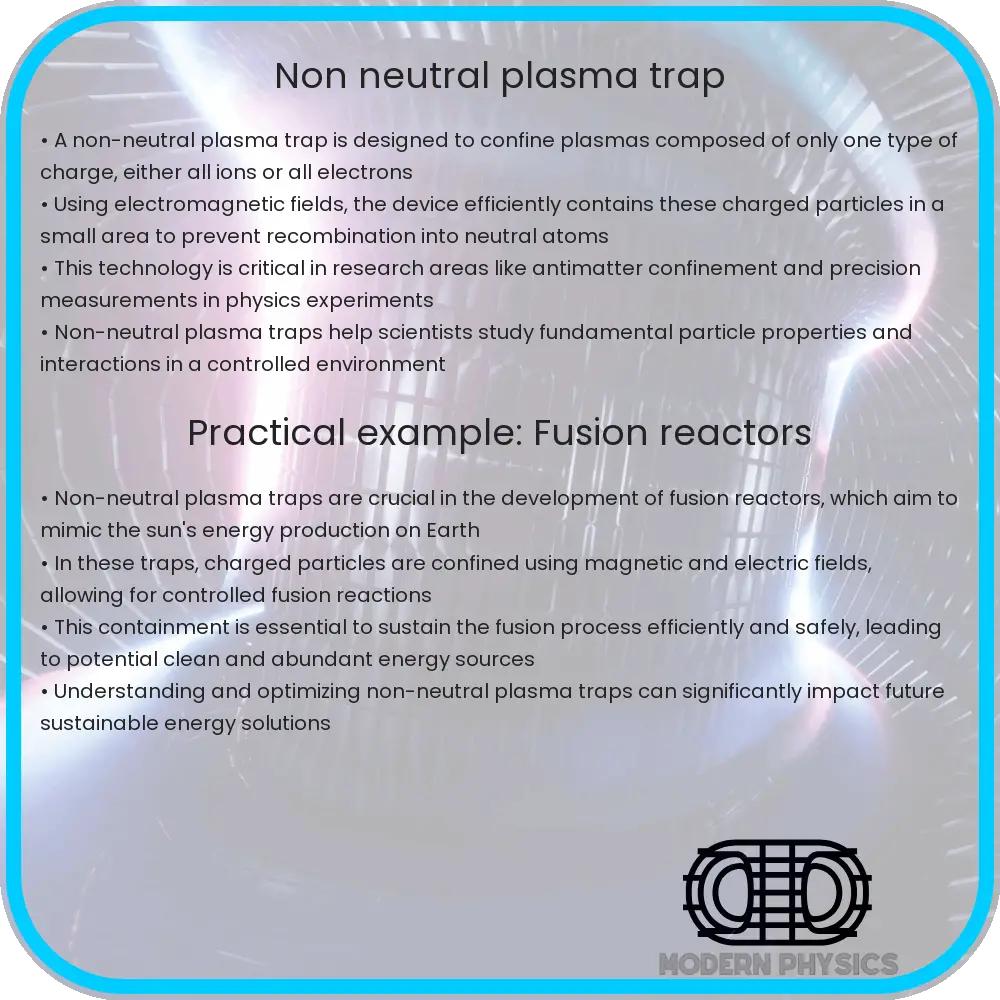
Non-neutral plasma traps are sophisticated devices designed to confine plasma, a state of matter composed of charged particles including ions and electrons, in a way that the overall charge is not neutral. This contrasts with conventional plasma confinement systems which aim to maintain a neutral charge balance. The primary purpose of these traps is to study plasma dynamics, control charged particle beams, and explore applications in fusion energy, material science, and quantum computing.
Principles of Stability and Confinement
At the core of non-neutral plasma confinement is the use of magnetic and electric fields to create a stable trap for the plasma. The stability of these traps is paramount, as any instability can lead to loss of confinement and plasma escaping the trap. Magnetic fields are typically used to confine the plasma radially, while electric fields can trap the particles axially. This configuration is essential for creating a well-defined, stable trapping potential that can hold the plasma for extended periods, enabling detailed studies and applications.
The confinement efficiency of non-neutral plasma traps is influenced by several factors, including the strength and configuration of the magnetic and electric fields, the density and temperature of the plasma, and the geometry of the trap itself. Advanced techniques, such as Penning traps and Paul traps, employ dynamic fields to achieve high levels of control over the plasma, improving confinement times and stability.
Applications of Non-Neutral Plasma Traps
- Fusion Energy: Non-neutral plasma traps are instrumental in the research and development of fusion reactors, where understanding plasma behavior under confinement can lead to more efficient and stable fusion processes.
- Material Science: The unique conditions within non-neutral plasma traps allow for the synthesis and study of novel materials under extreme conditions, contributing to advancements in materials science.
- Quantum Computing: Utilizing trapped ions within non-neutral plasma environments offers a pathway to developing quantum bits (qubits), the building blocks of quantum computers, promising a revolution in computing power and security.
Challenges and Future Directions
The development and operation of non-neutral plasma traps come with their set of challenges. One of the primary issues is the precise control of the plasma’s parameters, such as its density and temperature, to maintain stability and confinement over time. Additionally, mitigating the effects of non-ideal phenomena, like anomalous diffusion and instabilities caused by external perturbations, remains a critical area of research. Technological advancements in materials science and electromagnetic field generation are essential to address these challenges, enabling the construction of more efficient and robust plasma traps.
Future research in non-neutral plasma traps is also directed towards scaling up the technology for practical applications. For fusion energy, this means creating larger traps capable of confining plasma at the conditions necessary for sustained fusion reactions. In the field of quantum computing, efforts are focused on increasing the number of qubits that can be reliably controlled and entangled, which is crucial for the development of practical quantum computers. Additionally, interdisciplinary approaches combining non-neutral plasma physics with other fields, such as nanotechnology and bioengineering, open new avenues for innovation.
Conclusion
Non-neutral plasma traps represent a fascinating intersection of physics, engineering, and technology, offering a window into the behavior of plasma under unique conditions. The stability and confinement of non-neutral plasmas are critical for a range of applications, from fusion energy to quantum computing and material science. Despite the challenges associated with controlling these complex systems, ongoing research and technological advancements promise to overcome these hurdles, paving the way for significant breakthroughs. As our understanding and capabilities evolve, non-neutral plasma traps will undoubtedly continue to play a pivotal role in advancing our technological frontiers, offering solutions to some of the most pressing challenges in science and industry.