
Understanding the predictive techniques and impacts of soil erosion modeling in environmental and agricultural management.
Understanding Soil Erosion Modeling
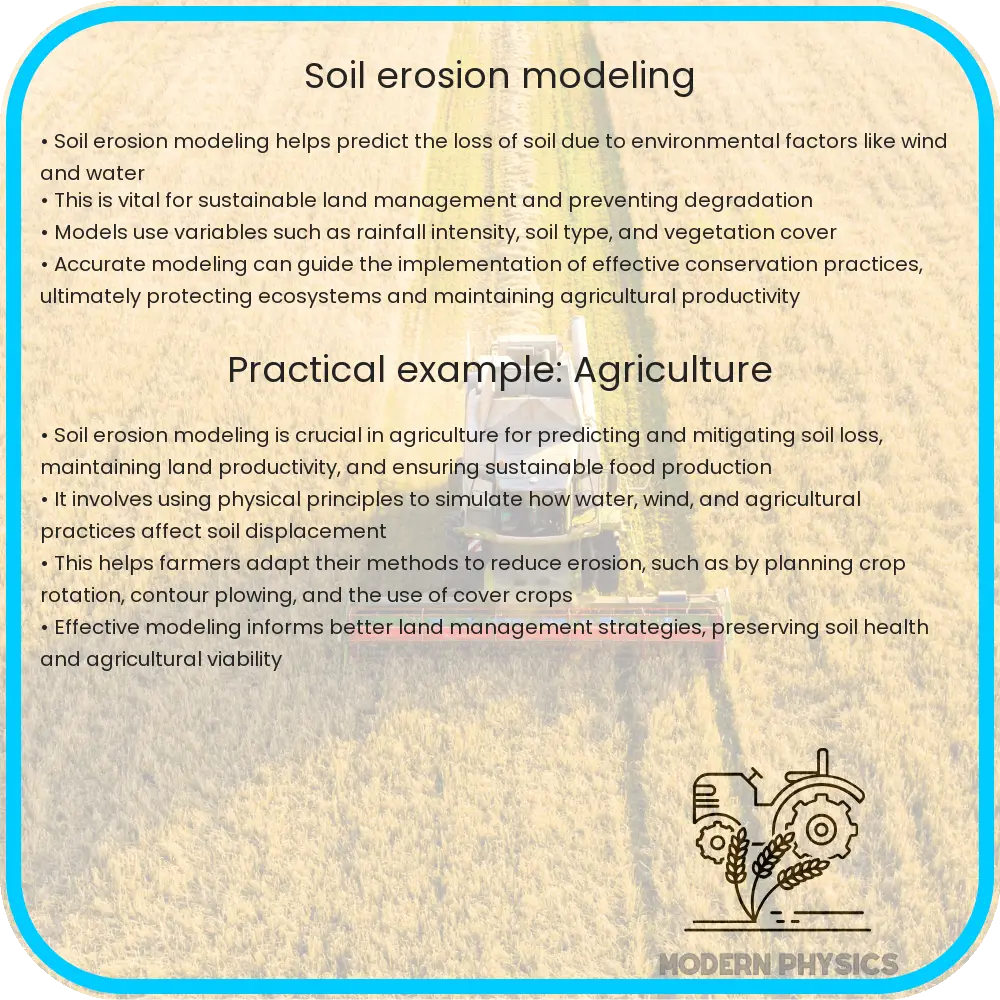
Soil erosion is a natural process where the top layer of soil is worn away due to factors like water, wind, and human activity. This phenomenon can lead to significant environmental and agricultural problems. Soil erosion modeling is crucial for predicting and mitigating these effects. It employs various scientific techniques and formulas to simulate the processes and effects of soil erosion, enabling precision in predictions and effectiveness in prevention strategies.
The Basics of Soil Erosion Modeling
Several models have been developed to predict soil erosion; these can be broadly categorized into empirical, conceptual, and physically-based models.
- Empirical Models: These models use data from past events to predict future erosion under similar conditions. The Universal Soil Loss Equation (USLE) and its revised version, RUSLE, are prime examples. They estimate the average annual soil loss by considering factors like rainfall pattern, soil type, topography, crop system, and management practices.
- Conceptual Models: Such models integrate empirical data with theoretical understanding of erosion processes. They are useful in understanding complex interactions under varied conditions and often help in decision-making processes regarding land use.
- Physically-based Models: These models provide a detailed representation based on the fundamental principles of mass, momentum, and energy conservation. The Water Erosion Prediction Project (WEPP) is an example which uses climate data, soil properties, topography, and crop management to simulate erosion at single storm events and annually.
Precision and Impact of Soil Erosion Models
Soil erosion models vary in terms of precision. Empirical models, while simpler and less data-intensive, might not accurately predict erosion in conditions markedly different from those on which they were initially based. Physically-based models, although more complex and requiring substantial data, are typically more adaptable to different scenarios and can offer more precise predictions.
The impact of accurate soil erosion modeling cannot be overstated. It influences:
- Environmental Conservation: By predicting where erosion is most likely to occur, measures can be implemented to prevent habitat destruction and natural disasters like landslides and flooding.
- Agricultural Productivity: Understanding soil loss and its dynamics helps in choosing better land use practices, enhancing soil health, and increasing agricultural yield.
- Infrastructure Safety: Accurate models can help in planning and developing infrastructure that can withstand the impacts of potential soil erosion.
Mitigation Methods Derived from Soil Erosion Models
Effective mitigation strategies rely heavily on the outputs from soil erosion models. Based on the severity and type of erosion predicted, various methods can be implemented:
- Vegetative Cover: Planting vegetation can significantly reduce soil erosion as plant roots hold the soil together and their canopy reduces the impact of raindrops on the soil.
- Contour Farming: Plowing along the contours of hills and slopes can help retain water runoff and reduce its speed, thereby minimizing erosion.
- Terracing: Building terraces on steep slopes drastically reduces erosion by breaking long slopes into smaller, more manageable lengths.
Each method has its advantages and is chosen based on the specific requirements of the terrain and the models’ predictions about erosion patterns.
As we delve deeper into soil erosion models, we’ll explore specific models in detail, looking at their algorithms, data requirements, and case studies showing their successful implementation in soil erosion prevention and control.
Case Studies and Real-World Applications
To illustrate the effectiveness of soil erosion models, consider the application of the RUSLE model in the Loess Plateau of China. This region, known for its highly erodible soil, has seen significant improvements in soil conservation and agricultural productivity through the strategic use of terracing and vegetative cover, guided by RUSLE predictions.
Another example is the use of WEPP in the United States for managing the impact of extreme weather events on farmlands. It has helped in designing effective crop rotation strategies and contour plowing patterns that adapt to changing weather patterns, thus reducing soil loss and improving water quality.
Future Directions in Soil Erosion Modeling
As technology advances, soil erosion models are increasingly integrating more sophisticated data analysis techniques, such as remote sensing and machine learning. These technologies promise to enhance the accuracy and efficiency of predictions, allowing for real-time soil erosion management.
Moreover, the future of soil erosion modeling is likely to focus on sustainability. This includes developing models that not only prevent erosion but also enhance biodiversity and support the ecosystem services provided by the soil. Such integrated approaches are crucial in facing the challenges of climate change and increasing food security worldwide.
Conclusion
Soil erosion remains a pressing environmental challenge that threatens agriculture, infrastructure, and ecosystems. Through the development and application of soil erosion models, we can predict problematic areas and implement effective soil conservation strategies. Models like USLE, RUSLE, and WEPP have been instrumental in providing the framework needed to address these issues. Moving forward, the integration of advanced technology and a focus on sustainable practices will continue to improve the precision and impact of these models.
Whether you are a student, a professional, or simply a concerned citizen, understanding soil erosion and its modeling is crucial for contributing to a sustainable future. By taking a proactive approach and supporting mitigation strategies informed by solid scientific research, we can help ensure that our soil—arguably one of our most precious natural resources—remains healthy and productive for generations to come.