
Explore the exciting physics of skateboarding on ramps: Learn about balance, forces, motion, and Newton’s laws in this engaging and informative guide.
Understanding Skateboarding Physics: Ramp Dynamics
Skateboarding, a thrilling blend of sport, art, and science, offers a practical demonstration of physics principles in action. When a skateboarder tackles a ramp, they’re not just showcasing their skills but also navigating a complex interplay of balance, forces, and motion. This article delves into the science behind skateboarding on a ramp, making physics both accessible and exciting.
The Role of Balance in Skateboarding
Balance is pivotal in skateboarding. As a skateboarder ascends or descends a ramp, they must continuously adjust their center of gravity to maintain stability. This involves aligning their body’s mass over the skateboard. The distribution of weight is crucial; leaning too far in any direction can lead to a loss of balance and control.
Forces at Play
Several forces are at work during a skateboarding maneuver. The most prominent are gravitational force, friction, and the normal force.
- Gravitational Force: This is the force that pulls the skateboarder towards the Earth. It’s pivotal in ensuring the skateboarder comes back down the ramp after going up.
- Friction: The interaction between the skateboard wheels and the ramp surface is governed by friction. This force is essential for propelling the skateboard forward and for executing turns and tricks.
- Normal Force: The ramp exerts an upward force on the skateboarder, known as the normal force. It acts perpendicular to the surface of the ramp.
Understanding Motion Dynamics
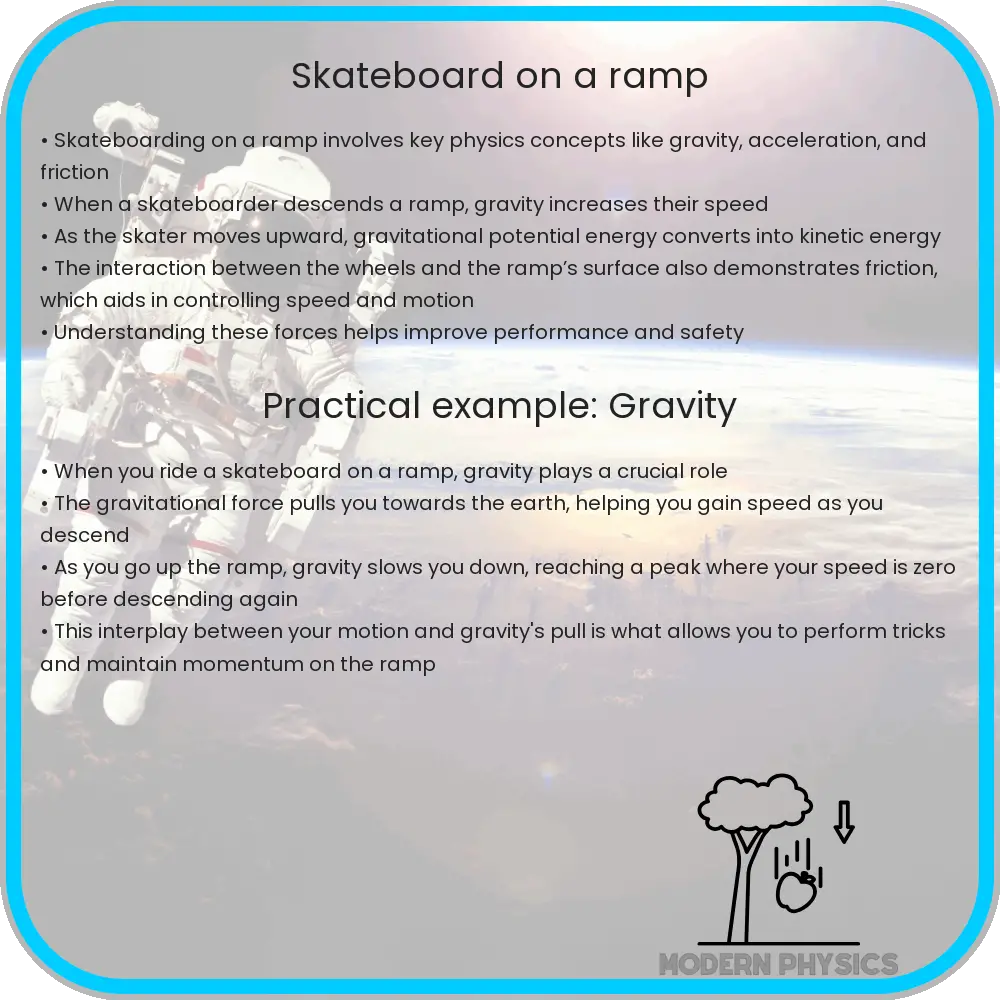
When a skateboarder moves along a ramp, they experience different types of motion. At the top of the ramp, there’s potential energy due to the height. As the skateboarder descends, this potential energy converts into kinetic energy, increasing their speed. Conversely, as they ascend, the kinetic energy converts back into potential energy, slowing them down.
The curvature of the ramp also influences motion. At the curve’s apex, centripetal force is necessary to keep the skateboarder moving in a circular path. Without sufficient speed, the skateboarder might not have enough centripetal force to complete the curve and may fall.
Understanding these physical principles not only enhances the appreciation of skateboarding as a sport but also provides practical insights into the fundamental laws of motion and force. The next section will further explore the intricate dynamics of skateboarding maneuvers and their underlying physics.
Advanced Dynamics in Skateboarding
Delving deeper into skateboard dynamics, advanced maneuvers showcase more complex physics. Tricks like ollies, flips, and grinds involve additional forces and motion principles.
- Angular Momentum: This is crucial for tricks involving spins and flips. A skateboarder manipulates their body’s angular momentum to perform these tricks, with the principle of conservation of angular momentum playing a key role.
- Force of Impact: Landing a trick requires managing the force of impact. The skateboarder must bend their knees upon landing to reduce the impact force, following the principle of impulse and momentum.
Physics in Skateboarding Techniques
Skateboarding techniques also have a scientific basis. For example, the technique of ‘pumping’ on a ramp allows a skateboarder to gain speed without pushing off the ground. This involves timing body movements in sync with the gravitational pull and the ramp’s shape to increase kinetic energy.
Applying Newton’s Laws
Newton’s laws of motion are prominently exhibited in skateboarding:
- First Law (Inertia): A skateboard remains in a state of rest or uniform motion unless acted upon by an external force.
- Second Law (F=ma): The acceleration of the skateboard is proportional to the net force acting on it and inversely proportional to its mass.
- Third Law (Action-Reaction): For every action, there is an equal and opposite reaction. This is evident when a skateboarder pushes against the ramp to gain height.
Conclusion: The Intersection of Skateboarding and Physics
In conclusion, skateboarding on a ramp is not just an athletic endeavor but also a vivid illustration of physics in motion. It encapsulates the principles of balance, forces, and motion, making these abstract concepts tangible and engaging. From mastering balance and understanding the forces at play to applying Newton’s laws and manipulating angular momentum, skateboarding is a dynamic and exhilarating way to explore the fundamentals of physics.
This fusion of sport and science enriches our understanding of both disciplines, providing a unique perspective on the natural laws that govern our world. Whether a skateboarder, a student, or a physics enthusiast, the exploration of these principles through skateboarding offers a captivating and educational experience, blending the thrill of physical mastery with the intellectual stimulation of scientific inquiry.