
Learn about diamond anvils, crucial tools in high-pressure physics used to simulate extreme conditions like those deep within planets and in material synthesis.
Exploring Diamond Anvils: Harnessing Extreme Pressures
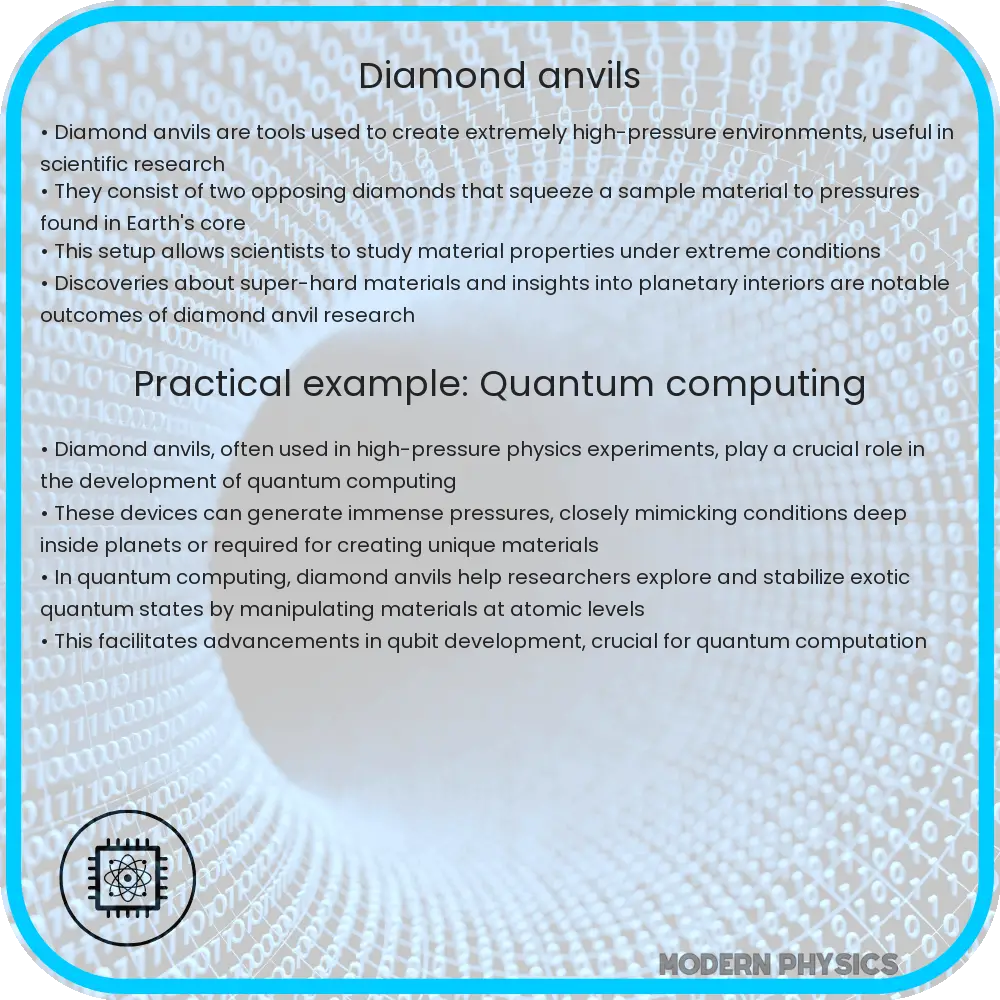
Diamond anvils are a remarkable tool in the field of high-pressure physics, enabling scientists to study materials under conditions that mimic those deep within planets or needed for synthesizing new materials. Despite their tiny size, diamond anvils can exert enormous pressures, equivalent to those found at the center of the Earth, thanks to the superior hardness and durability of diamond.
Design and Composition
The heart of a diamond anvil cell (DAC) consists of two opposing diamonds with a small flat surface, typically a few hundred micrometers in diameter. Placed between these diamonds is the sample material, which can be subjected to pressures of several million atmospheres. The diamonds are mounted in a way that allows very precise control over the pressure applied to the sample. This setup not only facilitates the generation of extreme pressure but also enables optical access to the sample, which is crucial for many types of analysis, such as spectroscopy or X-ray diffraction.
The Role of Diamond’s Unique Properties
Diamonds are not only renowned for their brilliance in jewelry but also possess exceptional physical properties that make them ideal for use in high-pressure experiments:
- Hardness: Diamond is the hardest known natural material on Earth, which means it can exert a substantial pressure without undergoing deformation itself.
- Transparency: Diamonds are transparent over a wide range of wavelengths, including ultraviolet, visible, and infrared, as well as in X-rays. This transparency allows for detailed observation and analysis of the sample material under extreme pressures.
- Thermal Conductivity: Diamond has the highest thermal conductivity among natural materials, helping to dissipate any heat generated by sample manipulation or laser heating in experiments.
Applications of Diamond Anvil Cells
Diamond anvils are used in a variety of scientific disciplines to achieve high-pressure environments necessary for research and development. Some typical applications include:
- Material Science: Researchers use DACs to understand how materials behave under high pressure, which can lead to the discovery of new materials or new phases of matter.
- Geophysics: By simulating the extreme pressures and temperatures found deep within the Earth, scientists can study the physical and chemical processes that govern Earth’s interior.
- Biology: High-pressure studies can reveal how living organisms might adapt to high-pressure environments, such as those found in deep-sea habitats.
Measuring Pressure within a Diamond Anvil Cell
Accurately measuring the pressure exerted within a DAC is crucial for the validity of any experiment. Pressure is typically determined using a material with a well-known equation of state as a pressure standard. This standard material changes its properties, such as electrical resistance or X-ray diffraction pattern, in a predictable way under known pressures. Calibration allows researchers to precisely correlate these changes with specific pressure levels inside the DAC.
Furthermore, the ability to maintain and precisely control the pressure over extended periods is vital for experiments that require steady conditions to accurately track changes in material properties or observe slow-reacting samples.
Challenges and Limitations
Despite their impressive capabilities, diamond anvils also face certain challenges and limitations:
- Cost: Diamonds are expensive, and high-quality diamonds suitable for DACs are especially costly, which can limit accessibility and widespread use.
- Sample Size: The size of the sample that can be studied is extremely limited due to the small surface area of the diamonds, sometimes making it difficult to gather enough data for definitive conclusions.
- Durability: While diamonds are incredibly hard, they are also brittle and can fracture under extreme conditions or if improperly handled.
Future Perspectives
Continued advancements in diamond synthesis and fabrication technologies are likely to mitigate some of the existing challenges faced by diamond anvils. Researchers are also exploring alternative materials that can either replace or work in conjunction with diamonds to broaden the range of experiments and reduce costs. Innovations in microscopic and spectroscopic techniques will further enhance the capabilities and applications of diamond anvil cells in various scientific domains.
Conclusion
Diamond anvils are an indispensable tool in modern high-pressure research, offering unparalleled opportunities to explore the behavior of materials under extreme conditions. Their contribution to our understanding of material science, geophysics, and other fields has been profound. While there are challenges associated with their use, ongoing developments and innovations promise to enhance their utility and accessibility. As technology progresses, diamond anvils will continue to be at the forefront of high-pressure research, helping to unravel some of the most pressing mysteries in science and engineering.