
Explore the physics of skateboarding with a deep dive into velocity, acceleration, and force on skate ramps, blending thrill with science.
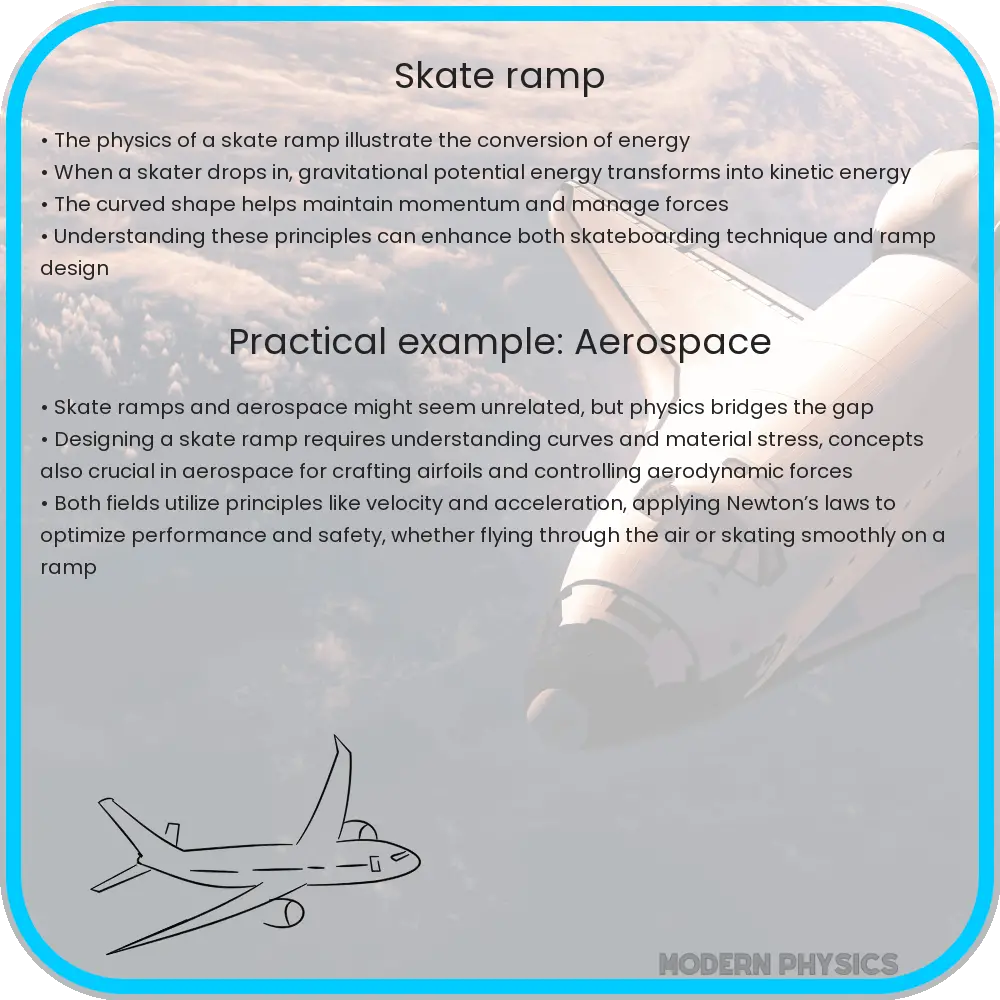
Understanding Skate Ramp Kinematics: Velocity, Acceleration, and Force
Skateboarding on ramps is not only a thrilling sport but also a fascinating example of physics in motion. The study of kinematics, which deals with motion without considering its causes, provides a deep understanding of what happens when a skateboarder glides up and down a ramp. In this article, we explore the key concepts of velocity, acceleration, and force as they apply to skate ramp kinematics.
Velocity: The Speed and Direction of Motion
Velocity is a vector quantity, meaning it has both magnitude and direction. On a skate ramp, velocity changes continuously as the skateboarder moves up, down, or along the ramp. The magnitude of the velocity – the speed – is highest at the lowest point of the ramp due to gravitational acceleration. As the skateboarder ascends, the speed decreases until it momentarily reaches zero at the peak. This constant change in speed and direction makes ramp skating an excellent example of varying velocity.
Acceleration: The Rate of Change of Velocity
Acceleration in skateboarding is primarily influenced by gravity and the shape of the ramp. When a skateboarder descends the ramp, gravity accelerates them downwards. This acceleration changes as they move along the curved surface of the ramp, experiencing both tangential and radial acceleration. The steeper the ramp, the greater the acceleration. Conversely, as the skateboarder ascends, they decelerate due to gravity opposing their motion.
Force: The Interaction that Changes Motion
Forces acting on a skateboarder include gravity, normal force from the ramp surface, and friction. Gravity constantly pulls the skateboarder towards the earth, dictating their acceleration down the ramp. The normal force, perpendicular to the surface, changes with the ramp’s curvature, influencing the skateboarder’s vertical and horizontal motion. Friction between the skateboard wheels and the ramp surface is crucial for controlling speed and executing tricks.
These principles of kinematics not only make skateboarding an exhilarating sport but also a practical, real-world application of physics. Understanding these concepts enhances the appreciation of the skill and physics involved in skateboarding.
Application of Newton’s Laws in Skate Ramp Kinematics
Newton’s Laws of Motion are fundamental in understanding skate ramp kinematics. The first law, which states that an object in motion stays in motion unless acted upon by an external force, is evident when a skateboarder maintains motion on a flat ramp section. The second law, F = ma (Force equals mass times acceleration), applies to the skateboarder’s changing acceleration due to gravity and the ramp’s shape. Finally, the third law, which states that every action has an equal and opposite reaction, is observed in the interaction between the skateboard wheels and the ramp surface.
The Role of Energy in Skate Ramp Kinematics
Energy transformation is another key aspect of skate ramp kinematics. Potential energy is highest at the ramp’s peak, where the skateboarder’s velocity is lowest. As the skateboarder descends, potential energy converts into kinetic energy, increasing velocity. At the lowest point, kinetic energy is at its maximum. This interplay between potential and kinetic energy is a continuous cycle that defines the motion on a skate ramp.
Angular Momentum and Skateboarding Tricks
Angular momentum plays a crucial role in performing skateboarding tricks. As skateboarders launch into the air, conservation of angular momentum allows them to execute spins and flips. The distribution of their body mass and the speed of rotation determine the success of these tricks, illustrating the principles of rotational kinematics.
Conclusion
Skate ramp kinematics is a perfect blend of thrill and physics. The interplay of velocity, acceleration, and force, governed by Newton’s laws and energy principles, defines the motion of a skateboarder on a ramp. Understanding these concepts provides a deeper appreciation of the sport and highlights its relevance as a practical application of physics. Whether it’s the basic motion up and down the ramp, the execution of intricate tricks, or simply cruising, skateboarding exemplifies the fundamental principles of kinematics in an engaging and dynamic way. This fascinating intersection of physical laws and athletic prowess not only enhances the spectator’s enjoyment but also inspires a new generation of enthusiasts to explore the science behind the sport.