
Explore the dynamics, kinetics, and applications of non-equilibrium condensation in this comprehensive article, unraveling its industrial impact.
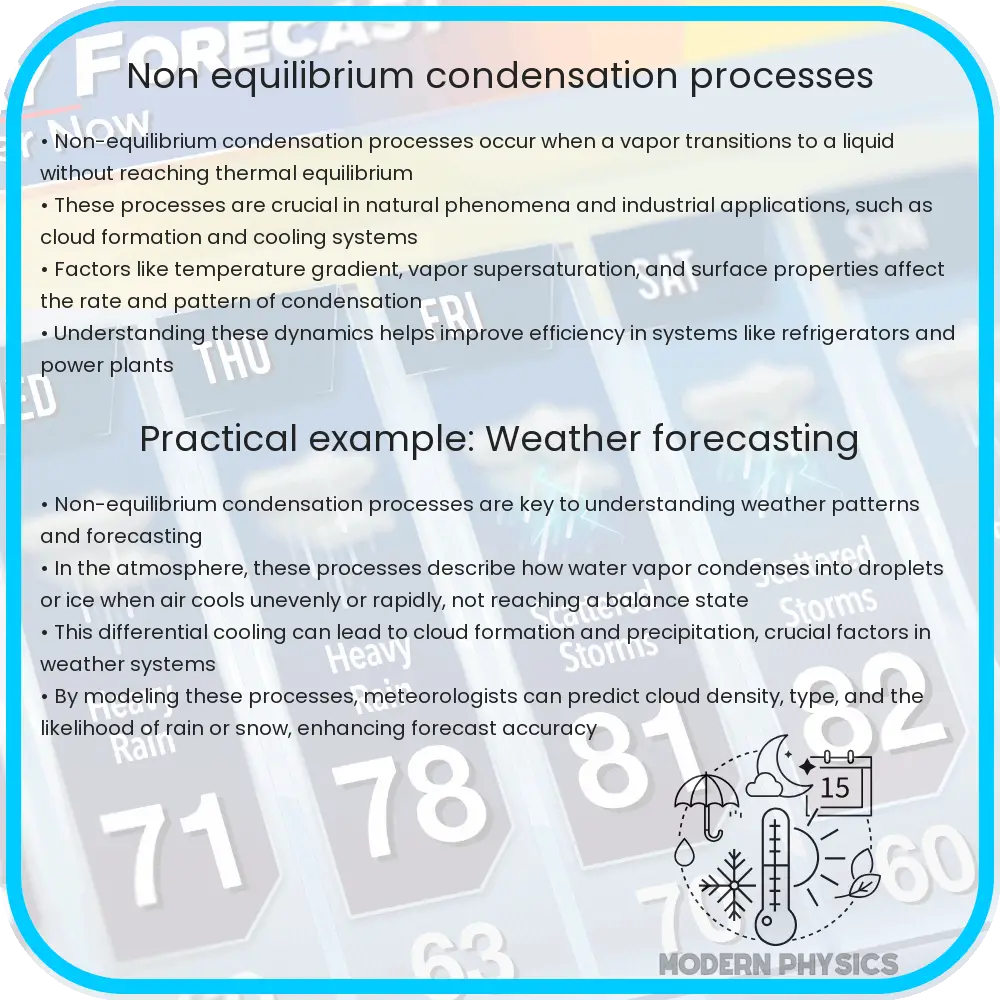
Understanding Non-Equilibrium Condensation: Dynamics and Kinetics
Non-equilibrium condensation is a fascinating area of physical chemistry that delves into the dynamics and kinetics of phase transitions occurring outside the equilibrium state. This process is pivotal in numerous industrial and natural phenomena, ranging from cloud formation in the atmosphere to the design of advanced materials.
Dynamics of Non-Equilibrium Condensation
The dynamics of non-equilibrium condensation are governed by the interplay between phase change, temperature gradients, and mass transport. Unlike equilibrium condensation, which occurs under steady-state conditions, non-equilibrium condensation involves rapidly changing environmental conditions. This leads to unique patterns of droplet formation, growth, and distribution. One notable aspect is the Ostwald ripening process, where larger droplets grow at the expense of smaller ones due to differences in vapor pressure.
Kinetics of Non-Equilibrium Condensation
Kinetic factors play a crucial role in non-equilibrium condensation. The rate at which molecules in a vapor phase collide and coalesce to form liquid droplets is critical. This rate depends on factors such as temperature, pressure, and the presence of nucleation sites. In non-equilibrium settings, these factors are not constant, leading to complex kinetic behaviors. The classical theory of nucleation, which describes the formation of critical-sized clusters preceding droplet formation, is often employed to understand these kinetics.
Applications in Various Fields
Non-equilibrium condensation finds applications in a myriad of fields. In meteorology, it helps in understanding cloud formation and precipitation. In material science, it’s essential for techniques like chemical vapor deposition (CVD), used in semiconductor manufacturing. Environmental engineering also benefits from the study of non-equilibrium condensation in controlling pollution and designing efficient exhaust systems.
In summary, the study of non-equilibrium condensation offers invaluable insights into various natural and industrial processes. By understanding the dynamics and kinetics of this phenomenon, we can optimize industrial processes, predict weather patterns, and develop new materials with enhanced properties.
Advanced Theoretical Models and Computational Simulations
Advancements in theoretical models and computational simulations have significantly enhanced our understanding of non-equilibrium condensation. Complex algorithms and high-performance computing enable scientists to simulate condensation processes at molecular levels. These simulations provide insights into the microscopic interactions that drive condensation, allowing for more accurate predictions and optimization of processes.
Impact on Energy Efficiency and Sustainability
Non-equilibrium condensation plays a crucial role in energy efficiency and sustainability. In power generation, for instance, the condensation of steam in turbines directly impacts their efficiency. Optimizing these processes can lead to significant energy savings and reduced environmental impact. Similarly, in the field of refrigeration and air conditioning, understanding non-equilibrium condensation can lead to the development of more efficient and environmentally friendly systems.
Challenges and Future Directions
Despite significant advancements, challenges remain in fully understanding and controlling non-equilibrium condensation. One of the primary challenges is the scalability of laboratory results to industrial applications. Furthermore, the unpredictable nature of non-equilibrium systems, influenced by external variables like temperature fluctuations and impurities, adds to the complexity. Future research is likely to focus on developing more robust models that can accurately predict condensation behavior under a wide range of conditions.
Conclusion
Non-equilibrium condensation is a dynamic and complex phenomenon with significant implications in various scientific and industrial fields. The interplay of dynamics and kinetics in these systems offers both challenges and opportunities for innovation. Advanced computational models and theoretical understanding continue to push the boundaries of our knowledge in this area. As we continue to explore the depths of non-equilibrium condensation, its potential to revolutionize industries, from energy to environmental engineering, becomes increasingly evident. This evolving field promises not only scientific advancement but also practical solutions to some of the most pressing challenges of our time.