
Quasi-anechoic chambers are specialized rooms designed to absorb sound reflections effectively across most, but not all, frequency ranges.
Quasi-Anechoic Chambers: Understanding the Essentials
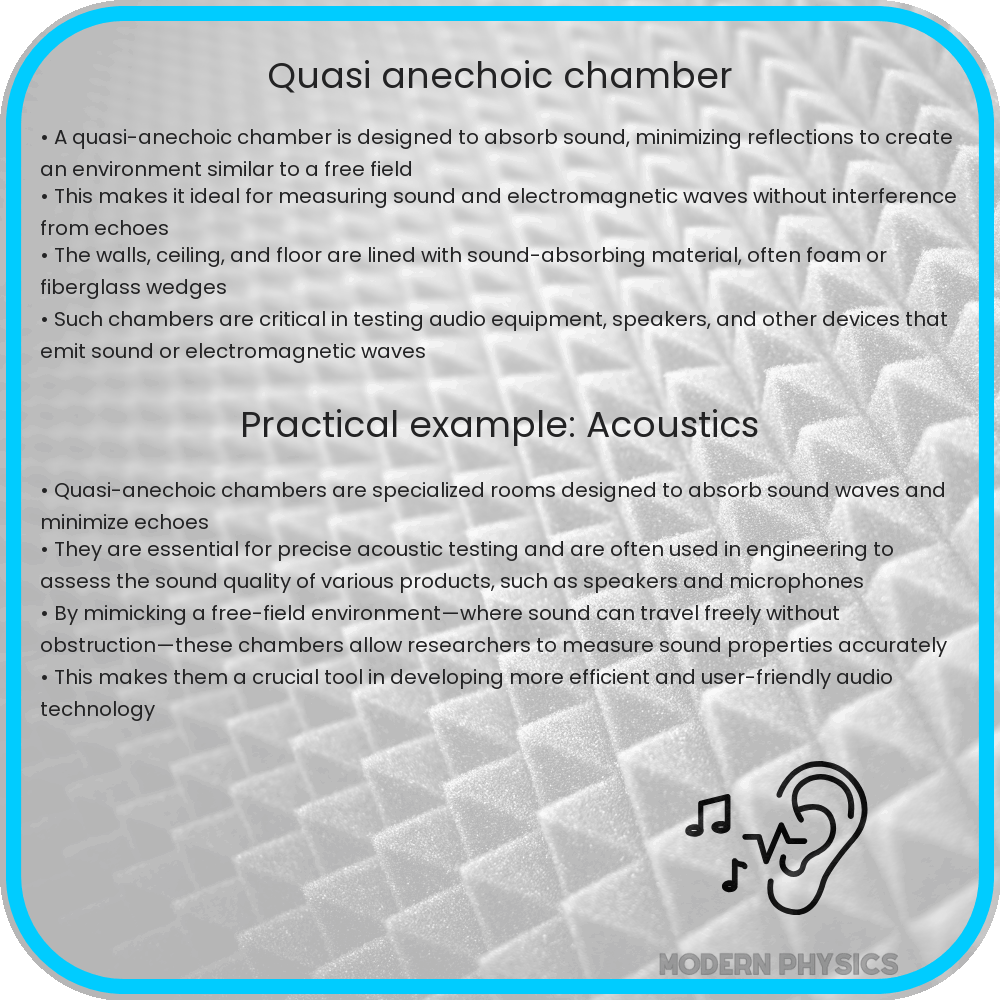
A quasi-anechoic chamber is a specialized room designed to absorb reflections of sound or electromagnetic waves. This capability is crucial for conducting precise acoustic measurements and ensuring controlled testing conditions. Unlike fully anechoic chambers that absorb sounds across all frequencies, quasi-anechoic chambers are particularly effective in absorbing sounds in most, but not all frequency ranges.
Design and Function of Quasi-Anechoic Chambers
The design of quasi-anechoic chambers typically features wall, ceiling, and floor treatments with sound-absorbing material, such as fiberglass wedges or foam. These materials are structured in a way that minimizes the reflection of sound back into the room, essentially mimicking an open outdoor environment where there is no echo.
These chambers are designed to be free of echo at frequencies above a certain cutoff frequency, which varies depending on the specific geometry and materials used. The cutoff frequency is generally determined by the formula:
fc = 1/(2√(a * β)),
where fc is the cutoff frequency, a is the absorption coefficient of the wedge material, and β is the distance into the wedge where the sound absorption is significant.
Effective within a specified range, quasi-anechoic chambers are essential in various applications like audio product testing, loudspeaker measurements, and automotive noise, vibration, and harshness (NVH) analysis. Below the cutoff frequency, the sound reflections can still occur, as the chamber does not absorb lower frequencies efficiently.
Applications of Quasi-Anechoic Chambers
The practical applications of quasi-anechoic chambers are vast. In the automotive industry, engineers use these chambers to pinpoint sources of noise and effectively measure how sound propagates from different components, such as the engine or exhaust system. This is critical in designing vehicles that meet specific noise standards and enhance the auditory experience inside the cabin.
In the realm of product development, manufacturers utilize these chambers to test how electronic devices like mobile phones, speakers, and home appliances emit sound. This testing ensures that products meet regulatory standards and consumer expectations for sound quality and loudness.
Moreover, quasi-anechoic chambers play a significant role in research and development sectors where precise acoustic measurements are required. Whether it’s studying the sonic properties of materials or developing new audio technologies, these chambers provide an indispensable tool for accurate sound analysis.
Maintenance and Challenges of Quasi-Anechoic Chambers
Maintaining a quasi-anechoic chamber requires regular checks to ensure the sound-absorbing materials remain effective. Over time, these materials can degrade or become contaminated with dust and other particulates, which may affect their acoustic properties. Additionally, the precise alignment and condition of the wedges or foam are critical in maintaining the chamber’s functionality, necessitating periodic inspections and potential adjustments.
One of the primary challenges in operating a quasi-anechoic chamber is managing the cutoff frequency. The effectiveness of the chamber in various applications depends heavily on accurate cutoff frequency settings, which require careful calibration and understanding of material properties and chamber dimensions. Furthermore, adapting the chamber to test different types of devices or sounds can be complex and time-consuming.
Technological Advancements and Future Trends
As technology evolves, so do the methods and materials used in quasi-anechoic chambers. Recent advancements include the development of more efficient, environmentally friendly sound-absorbing materials and the integration of automated systems that streamline testing processes. Researchers are also exploring ways to lower the cutoff frequency to expand the range of effective sound absorption, thereby enhancing the chamber’s utility in analyzing lower frequencies.
Looking towards the future, it is expected that there will be increased integration of digital modeling and simulation technologies. This advancement could allow for virtual quasi-anechoic environments that can predict and analyze sound patterns more efficiently, thereby reducing the need for physical testing and expediting product development cycles.
Conclusion
Quasi-anechoic chambers play a pivotal role in a wide range of industries by enabling precise measurements and analysis of sound properties. From automotive engineering to consumer electronics, these chambers help ensure that products not only meet legal sound regulations but also reach the highest standards of audio performance. Despite their complexities and the challenges inherent in their design and maintenance, quasi-anechoic chambers remain an indispensable tool in the quest for noise control and sound quality. As technology advances, the capabilities and applications of these chambers will continue to expand, promising even greater precision and efficiency in sound testing and analysis.