
Orthotropic acoustic materials are engineered with unique directional soundproofing properties, essential in applications requiring tailored sound isolation.
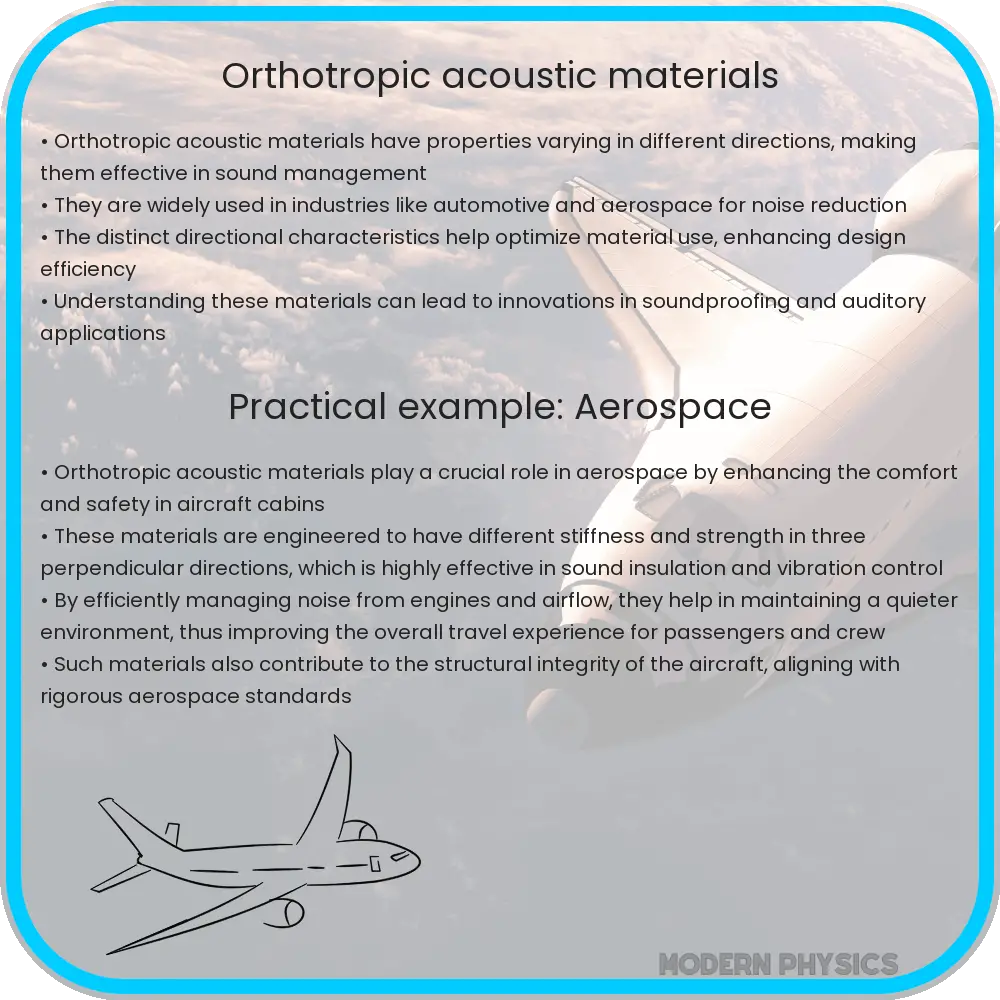
Understanding Orthotropic Acoustic Materials: An Overview
Orthotropic acoustic materials are engineered to exhibit unique soundproofing characteristics that differ along three mutually perpendicular axes (typically, the axes are the axial, radial, and circumferential directions). These materials are crucial in various applications where directional sound isolation and damping is necessary. Understanding how these materials function can shed light on their efficiency and the strategic considerations involved in their design.
Basic Principles of Orthotropic Materials
Material anisotropy, such as that in orthotropic materials, refers to the variance in physical properties depending on the direction in which they are measured. Unlike isotropic materials, which have uniform properties in all directions, orthotropic materials have three distinct and orthogonal principal axes, each with different material characteristics. This directional variance affects how sound waves interact with the material, making possible highly efficient, tailored soundproofing solutions.
Soundproofing Efficiency of Orthotropic Materials
The soundproofing capabilities of orthotropic materials come from their ability to absorb, reflect, or damp sound waves differently depending on the sound’s direction of travel. This quality makes them particularly useful in environments where noise control is required in specific directions. For example, in an automotive setting, orthotropic materials might be oriented in such a way as to maximize absorption of engine noise while minimizing the impact on the overall vehicle weight.
- Directional Sound Absorption: This refers to the material’s ability to absorb sound more effectively in certain directions. This is critical in environments such as recording studios or theaters, where controlling the path of sound waves is vital.
- Damping Properties: Orthotropic materials can also dissipate energy from sound waves differently along their axes. This is particularly important in reducing vibrations which can transport sound energy through structures.
- Reflective Characteristics: By carefully aligning the material’s axes relative to common sound sources, engineers can also use these materials to reflect sound away from sensitive areas, further enhancing sound protection.
Design Considerations for Using Orthotropic Acoustic Materials
Designing with orthotropic materials requires an understanding of the directional properties and how they correlate with the intended application. Engineers must consider a variety of factors:
- Orientation: The alignment of the material’s principal axes relative to the predominant sound sources and desired paths for sound travel is critical.
- Material Composition: Various materials such as fibers, foams, and composites can be engineered to have orthotropic properties. The choice of material impacts the soundproofing performance, weight, and durability.
- Environmental Compatibility: Factors like temperature ranges, humidity, and exposure to chemicals affect the usefulness and lifespan of these materials in specific settings.
By carefully integrating these considerations into the design phase, orthotropic acoustic materials can be utilized to maximize sound isolation and improve the overall acoustic environment. This integration demonstrates a profound connection between material science and acoustic engineering, illustrating how physics can be applied to solve real-world challenges in innovative ways.
Applications in Various Industries
Orthotropic acoustic materials are implemented across multiple fields. Here are a few notable applications:
- Automotive Industry: Employing orthotropic materials in car designs helps in minimizing the noise from engines and roads, providing a quieter cabin experience.
- Building Construction: These materials prove beneficial in constructing soundproof rooms or sections within buildings, such as in hospitals or studios, where controlling sound propagation is essential.
- Aerospace: Effective noise reduction in aircraft cabins and around delicate instruments can be achieved through the strategic placement of orthotropic acoustic materials.
Future Advancements and Research
Research into orthotropic acoustic materials is advancing, aiming to make them more effective and sustainable. Innovations may include:
- Increased Recyclability: Developing materials that can be recycled or are biodegradable to address environmental concerns.
- Enhanced Performance: Refining the fabrication processes to enhance the acoustic damping capabilities without compromising material strength or adding excessive weight.
- Smart Material Technologies: Integrating sensors and smart technologies to adapt the acoustic properties dynamically according to real-time environmental and situational conditions.
Conclusion
Orthotropic acoustic materials showcase a fascinating integration of material science and acoustic engineering. By understanding and leveraging the unique directional properties of these materials, designers and engineers can create solutions tailored to specific soundproofing needs. As the demand for quieter and more comfortable environments grows in various sectors, the role of these materials becomes increasingly critical. Ongoing research and development will likely continue to push the boundaries of what these innovative materials can achieve, offering new solutions for noise management and setting new standards in both functionality and sustainability.
The exploration of orthotropic acoustic materials is not just about improving sound environments but also about appreciating how a deeper understanding of physics and engineering principles can lead to real-world applications that enhance our daily lives and industries.