
Learn how Schroeder diffusers enhance acoustics by evenly scattering sound in rooms to improve clarity and richness.
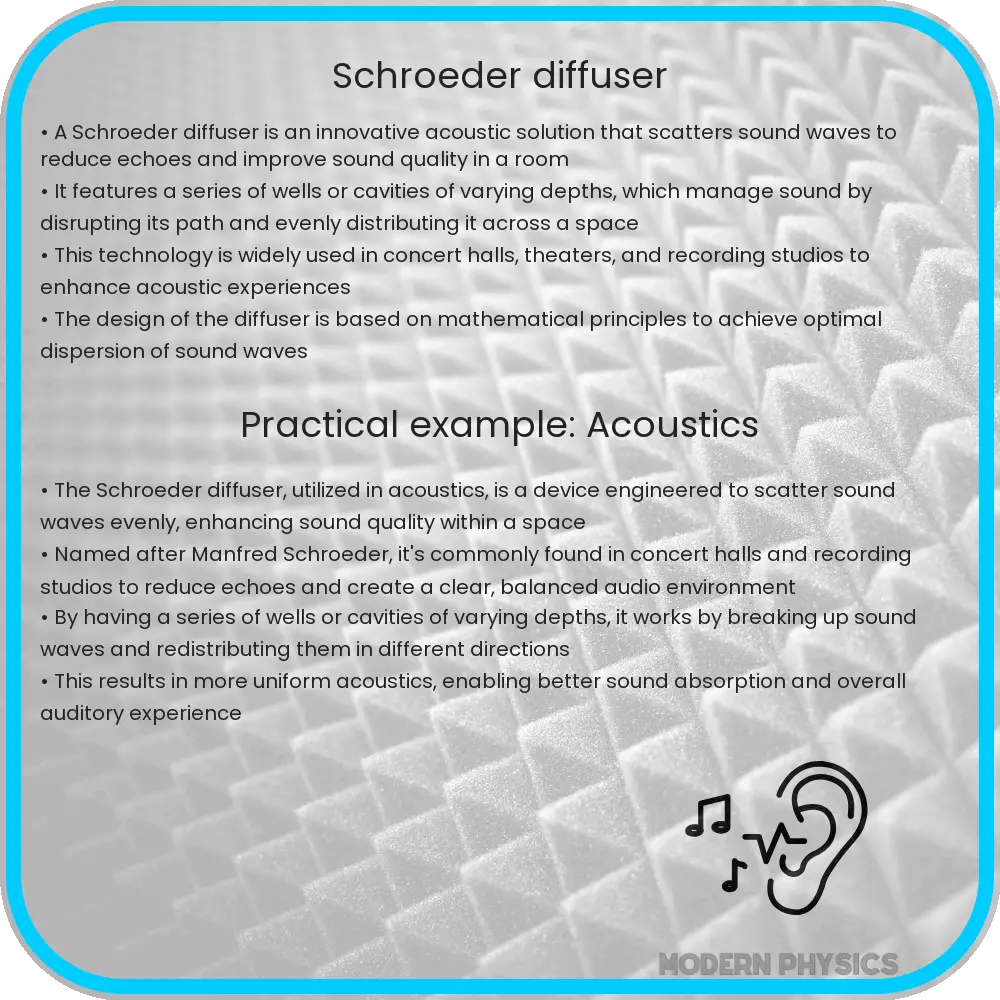
Understanding the Schroeder Diffuser for Enhanced Acoustic Environments
The quality of sound in any environment can significantly alter our experience, whether we’re enjoying music in a concert hall, giving a presentation in a conference room, or watching a performance in a theater. Acoustic diffusers are vital in fine-tuning these auditory experiences. Among the myriad of diffuser designs, the Schroeder diffuser stands out for its effectiveness and scientific design principle. In this article, we will explore how Schroeder diffusers work, their design criteria, and their role in achieving acoustic clarity through sound diffusion.
What is a Schroeder Diffuser?
A Schroeder diffuser, named after Manfred Schroeder, a pioneer in the field of acoustics, is a structured array of wells or cavities designed to scatter sound evenly across a room. The goal of this evenly scattered sound is to enhance the richness and clarity of music or speech by reducing echoes and other acoustic distortions. The unique feature of the Schroeder diffuser lies in its ability to disperse sound waves both spatially and temporally, thus optimizing the acoustical qualities of a space.
Principles of Sound Diffusion
Sound diffusion is the process by which the energy of sound is spread evenly in a given environment. When sound waves strike a flat, hard surface, they are either absorbed or reflected in a singular direction, leading to acoustic issues like echos or hotspots. In contrast, a diffusive surface breaks up the sound waves and scatters them in multiple directions, reducing interference and enhancing the quality of sound across the spectrum. This is where Schroeder diffusers excel.
Design of Schroeder Diffusers
The design of a Schroeder diffuser is based on the mathematic principles of number theory. The depth and spacing of the wells are calculated based on quadratic residue sequences to ensure that the phases of reflected waves are distributed uniformly. Typically, the number of wells, N, in a Schroeder diffuser is a prime number, and the depth, dn, for each well is derived using the formula:
dn = (n2 mod N) * L / N
Where L is the maximum depth of any well, n is the well index (ranging from 0 to N-1), and N is the total number of wells, which is chosen based on the desired frequency range for diffusion.
- This formula ensures that each well will have a unique depth, disrupting the coherence of sound wavelengths directed at the diffuser, thereby scattering them more effectively.
- The resultant effect is a more diffuse sound field, which can enhance the auditory perception in the room.
Applications in Real-Life Scenarios
Schroeder diffusers are commonly used in venues where sound quality is paramount. This includes recording studios, auditoriums, concert halls, and home theaters. In each of these situations, the objective is to create an acoustically balanced environment, free of undesirable sound distortions that can muddle clarity and detail.
For instance, in a recording studio, the placement of Schroeder diffusers on walls and ceilings helps in achieving a dry sound atmosphere by reducing the occurrence of standing waves and flutter echoes. This environment is crucial for capturing the true sound of instruments and vocals without coloration.
- Similarly, in concert halls, diffusers prevent the focusing of sound in particular areas, thus ensuring that all attendees receive a uniform sound experience, regardless of their seating position.
- In home theaters, these diffusers contribute to the immersive sound expected from high-fidelity audio setups tailored for movies and music.
Comparison with Other Acoustic Treatments
While Schroeder diffusers are highly effective in managing sound quality, it’s valuable to understand how they compare to other acoustic treatments. Common alternatives include absorptive panels and bass traps, each serving unique purposes. Absorptive panels mainly reduce sound reflections to minimize reverberation, suited for overly live rooms. Bass traps are specialized to absorb low-frequency sounds, usually placed in room corners to manage bass buildup.
However, unlike these treatments, Schroeder diffusers preserve the energy within the room while smoothing out sound irregularities, making them ideal for spaces where sound preservation is as important as sound clarity.
Maintenance and Installation Considerations
Installing and maintaining Schroeder diffusers require careful consideration to achieve optimal results. Installation involves positioning the diffusers at strategic points determined by the specific acoustic needs of the environment. Commonly, they are placed on rear walls or ceilings to target reflections from primary sound sources.
- Maintenance of these diffusers is relatively low-key since they don’t involve any mechanical parts that could wear out over time. However, periodic dusting and ensuring they remain free of obstructions is crucial to retain efficiency.
Conclusion
Schroeder diffusers represent a sophisticated solution in the realm of acoustic treatments, balancing the need for sound clarity with the richness of sound preservation. Their design, rooted in mathematical principles, ensures a broad and uniform distribution of sound across various environments. From enhancing the acoustics in professional settings like recording studios and concert halls to optimizing audio in personal spaces such as home theaters, Schroeder diffusers offer an essential tool for achieving premium sound quality. By understanding their operation, design, and application, one can appreciate the depth of scientific thought and practical engineering that goes into creating more harmonious acoustic spaces.
As audio technology and architectural acoustics continue to evolve, the principles embedded within Schroeder diffusers will endure, adapting to new challenges and providing tailored solutions that enhance our auditory experiences. Whether for professional or personal use, integrating such diffusers into acoustic design fosters environments where sound is not merely heard but experienced in its fullest capacity.