
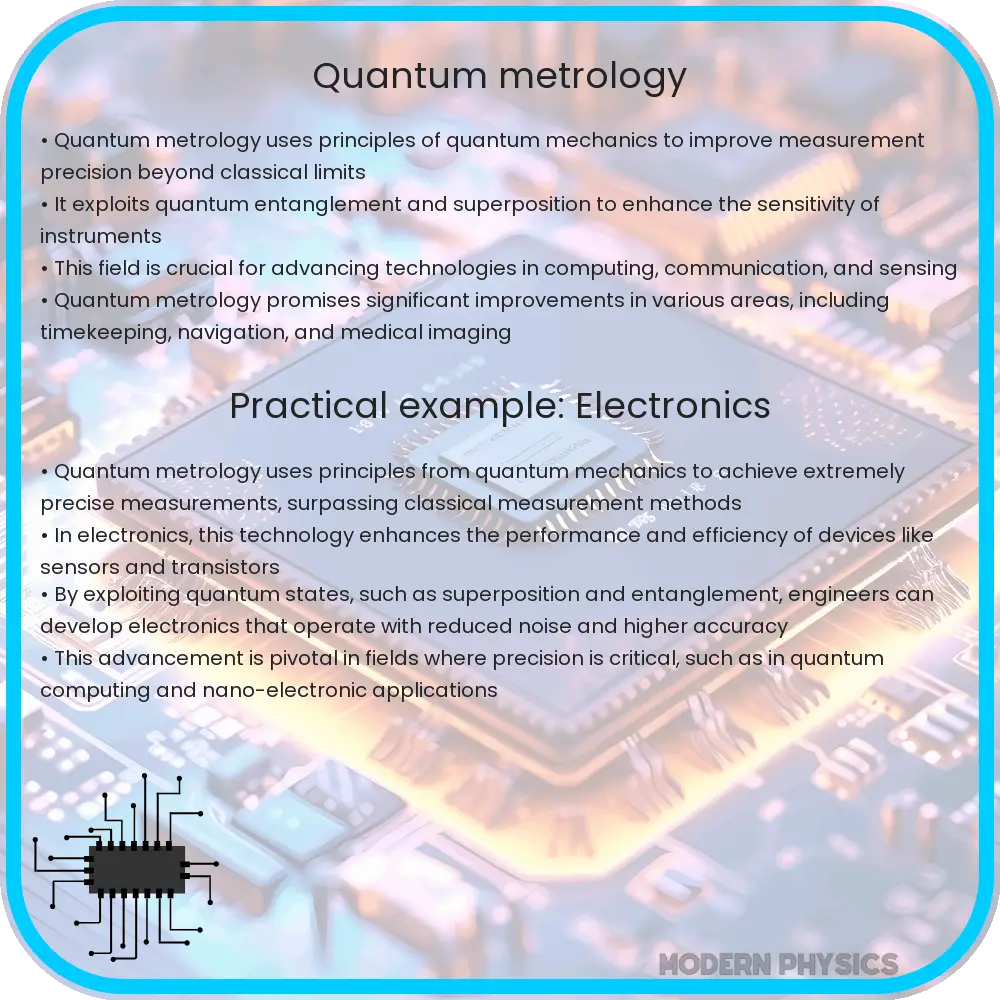
Quantum metrology utilizes quantum mechanics principles to enhance measurement precision and sensitivity beyond classical capabilities.
Introduction to Quantum Metrology
Quantum metrology is a field of science that leverages the principles of quantum mechanics to achieve measurements with unprecedented accuracy and sensitivity. It explores the use of quantum phenomena, such as superposition and entanglement, to improve the precision beyond what is possible with classical techniques.
Basics of Quantum Metrology
At its core, quantum metrology seeks to exploit the peculiar properties of quantum states to enhance the precision of various measurement techniques. Superposition allows quantum systems to be in multiple states simultaneously, while entanglement involves a deep-seated correlation between quantum particles irrespective of the distance separating them. These phenomena are foundational in enabling quantum metrology to surpass classical measurement limits.
The primary metric in quantum metrology is the enhancement of measurement sensitivity, which can be quantified by improvements in precision, defined as the inverse of variance (the mean of the squared deviation from the average). Commonly, in classical metrology, the precision improves as the square root of the number of measurements taken, known as the Standard Quantum Limit (SQL). Quantum metrology, however, employs strategies that can reach the Heisenberg Limit, where precision scales linearly with the number of quantum resources (such as particles) used in the measurement.
Essential Techniques in Quantum Metrology
A variety of techniques are pivotal in the implementation of quantum metrology:
- Quantum Sensors: Devices that exploit quantum entanglement or superposition to enhance their sensitivity. These sensors are increasingly used in fields like magnetic field sensing, temperature, and pressure measurements.
- Quantum Imaging: A technique that allows for imaging properties at resolutions that surpass classical diffraction limits, by exploiting quantum states of light such as entangled photons.
- Quantum Clocks: Clocks that use the frequency standards provided by ultra-precise quantum phenomena, like the transitions in atoms or ions, to measure time with extraordinary accuracy, vastly superior to that of classical counterparts.
Quantum metrology also employs complex statistical methods for data analysis to decipher the information obtained via these advanced quantum systems, which is integral to realizing high-precision measurements.
Applications of Quantum Metrology
Quantum metrology holds significant potential across various domains:
- Scientific Research: Enhances the capabilities of experiments where high precision is crucial, such as in tests of fundamental physical theories and constants.
- Military and Aerospace: Offers better navigation systems and more precise sensors, which can improve accuracy without reliance on external satellite signaling.
- Healthcare: Through advanced imaging techniques, healthcare professionals can achieve more accurate diagnostics at a molecular or even atomic level.
- Information Technology: Aids in developing components for quantum computing and ensuring robust encryption methodologies in communication systems.
In the next section, we will dive deeper into the challenges and future prospects of quantum metrology.
Challenges and Future Directions in Quantum Metrology
The advancement of quantum metrology, while promising, faces several key challenges that need to be addressed to fully realize its potential:
- Technological Hurdles: Creating and maintaining quantum states is technically demanding, requiring extremely precise control and isolation from environmental interference.
- Quantum Decoherence: This phenomenon, wherein a quantum system loses its quantum properties due to interaction with its surroundings, poses a significant barrier to developing stable, reliable quantum sensors and other devices.
- High Costs: The equipment and materials needed for quantum measurements are often prohibitively expensive, limiting broader application and experimentation.
- Complexity of Data Analysis: The data derived from quantum metrological processes can be extremely complex, requiring sophisticated algorithms and computational resources to interpret accurately.
Despite these challenges, the future of quantum metrology looks bright. Ongoing research and development are continually pushing the boundaries of what’s possible, driven by advancements in quantum computing, materials science, and photonics. As these technologies mature, they will alleviate many of the current limitations.
Conclusion
Quantum metrology represents a revolutionary leap forward in measurement science. By harnessing the strange and counterintuitive properties of quantum mechanics, this field offers precision and sensitivity that are simply unattainable with classical methods. From enhancing scientific research to improving healthcare diagnostics and securing information, the applications of quantum metrology are vast and impactful.
As we continue to overcome technological and economic hurdles, the integration of quantum metrology into everyday technology seems increasingly feasible. This will not only propel scientific and technological progress but also has the potential to fundamentally alter our approach to problem-solving across disciplines. The journey of quantum metrology, filled with challenges and opportunities, promises to be one of the most exciting frontiers in modern science and engineering.