
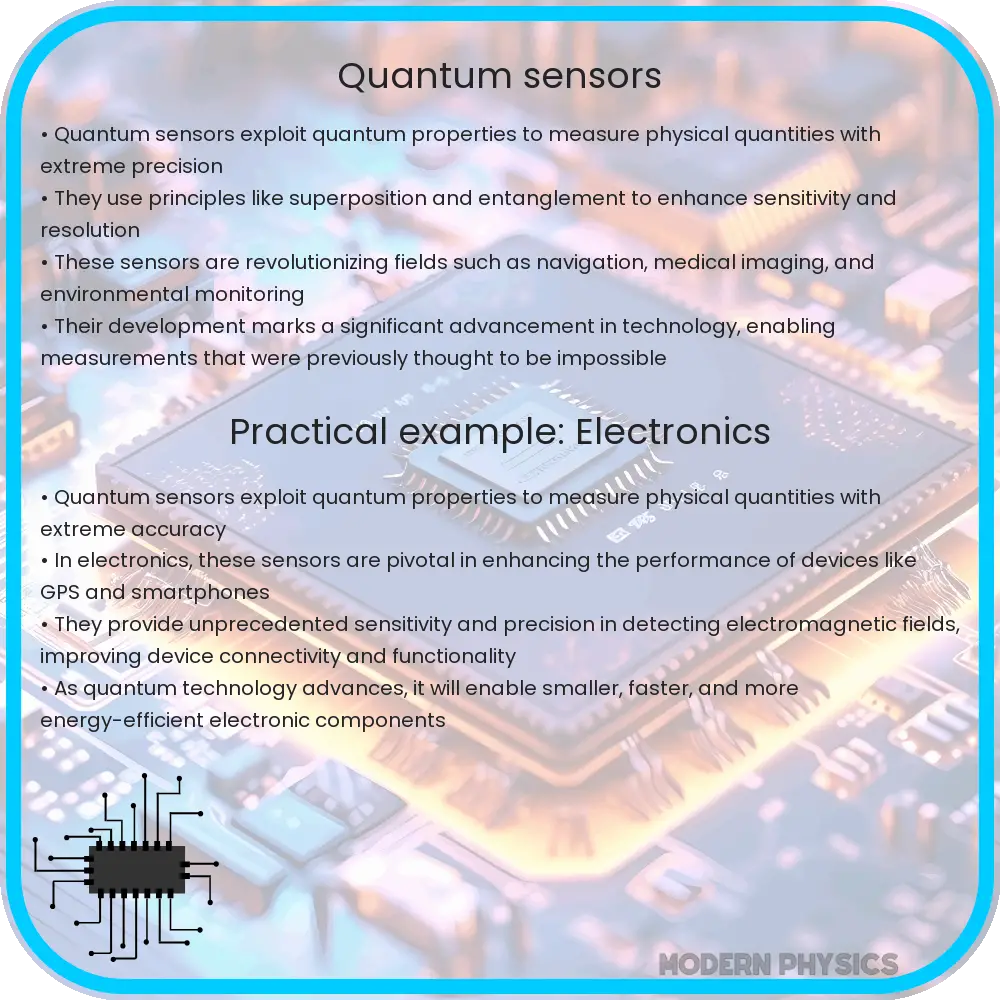
Quantum sensors leverage quantum mechanics principles for ultra-precise measurements across various physical quantities.
Introduction to Quantum Sensors
Quantum sensors utilize the principles of quantum mechanics to make measurements with extreme precision. These devices exploit the quantum properties of particles, such as superposition and entanglement, to measure physical quantities like time, temperature, magnetic fields, and more, with accuracy levels that are unattainable by classical means.
Basics of Quantum Sensors
At the heart of quantum sensors is the utilization of qubits, the basic units of quantum information akin to bits in classical computing. These qubits can exist simultaneously in multiple states, unlike classical bits which are distinctly either 0 or 1. This ability allows quantum sensors to perform complex measurements and detect subtle variations in the environment.
To understand how quantum sensors work, consider the concept of superposition, where a qubit can be in multiple states at once. When deployed in sensors, this property help capture a wide range of data from a quantum system’s response to external influences, which can then be translated into precise measurements.
Uses of Quantum Sensors
- Timekeeping: Atomic clocks are a prime example of quantum sensors in timekeeping, using the precise oscillations of atoms to keep time with exceptional accuracy.
- Magnetic Field Detection: Quantum magnetometers use atomic spins to detect magnetic fields, which is crucial in geophysics for mineral exploration and in medicine for techniques like magnetoencephalography.
- Temperature measurement: Quantum thermometers can measure temperatures at incredibly small scales, essential in environments where traditional thermometers cannot function effectively.
Advances in Quantum Sensors
The field of quantum sensing is rapidly advancing with numerous research groups and companies pushing the boundaries of what’s possible. One of the significant advancements in this field is the development of portable quantum sensors. These devices could revolutionize various industries by allowing precise measurements in remote or previously inaccessible locations.
Another innovative development is the integration of quantum sensors with other technologies. For example, merging quantum sensors with artificial intelligence (AI) enhances data interpretation, enabling more sophisticated decision-making based on quantum sensor data.
The potential of quantum sensors extends into the cosmos as well. NASA, for instance, utilizes quantum sensors to navigate spacecrafts with unprecedented precision, minimizing errors that could occur due to small miscalculations in position or trajectory.
Moreover, the sensitivity of quantum sensors makes them particularly useful in scientific research, where they can detect signals that would be too faint or too subtle for classical sensors to pick up. This capability is essential for probing the mysteries of dark matter and other elusive physical phenomena.
Challenges Facing Quantum Sensors
Despite their potential, quantum sensors also face significant challenges that must be addressed to maximize their impact. One primary hurdle is the extreme conditions often necessary for their operation, such as very low temperatures and isolation from any environmental interference. These requirements can make quantum sensors expensive and complex to maintain.
Additionally, quantum sensors are sensitive to decoherence, a process where the quantum states of the qubits lose their quantum properties, primarily due to interaction with the surrounding environment. Developing techniques to preserve coherence in quantum systems is therefore critical for the practical deployment of these sensors.
Future Outlook
The field of quantum sensors is poised for exciting developments. As researchers continue to overcome challenges like decoherence and operational conditions, we can expect broader adoption and new applications. From enhancing the precision of medical diagnostics to improving navigation systems and beyond, the potential uses for quantum sensors span a wide array of fields and industries.
Future advancements may also lead to the miniaturization of quantum sensors, making them more accessible for everyday use. This progress could translate into quantum-powered devices in consumer electronics, further integrating quantum technology into everyday life.
Conclusion
Quantum sensors represent a significant leap forward in measurement technology, offering unprecedented precision by leveraging the principles of quantum mechanics. Though still facing significant developmental challenges, ongoing research and the integration with technologies like AI are opening new possibilities for their application. As we stand on the brink of a quantum revolution, the continued evolution of quantum sensors holds promising potential to transform our approach to science and technology, making what was once thought to be highly theoretical both practical and commonplace.