
Explore the revolutionary potential of quantum-enhanced measurements, leveraging quantum mechanics to surpass classical measurement limits in precision and accuracy.
Introduction to Quantum-Enhanced Measurements
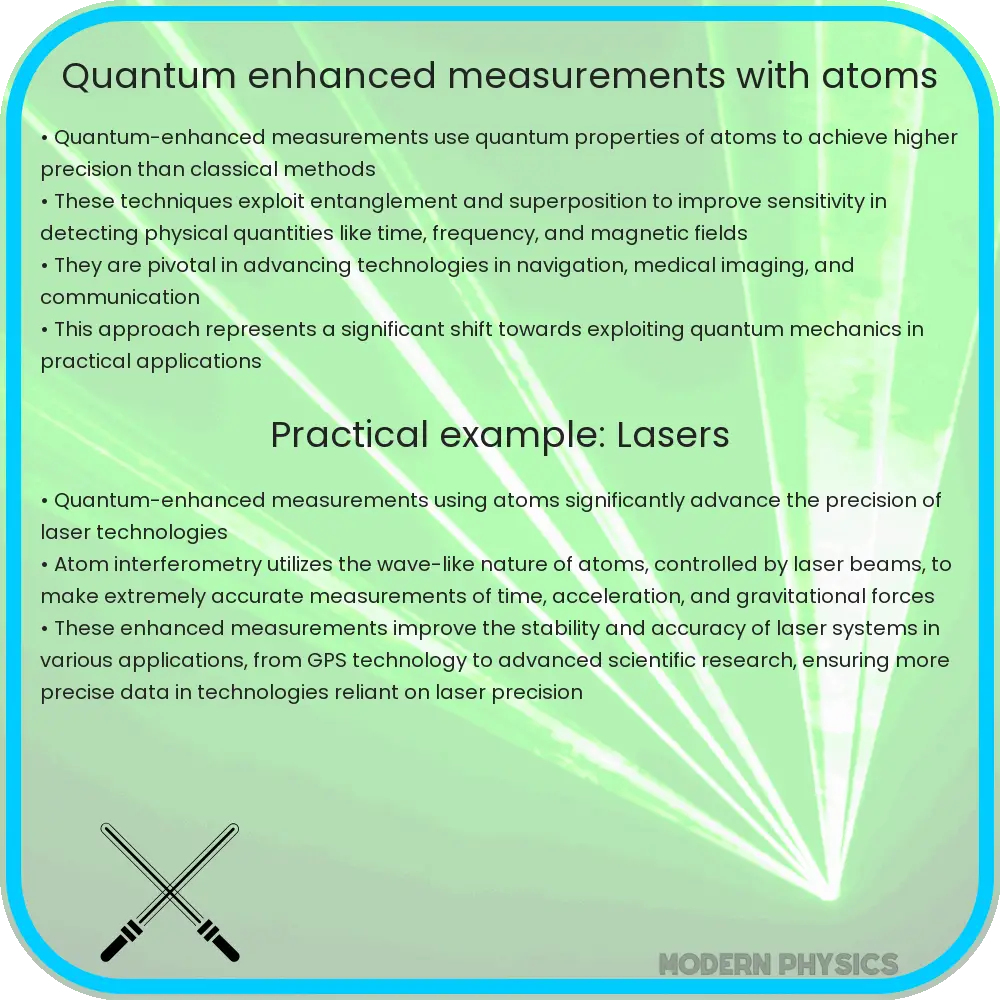
In the realms of physics and technology, the ability to measure with great precision is paramount. Traditional measurement techniques have served us well, but as we venture further into the microscopic and macroscopic bounds of the universe, the limitations of these methods become clear. Quantum-enhanced measurements, utilizing principles from quantum mechanics, offer the potential to vastly improve accuracy beyond what classical physics allows.
Quantum mechanics, a fundamental theory in physics that provides a description of the physical properties of nature at the scale of atoms and subatomic particles, is key to these new measurement techniques. This article will explore how utilizing quantum states, such as superposition and entanglement, can enhance measurement capabilities and pave the way for breakthroughs in various fields of science and engineering.
The Basics of Quantum States
At the heart of quantum-enhanced measurements are the peculiar and often non-intuitive states that quantum systems can exist in. Two core concepts are essential here:
- Quantum Superposition: This principle posits that a quantum system can exist simultaneously in multiple states. A famously known example is Schrödinger’s cat, which illustrates a scenario where an object (in this case, the cat) can be both alive and dead, until its state is observed.
- Quantum Entanglement: When particles become entangled, the state of one (no matter the distance from its partner) instantaneously affects the state of the other. This phenomenon, which Einstein famously critiqued as “spooky action at a distance,” is now a cornerstone of advanced quantum technologies.
These properties are harnessed in quantum-enhanced measurements to improve the precision of measurements that are subject to classical limits defined by the noise and other errors.
Application of Quantum-Enhanced Measurements
One key application area of quantum-enhanced measurements is in the field of metrology, the science of measurement. Here, quantum mechanics offers new ways to construct more precise standards of measurements. This approach is critical in areas that require extremely high precision, such as:
- Timekeeping: Utilizing atomic clocks, which operate on the difference between energy levels in cesium atoms, enhanced by quantum mechanics to achieve accuracies up to a fraction of a second over millions of years.
- Electrical Standards: Developing voltage standards and resistances based on quantum phenomena such as the Josephson junction and the quantum Hall effect, respectively.
- Sensing and Imaging: Improvements in the sensitivity and resolution of sensors and imaging techniques can be achieved through quantum entanglement, potentially revolutionizing fields such as medical imaging and surveillance.
Each of these examples exploits quantum phenomena to surpass classical measurement limits, highlighting a trajectory toward a future where our measurement capabilities could be fundamentally enhanced by quantum mechanics.
Challenges in Quantum Measurements
Despite its promising advantages, quantum-enhanced measurement also faces significant challenges. Issues such as decoherence—the loss of quantum state coherence due to environmental interaction—and the technical difficulty in maintaining quantum states for long periods limit current advancements. Furthermore, implementing these systems outside of highly controlled laboratory settings presents additional obstacles that must be overcome as this technology transitions from experimental to practical applications.
Quantum-enhanced measurements represent a thrilling fusion of fundamental quantum mechanics with practical engineering applications. As research and technology progress, these quantum techniques are set to redefine the boundaries of what can be measured, opening up new horizons in science and technology domains.
Stay tuned as we delve deeper into specific examples of quantum-enhanced measurement systems, their implementation, and the potential future landscape shaped by quantum measurement technologies.
Future Prospects of Quantum-Enhanced Measurements
As research continues to advance in quantum-enhanced measurements, we may see increased integration into more mainstream applications. Future innovations could include more portable and robust quantum devices for use in fields like geology for mineral exploration, or in space exploration where precise measurements are critical. The implications for quantum computing are also profound, with potential for faster and more secure data processing and transmission.
Moreover, the interconnectedness of quantum technologies means advancements in measurement can accelerate progress in other quantum fields, fostering a holistic advancement in our technological capabilities. Investment in education and workforce training in quantum technologies also plays a crucial role in realizing the potential of quantum-enhanced measurements.
Educational and Regulatory Considerations
To fully embrace the era of quantum measurement, a supportive framework is necessary. This involves not only investments in research and development but also education reform to prepare future scientists and engineers. Furthermore, ethical and regulatory considerations must be addressed to ensure that quantum measurement technologies are used responsibly and for the benefit of all.
Policy-making will need to keep pace with the rapid developments in technology to deal with issues such as privacy concerns around ultra-sensitive quantum sensors which could, hypothetically, measure extremely personal data without knowledge or consent.
Conclusion
Quantum-enhanced measurements are poised to revolutionize our approach to science and engineering. By leveraging the bizarre yet powerful principles of quantum mechanics, we unlock new potentials in measurement accuracy, thereby enhancing numerous fields from healthcare to environmental monitoring. Despite facing significant challenges such as decoherence and the complexities of quantum system management, the collective effort of researchers, engineers, and policymakers can pave the way for a future where quantum measurement technologies are as common as classical counterparts today.
In essence, we are on the brink of a new era, one that could redefine our approach to solving some of science’s and technology’s most enduring problems. It is an exciting time for professionals in the field and an exhilarating topic for anyone fascinated by the prospects of quantum technologies.