
Explore the fascinating world of Quantum Holography, where quantum mechanics meets optical imaging, with insights into QED, photons, and applications.
Understanding Quantum Holography: The Intersection of Quantum Mechanics and Optical Imaging
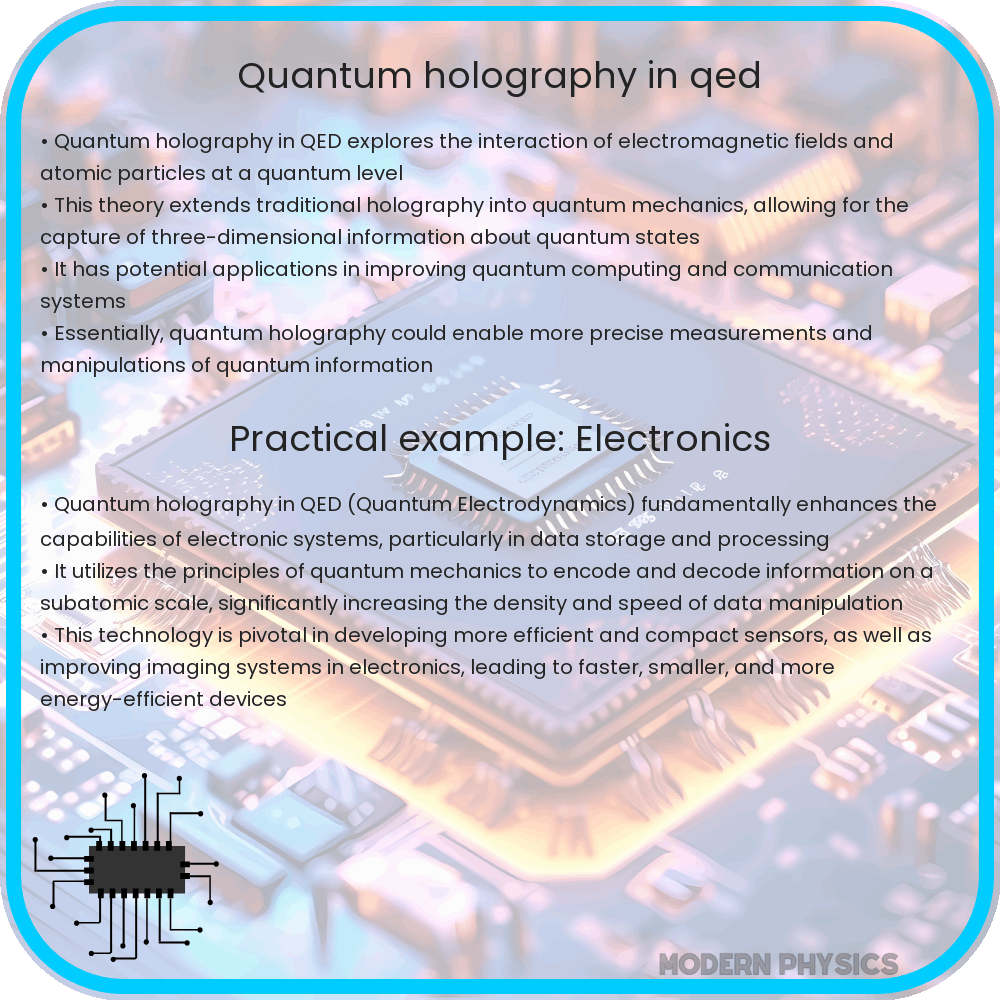
Quantum Holography is a groundbreaking field that merges the principles of quantum mechanics with the techniques of optical imaging, offering a new perspective on capturing and interpreting information at the quantum scale. This cutting-edge technology leverages the unique properties of quantum states, particularly photons, to enhance imaging methods beyond the limits of classical physics.
Quantum Electrodynamics (QED) and Its Role in Quantum Holography
At the heart of Quantum Holography lies Quantum Electrodynamics (QED), the quantum theory of light and matter interactions. QED explains how light and matter interact at the most fundamental level, involving the exchange of photons, the elementary particles of light. This theory is crucial for understanding the behavior of photons in quantum holographic processes.
Photons: The Messengers of Quantum Information
Photons play a central role in Quantum Holography. As carriers of electromagnetic force, photons are quantum objects with dual wave-particle characteristics. In quantum holography, photons are manipulated to carry information about the phase and amplitude of light waves, essential for creating high-resolution holographic images.
Applications of Quantum Holography
The applications of Quantum Holography are diverse and impactful across multiple fields. One significant application is in medical imaging, where it can provide highly detailed images of biological structures at a molecular level. This precision is paramount in understanding complex biological processes and in the early detection of diseases.
- Telecommunications: Quantum holography has the potential to revolutionize data transmission, offering a new dimension in secure and efficient communication channels.
- Quantum Computing: In quantum computing, holography can be utilized for storing and processing quantum information, thus enhancing computational power and security.
- Microscopy: The ability to capture images at the quantum level makes quantum holography a powerful tool in advanced microscopy, enabling researchers to observe phenomena that were previously invisible.
Quantum Holography represents a significant leap forward in our ability to visualize and understand the quantum world. Its integration of quantum mechanics and optical imaging opens new frontiers in science and technology, heralding a future of enhanced imaging capabilities and novel applications in various sectors.
Advancements and Challenges in Quantum Holography
As Quantum Holography continues to evolve, significant advancements are being made, particularly in the precision and efficiency of holographic imaging techniques. Researchers are continually exploring ways to manipulate photons more effectively, leading to higher resolution images and faster processing times. However, challenges remain, especially in terms of the technical complexity and the need for highly sensitive equipment to detect quantum holographic signals.
Future Directions and Potential Impact
The future of Quantum Holography is vibrant with possibilities. One promising direction is the integration of artificial intelligence to enhance image analysis, which could lead to more accurate interpretations of quantum holographic data. Additionally, ongoing research in quantum physics may reveal new aspects of photon behavior, further refining holographic techniques. The potential impact of these advancements extends beyond the realms of science and technology, influencing areas like cybersecurity, where quantum holography could play a vital role in developing unbreakable encryption methods.
Concluding Thoughts on Quantum Holography
Quantum Holography stands at the forefront of a new era in imaging and information processing. It embodies the fascinating convergence of quantum mechanics and optical imaging, showcasing the power of photons as information carriers. The applications of this technology, from medical imaging to quantum computing, signify a major shift in how we perceive and interact with the quantum world.
Despite the challenges, the continuous advancements in this field promise to unlock new capabilities in imaging and data transmission, paving the way for revolutionary changes in various industries. As researchers and technologists further explore and refine this technology, Quantum Holography is poised to become an integral part of our journey into the depths of quantum mechanics and its practical applications in the modern world.
In conclusion, Quantum Holography is not just a scientific achievement; it’s a beacon of innovation that lights the path to a future where the quantum and macroscopic realms intertwine more seamlessly, creating a world where the unseen and the seen are connected in ways previously unimaginable.