
Explore the intriguing world of Glauber States in Quantum Electrodynamics, bridging quantum and classical physics with applications in quantum technology.
Glauber States in Quantum Electrodynamics: An Overview
Quantum Electrodynamics (QED) is a fundamental theory in physics that describes how light and matter interact. Among its many intriguing aspects are Glauber States, named after physicist Roy J. Glauber. These states play a crucial role in understanding the coherence, photon statistics, and dynamics of quantum systems. This article delves into the intricate world of Glauber States, shedding light on their significance in QED and their implications in modern physics.
Understanding Glauber States
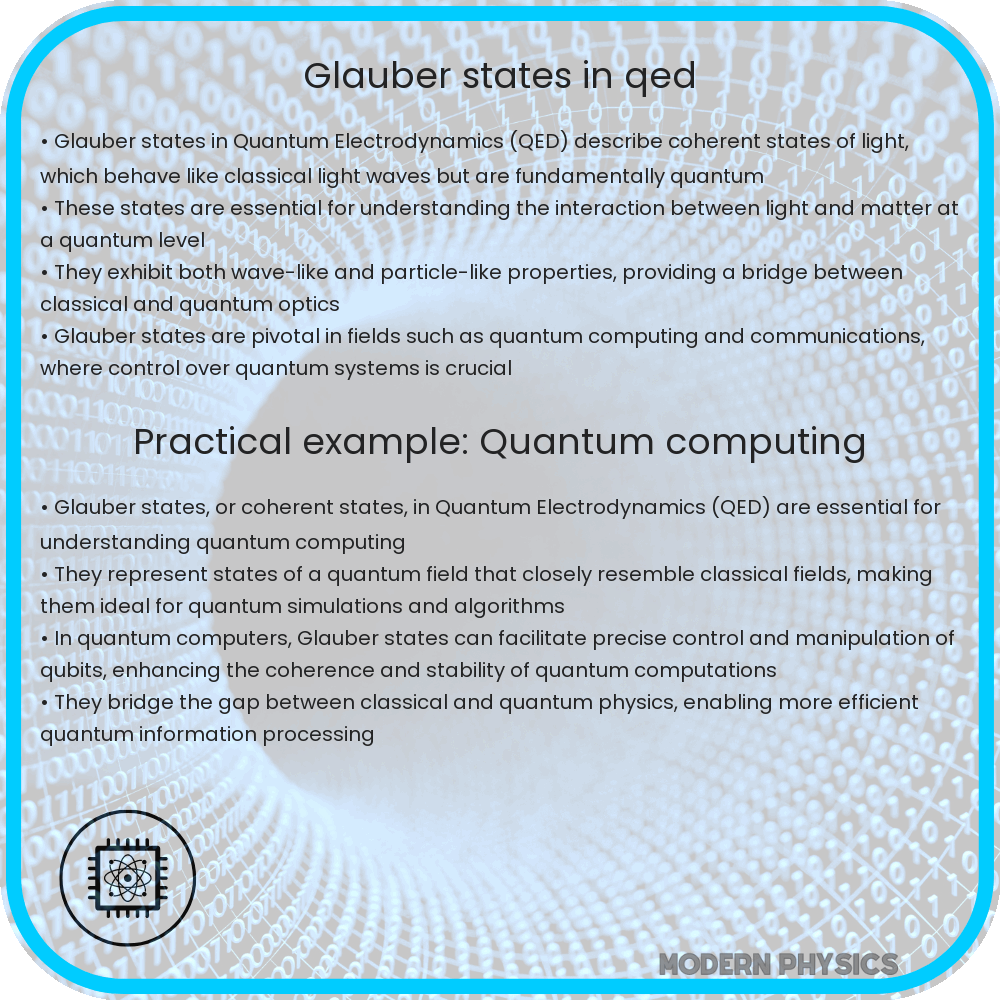
Glauber States, or coherent states, are specific types of quantum states of the electromagnetic field. They were first introduced by Glauber in the context of quantum optics. These states are particularly important because they bridge classical and quantum theories of light. In classical physics, light is described as a wave, while in quantum mechanics, it is depicted as a particle, known as the photon. Glauber States uniquely combine these two descriptions, representing a quantum state that most closely resembles a classical electromagnetic wave.
Coherence in Glauber States
The concept of coherence is central to understanding Glauber States. Coherence refers to the predictable and consistent phase relationship between waves at different points in space and time. In quantum optics, coherence is a measure of the predictability of the phase of the electromagnetic field. Glauber’s formalism allows for a quantitative description of both temporal and spatial coherence in quantum systems, making it invaluable for analyzing the behavior of lasers and other light sources.
Photon Statistics of Glauber States
Photon statistics is another key aspect of Glauber States. It deals with the distribution and behavior of photons in a given state. Glauber States exhibit a Poissonian photon distribution, which is a hallmark of classical light sources like lasers. This Poisson distribution contrasts with the Bose-Einstein distribution observed in thermal light sources, highlighting the classical-like nature of Glauber States in a quantum context.
Dynamics of Glauber States
The dynamic properties of Glauber States are crucial for understanding their behavior over time. These states are known for their stability and resilience to certain types of perturbations, which makes them ideal for applications in quantum information and communication. The evolution of Glauber States under various conditions provides insights into the fundamental processes of quantum decoherence and the transition between quantum and classical realms.
In the next section, we will delve deeper into the applications and implications of Glauber States in quantum technology, as well as their role in advancing our understanding of quantum physics.
Applications and Implications of Glauber States
Glauber States have far-reaching applications in various fields of physics, particularly in quantum information and communication. Their stability and predictability make them ideal candidates for transmitting quantum information. They are instrumental in quantum cryptography, where they can be used to secure communication channels against eavesdropping. Additionally, Glauber States are used in quantum computing, serving as a basis for implementing quantum logic gates and algorithms.
Advancing Quantum Physics with Glauber States
The study of Glauber States has significantly advanced our understanding of quantum mechanics. They provide a practical framework for exploring the boundary between classical and quantum worlds. This is particularly relevant in the study of quantum decoherence, which describes how quantum systems interact with their environment and gradually lose their quantum characteristics, behaving more classically. By analyzing Glauber States, physicists can better understand this transition and its implications for quantum theory.
Experimental Realizations and Challenges
Experimentally realizing Glauber States poses significant challenges, primarily due to the delicate nature of quantum states. Any interaction with the environment can lead to decoherence, disrupting the state’s coherence. However, advances in quantum optics and laser technology have made it possible to produce and manipulate Glauber States with high precision. These experimental endeavors not only validate theoretical predictions but also open new avenues for exploring quantum phenomena.
Conclusion
Glauber States in Quantum Electrodynamics represent a fascinating intersection of classical and quantum theories. Their ability to embody the characteristics of both light waves and particles offers a unique perspective on the nature of light. The coherence and photon statistics of Glauber States have been instrumental in advancing our understanding of quantum mechanics, particularly in the context of quantum coherence and decoherence. Their practical applications in quantum information and communication highlight their importance in the burgeoning field of quantum technology. Despite the challenges in their experimental realization, Glauber States continue to be a vital subject of research, pushing the boundaries of our understanding of the quantum world. As we delve deeper into the quantum realm, Glauber States will undoubtedly play a key role in uncovering new mysteries and applications of quantum physics.