
Explore the revolution in telecommunications with quantum fiber optics, enhancing speed, security, and precision in data transmission like never before.
Understanding Quantum Fiber Optics: A Leap in Telecommunication Technology
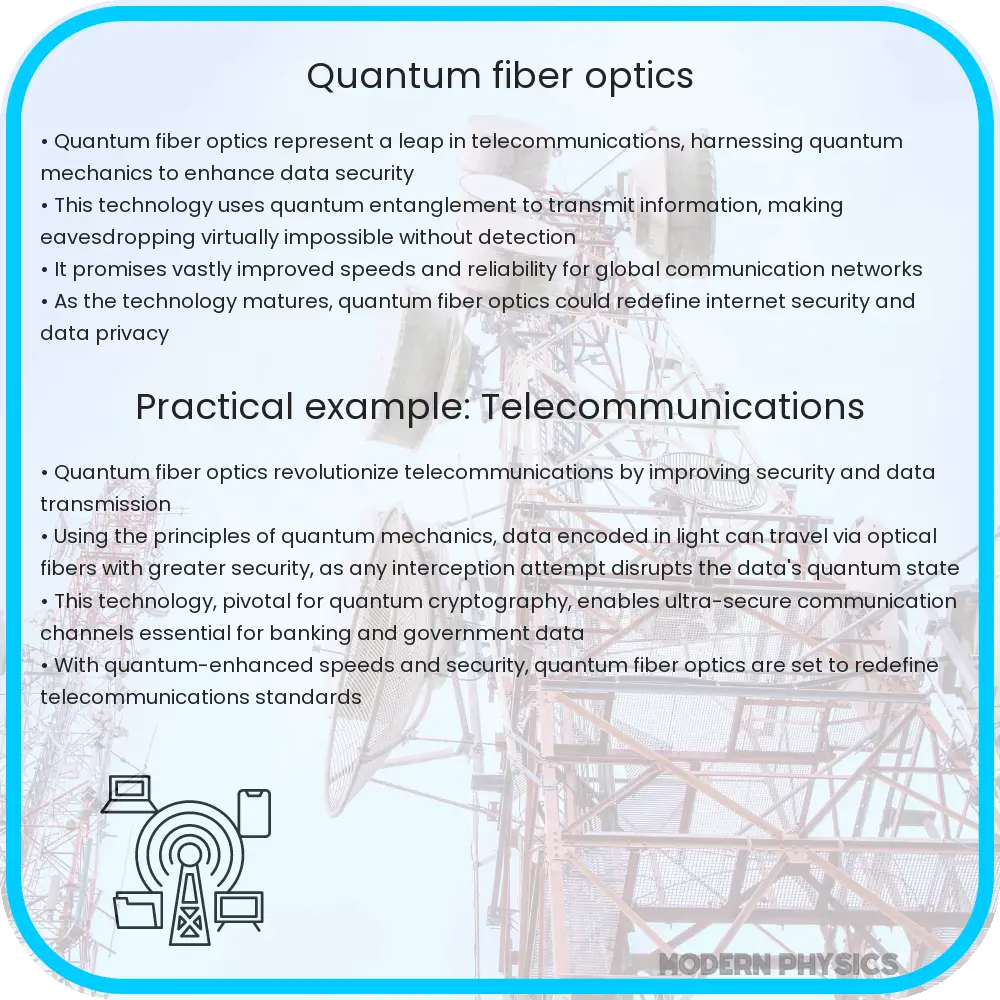
Quantum fiber optics represents a groundbreaking advancement in the realm of telecommunication, offering unprecedented improvements in speed, security, and precision. This innovative technology leverages the principles of quantum mechanics, particularly quantum entanglement and superposition, to transmit information over fiber optic cables with unparalleled efficiency and security.
The Speed Advantage of Quantum Fiber Optics
The speed at which data can be transmitted through quantum fiber optics is a significant leap forward. Traditional fiber optics already offer high-speed data transmission by using light pulses. However, quantum fiber optics takes this a step further by utilizing quantum bits or qubits. Qubits can exist in multiple states simultaneously, thanks to superposition, allowing for the transmission of more data at once compared to classical bits.
Enhancing Security with Quantum Encryption
One of the most promising aspects of quantum fiber optics is its potential to drastically improve security through quantum encryption, also known as quantum key distribution (QKD). QKD utilizes the principle of quantum entanglement, where two particles become interconnected in such a way that the state of one (no matter the distance) instantly influences the state of the other. This phenomenon is harnessed to detect any attempt at eavesdropping, as the act of measuring a quantum system inevitably alters its state. Therefore, any interference with the quantum keys would be immediately noticeable, ensuring a level of security that is currently unattainable with classical encryption methods.
The Precision of Quantum Fiber Optics
Quantum fiber optics also excels in precision, thanks to the inherent properties of quantum mechanics. The technology enables the transmission of information with minimal loss, even over great distances. This precision is crucial for applications requiring high levels of accuracy, such as in financial services, scientific research, and military communications. Furthermore, the ability to use quantum superposition and entanglement means that information can be encoded and transmitted in ways that reduce errors and improve the fidelity of the communication channel.
The introduction of quantum fiber optics into the telecommunications industry is poised to revolutionize how data is transmitted, received, and secured. With ongoing research and development, the potential applications and benefits of this technology are vast, promising a future where communication is faster, more secure, and more precise than ever before.
Challenges and Future Prospects
Despite the promising advantages of quantum fiber optics, there are significant challenges to overcome before this technology can be widely adopted. One of the main hurdles is the need for highly specialized equipment and materials that can maintain quantum states over long distances without decoherence. Additionally, the integration of quantum fiber optics with existing telecommunications infrastructure requires substantial investment and innovation. However, ongoing research in quantum repeaters and advanced materials is making strides towards resolving these issues, bringing us closer to a feasible quantum networking future.
The Role of Quantum Fiber Optics in Future Networks
As we advance, the role of quantum fiber optics in telecommunication networks is expected to evolve dramatically. Beyond just enhancing the speed, security, and precision of data transmission, quantum fiber optics could enable completely new types of computing and communication technologies, such as quantum computing and quantum internet. These advancements could revolutionize various sectors by providing ultra-secure communications, improving data processing capabilities, and facilitating complex scientific simulations.
Conclusion
Quantum fiber optics stands at the forefront of a telecommunications revolution, offering a glimpse into a future where data transmission is not only faster and more secure but also more precise. While challenges remain in terms of technology integration and infrastructure development, the potential benefits of quantum fiber optics are too significant to ignore. As researchers continue to unlock the mysteries of quantum mechanics and engineers develop new ways to harness these principles in practical applications, we move closer to realizing the full potential of quantum fiber optics. The journey towards a quantum-enhanced world is complex and fraught with technical challenges, but the rewards—revolutionizing telecommunications, enhancing global security, and opening new frontiers in computing—promise to reshape our digital world in ways we are just beginning to imagine.