
Explore how Quantum Dots revolutionize display technology and solar cells with enhanced efficiency and luminosity, unlocking the future of nanotech.
The Revolution of Quantum Dots in Display Technology
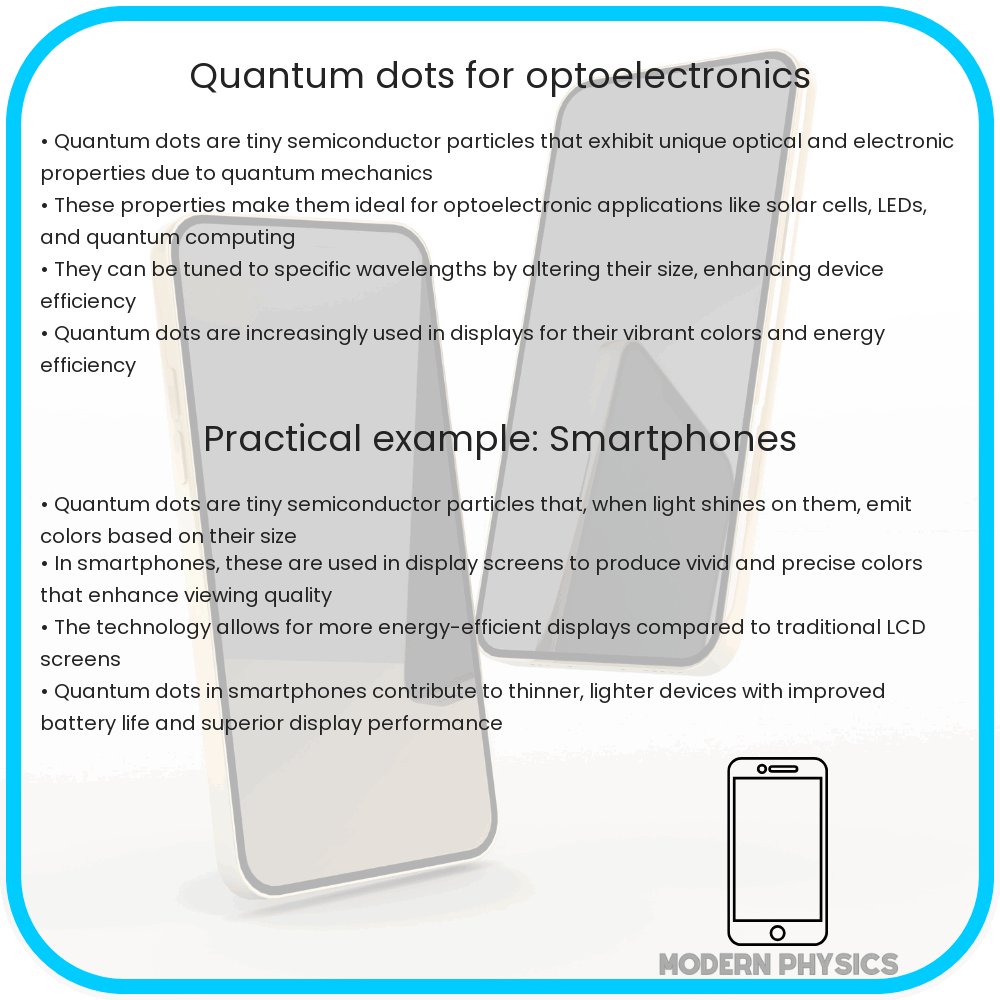
Quantum Dots (QDs) are semiconductor nanocrystals that possess unique optical and electronic properties due to their quantum mechanical effects. These tiny particles, typically between 2 to 10 nanometers in diameter, have the ability to convert light into vivid, pure colors, making them ideal for enhancing the efficiency and luminosity of displays. The core mechanism behind their functionality lies in the quantum confinement effect, where the size of the quantum dot dictates the color of light it emits. Smaller dots emit blue light, while larger dots emit red light, with intermediate sizes producing various shades of green.
Enhanced Efficiency Through Quantum Dots
One of the standout features of quantum dot technology is its ability to improve the energy efficiency of displays. Traditional liquid crystal displays (LCDs) rely on white LED backlighting, which passes through color filters to produce the desired hues. Unfortunately, this process is inefficient, as a significant amount of light is lost through the filters. Quantum dots, on the other hand, can be engineered to emit light in very specific wavelengths, closely matching the red, green, and blue filters used in displays. This direct emission reduces energy loss and increases the overall efficiency of the display.
Unparalleled Luminosity and Color Purity
The narrow emission spectrum of quantum dots also contributes to their ability to produce displays with unmatched luminosity and color purity. Unlike phosphors used in traditional displays, which emit a broader spectrum of light, quantum dots emit light at very specific wavelengths. This results in more saturated colors and a wider color gamut, enabling displays to cover up to 100% of the DCI-P3 color space. Such capability enhances the viewer’s experience by providing more lifelike and vibrant images.
Application in Various Display Technologies
Quantum dots have found applications in a variety of display technologies, including LCDs, light-emitting diodes (LEDs), and organic LEDs (OLEDs). In LCDs, QDs are used in the backlight unit to create more color-accurate and energy-efficient displays. For LED and OLED displays, quantum dots can be incorporated into the emissive layer, offering improved color saturation and efficiency. The versatility of quantum dots in enhancing both the efficiency and luminosity of displays underscores their revolutionary impact on the future of display technology.
Quantum Dots: Revolutionizing Display and Solar Cell Technologies
Quantum Dots (QDs) are nanoscale semiconductor particles that have unique optical and electronic properties due to their quantum mechanical effects. The size of these particles is directly correlated with their color: smaller dots emit blue light, while larger dots emit red light. This tunability is what makes quantum dots incredibly valuable in various applications, particularly in enhancing the efficiency and luminosity of displays and solar cells.
Applications in Display Technology
Quantum dots have significantly impacted display technology by enabling screens with a broader spectrum of colors, higher brightness, and increased energy efficiency. This is achieved through their incorporation into QD Light Emitting Diodes (QLED) displays. Quantum dots can be precisely controlled for their size, allowing for the production of pure and vibrant colors that surpass the capabilities of traditional display technologies. As a result, QLED displays boast superior color accuracy, making them ideal for high-end televisions and monitors.
Enhancing Solar Cell Efficiency
In the realm of solar energy, quantum dots offer a promising avenue to overcome the limitations of conventional photovoltaic cells. By harnessing the unique ability of quantum dots to absorb and convert a broader spectrum of sunlight into electricity, solar cells can achieve higher conversion efficiencies. This is particularly important in the pursuit of more sustainable energy sources, as quantum dot-enhanced solar cells can potentially harness more solar energy than ever before.
Conclusion
Quantum dots stand at the forefront of nanotechnology, offering transformative potential across a range of applications from vivid, energy-efficient displays to high-efficiency solar cells. Their unique properties, such as size-dependent color emission and superior light absorption, are key to their versatility and appeal in these fields. As research and development in quantum dots continue to advance, we can expect even greater efficiencies and enhancements in display and solar technologies. This not only promises to elevate our visual experience but also contributes significantly to the pursuit of sustainable energy solutions, marking quantum dots as a pivotal element in the technological advancements of the future.