
Delve into the intersection of quantum control and atomic collisions, exploring their roles in advancing quantum computing, encryption, and more.
Understanding Quantum Control and Atomic Collisions
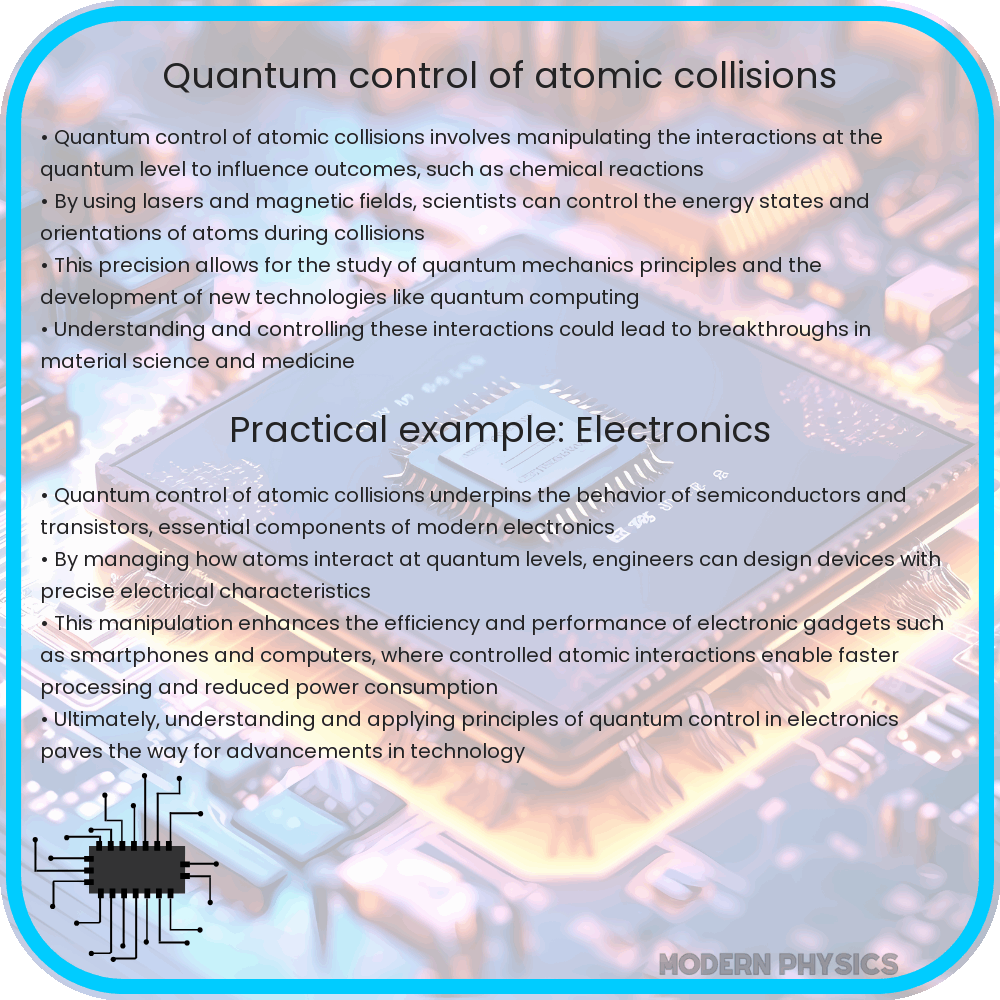
Quantum control and atomic collisions are fascinating areas in the field of physics that delve into the manipulation and interaction of atoms and particles at the quantum level. This exploration not only deepens our understanding of the quantum world but also lays the groundwork for advancements in technology, such as quantum computing and quantum encryption.
What is Quantum Control?
Quantum control refers to the process of steering the dynamics of quantum systems towards a desired state or outcome. This is achieved by applying external controls like electromagnetic fields or tailored laser pulses. The aim is to manipulate quantum states in a way that can be used for computation, information processing, or enhanced measurement techniques.
Basics of Atomic Collisions
Atomic collisions occur when two or more atoms come into close proximity and interact. These interactions can alter the energy states of the atoms involved, leading to various outcomes depending on the nature of the collision. Atomic collisions can be classified into two main types:
- Elastic collisions: In these collisions, the total kinetic energy of the atoms before and after the incident remains the same, though their energy may be redistributed among them.
- Inelastic collisions: In this type, part of the kinetic energy is converted into other forms of energy, such as electromagnetic energy, resulting in a change in the internal energy states of the atoms.
The Role of Collision Theory in Quantum Control
Collision theory in quantum mechanics provides a framework to understand how atomic collisions occur at a quantum level. It considers the wave-like properties of particles and the probabilistic nature of quantum mechanics. When two atomic particles collide, their quantum wave functions overlap, leading to a variety of possible outcomes, which can be determined using quantum mechanical calculations.
One of the key equations used in modeling these interactions is the Schrödinger equation, which describes how the quantum state of a physical system changes over time:
Hψ = iħ∂ψ/∂t
Here, H represents the Hamiltonian operator (total energy operator for the system), ψ is the wave function of the system, i is the imaginary unit, and ħ is the reduced Planck’s constant. This equation is fundamental for predicting the outcome of quantum interactions like atomic collisions.
Applications and Implications of Quantum Control and Atomic Collision
The realm of quantum control and atomic collisions is not just of theoretical interest but has practical applications in several cutting-edge technologies. For instance, precise control over quantum states is crucial for the development of quantum computers, which promise to surpass the capabilities of classical computers in solving certain types of problems. Additionally, understanding atomic collisions is essential in fields such as nuclear fusion, where controlled collisions could potentially be a source of vast amounts of energy.
In medicine, techniques developed through quantum control could lead to more precise and less invasive forms of surgery and diagnostic imaging. By accurately manipulating molecules and cells at the atomic level, novel treatments and imaging techniques can be developed, potentially revolutionizing healthcare.
Challenges in Quantum Control and Atomic Collisions
Despite the promising potential of quantum control and atomic collisions, there are significant challenges that researchers face. One of the primary obstacles is maintaining the coherence of quantum states. Quantum decoherence—the loss of quantum coherence due to interaction with the environment—can quickly deteriorate the information stored in a quantum state, complicating efforts to manipulate these states precisely.
Another challenge is the sheer complexity of the calculations involved in predicting the outcomes of atomic collisions. Quantum systems can be influenced by an enormous number of factors, and each variable can alter the outcome in unpredictable ways. Advanced computational techniques and algorithms are constantly being developed to improve the accuracy and efficiency of these predictions.
Educational and Research Opportunities in Quantum Physics
The intriguing complexities of quantum control and atomic collisions not only challenge physicists but also provide exciting opportunities for students and researchers. Educational programs focusing on quantum physics can open pathways to cutting-edge research and careers in technology and academia.
Moreover, collaborations across different scientific disciplines are critical. For instance, partnerships between physicists, chemists, and computer scientists can lead to novel insights and innovations in quantum computing and other technologies.
Conclusion
Quantum control and atomic collisions represent a profound branch of physics that bridges our understanding of the microscopic world with real-world applications that could transform technology and medicine. While the challenges in mastering this domain are non-trivial, the potential benefits make it a fascinating and worthwhile field of study. As researchers continue to untangle the complexities of the quantum world, we may soon witness the emergence of technologies that once seemed nothing short of miraculous. This continual evolution of quantum science not only enriches our knowledge but also enhances the capabilities of various scientific and technological fields, ultimately contributing to the betterment of society.
The exploration of quantum phenomena like control and collisions thus remains a vibrant area of scientific inquiry, promising to unlock further secrets of the universe while propelling us into a future ripe with innovation and discovery.