
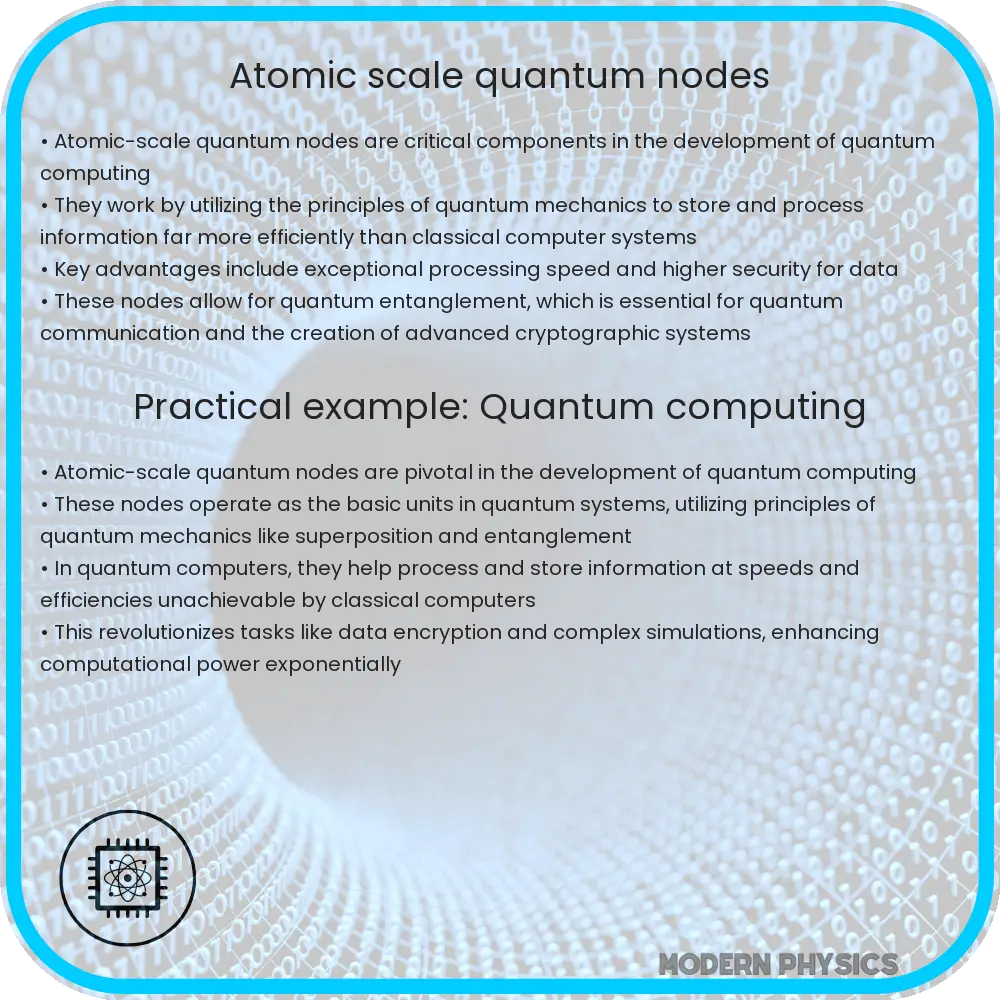
Understanding atomic-scale quantum nodes: engineered quantum systems exhibiting properties like superposition and entanglement for advanced quantum computing and secure communications.
Introduction to Atomic-Scale Quantum Nodes
Quantum technology, a rapidly developing field in physics and engineering, involves the manipulation and control of systems at the quantum level — typically at scales smaller than atoms. An exciting aspect of this field is the development of atomic-scale quantum nodes (ASQNs). These nodes are essentially engineered quantum systems that exhibit certain quantum properties, such as superposition and entanglement, at an atomic scale. They serve as the building blocks for more complex quantum networks, which have potential applications ranging from quantum computing to secure communication systems.
Understanding Atomic-Scale Quantum Nodes
At the heart of atomic-scale quantum nodes is the concept of quantum bits, or qubits, which are the quantum version of the bits found in classical computing. Unlike classical bits, which can be either 0 or 1, qubits can exist in states representing 0, 1, or any quantum superposition of these states, enabling them to perform multiple calculations simultaneously.
ASQNs are primarily created using individual atoms, ions, or electrons, each trapped and isolated in such a way that their quantum states can be manipulated precisely. These nodes leverage the principles of quantum mechanics to function. For example, the precise manipulation of an electron’s spin or the orientation of an atom’s magnetic field can be used to store and process information at the quantum level.
Key Applications of Atomic-Scale Quantum Nodes
- Quantum Computing: ASQNs can dramatically increase the computational power available for certain tasks, such as factoring large numbers, searching large databases, and simulating molecular structures in chemistry and materials science.
- Quantum Communication: By utilizing the property of quantum entanglement, ASQNs enable the creation of quantum secure communication channels. This is vital for cryptography and secure data transfer across large distances without the risk of eavesdropping.
- Quantum Sensing and Metrology: These nodes can be used to create sensors with sensitivity far greater than those possible with classical physics. This has applications in various fields, including astronomy and geology, where precise measurements are crucial.
One of the fascinating elements about ASQNs is their ability to interconnect, forming a quantum network or mesh. Each node in this network can process and relay quantum information, functioning in coherence with other nodes due to entanglement. This interconnectedness highlights a promising future for large-scale quantum networks that could resemble today’s classical internet.
Technical Challenges in Developing Atomic-Scale Quantum Nodes
Despite the promising advantages, developing ASQNs is not without challenges. These include issues related to the isolation and stability of qubits, coherence times, and the technical demands of quantum error correction. Given that quantum states are incredibly fragile, any interaction with the external environment can cause decoherence, effectively destroying the information the quantum state holds.
In practice, maintaining coherence over sufficient periods, and across significant distances, requires advancements in quantum repeaters and quantum error correction schemes. These areas are currently the focus of intense research and development, aiming to make quantum networks robust and reliable.
p>The field of quantum mechanics and atomic-scale engineering shows immense promise but is tempered by these significant engineering and technical hurdles. The development of atomic-scale quantum nodes remains at the cutting edge of research in quantum physics and engineering, with each breakthrough bringing us closer to a new era of technology.
Future Prospects of Atomic-Scale Quantum Nodes
The ongoing research and development in atomic-scale quantum nodes suggest a promising future that could revolutionize technology and science. As we begin to understand more about quantum phenomena and continue to improve our engineering capabilities, the potential applications of ASQNs could expand even further. This could lead to unprecedented advancements in areas such as quantum artificial intelligence, drug discovery, and even the development of new materials with bespoke properties.
Moreover, the interdisciplinary nature of quantum research implicates a synergy between fields such as materials science, computer science, and theoretical physics. This collaborative approach not only fosters innovation but also accelerates the practical applications of atomic-scale quantum nodes in everyday technology.
Conclusion
Atomic-scale quantum nodes stand at the confluence of quantum mechanics and advanced engineering, embodying the essence of both disciplines in their operation and application. The development of ASQNs opens a doorway to the future of technology where quantum computing, secure quantum communication, and high-precision sensing could become commonplace. Despite the formidable challenges in stabilizing and maintaining quantum coherence, the strides being made in quantum error correction and advanced materials provide a hopeful outlook.
As we continue to unlock the mysteries of quantum properties at atomic levels, we edge closer to a world where the quantum internet could redefine how information is shared and processed across the globe. For enthusiasts, researchers, and engineers alike, the journey of exploring and harnessing the capabilities of atomic-scale quantum nodes is not only a venture into advanced technology but also an adventure into the fundamental principles of the universe.