
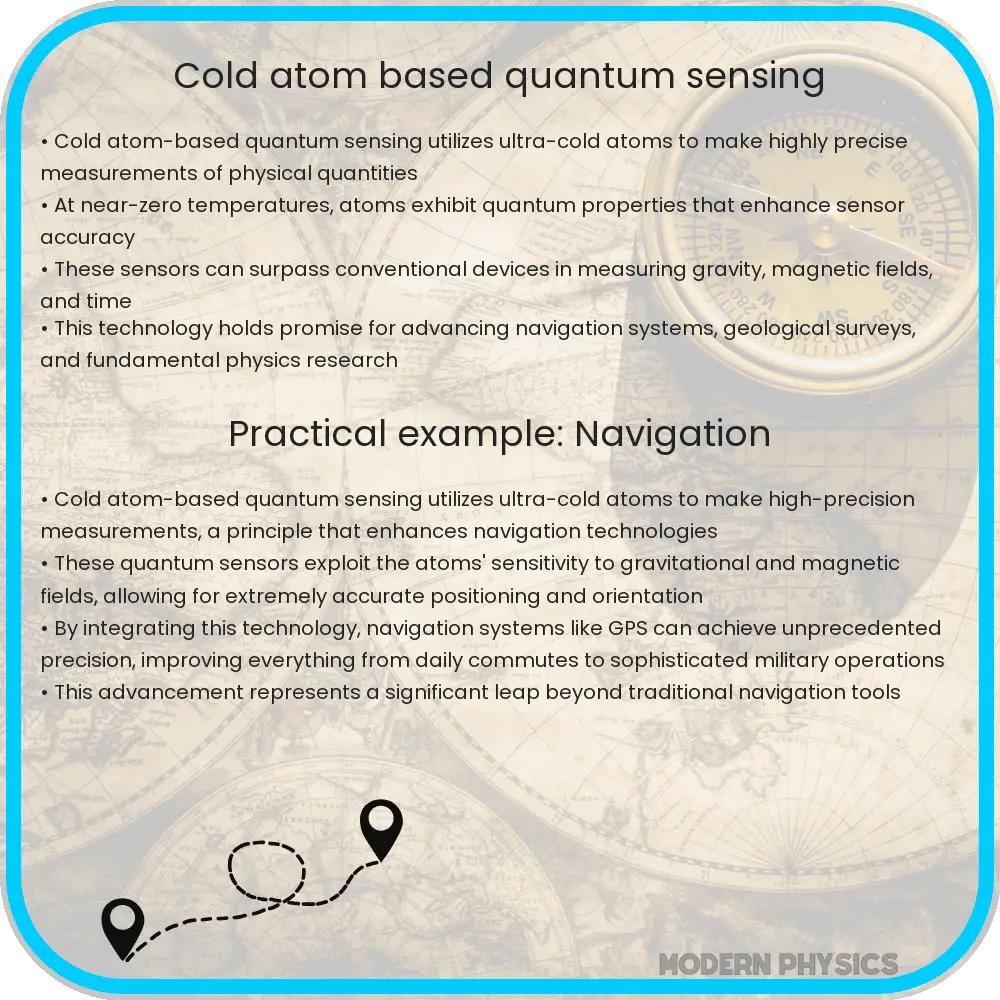
Cold atom quantum sensing utilizes ultracold atoms near absolute zero to measure quantum properties with high precision.
Introduction to Cold Atom Quantum Sensing
Quantum sensing represents one of the most promising frontier technologies, leveraging the principles of quantum mechanics to achieve ultra-sensitive measurements. Cold atom quantum sensing, in particular, uses atoms cooled to near absolute zero temperatures, allowing for precise control and measurement of their quantum properties. This article explores the basics of cold atom quantum sensing and highlights some of its major applications.
What are Cold Atoms?
Atoms are typically in constant motion, with their electrons buzzing around in random orbits. However, when these atoms are cooled to near absolute zero (approximately -273.15 degrees Celsius or zero Kelvin), they reach a state known as ‘ultracold’. At these extreme temperatures, atomic motion nearly halts and quantum phenomena like superposition and entanglement become more apparent and manipulable.
Techniques for Cooling Atoms
The primary method for cooling atoms is laser cooling, which involves the use of precisely tuned laser beams to counteract the momentum of atoms, effectively reducing their thermal motion. Another method, evaporative cooling, further cools the atoms by selectively removing the hottest atoms from a trap, allowing the remaining atoms to cool down even more. The combination of these techniques allows scientists to reach temperatures just a few billionths of a Kelvin above absolute zero.
Basics of Quantum Sensing with Cold Atoms
Quantum sensing with cold atoms exploits the quantum properties of these ultracold atoms for measurement purposes. One key feature of these systems is their sensitivity to very small changes in physical quantities like magnetic fields, time, acceleration, and gravitational forces. This is achieved by placing the cold atoms in a quantum superposition state, where they can exist in multiple states simultaneously.
This superposition state is highly sensitive to external influences, which lead to measurable changes in the quantum state of the atoms. By observing these changes, quantum sensors can detect variations in the environment or physical phenomena with unprecedented precision.
Key Technologies and Components
Cold atom quantum sensors are composed of several crucial technologies:
- Atom Traps: Devices that confine ultracold atoms in a small region of space using electromagnetic fields or optical cavities, enabling precise measurements.
- Laser Systems: Used not only for cooling but also for manipulating and probing the quantum states of the atoms during experiments.
- Quantum Interferometers: Instrumental in measuring the wave-like properties of atoms. They can reveal the effect of external forces on the superpositioned states of the atoms.
Applications of Cold Atom Quantum Sensing
The ultra-sensitive nature of cold atom quantum sensors makes them ideal for a variety of applications:
- Precision Timekeeping: Quantum atomic clocks use the oscillations of ultracold atoms as a reference, which could lead to more accurate GPS and global synchronization systems.
- Gravitational Mapping: These sensors can detect minute changes in gravitational force, useful for mineral exploration, underground mapping, and infrastructure monitoring.
- Space Research: In space, the reduced interference improves the accuracy of quantum sensors, aiding in studies of fundamental physics and space exploration.
Challenges and Future Prospects
Despite their impressive capabilities, cold atom quantum sensors face several challenges:
- Technical Complexity: The technology requires sophisticated equipment and extreme conditions that are difficult and expensive to maintain.
- Miniaturization: Developing smaller, portable quantum sensors that can be used in everyday applications remains a significant engineering challenge.
- Sensitivity to Disturbances: The high sensitivity of quantum sensors can also be a drawback, as they can be disturbed by minor environmental variations, requiring careful isolation and calibration.
Forthcoming advances in quantum computing and materials science may soon overcome these obstacles, leading to more robust and accessible cold atom quantum sensing technologies.
Conclusion
Cold atom quantum sensing is a cutting-edge technology that stands on the forefront of science and engineering. By utilizing ultracold atoms, researchers are able to explore and measure quantum phenomena with precision that was unimaginable just a few decades ago. From improving how we measure time to reshaping our understanding of gravitational forces, the applications of this technology are vast and varied. Though challenges remain in terms of technical complexity and practical implementation, the potential to significantly impact science, technology, and everyday life makes the pursuit of advancements in cold atom quantum sensing both exciting and essential. As researchers continue to innovate, we may see these quantum sensors become a fundamental part of modern technology, offering more precise and reliable data across a range of fields.