
Explore the cutting-edge technology of Quantum Cascade Lasers (QCLs), their operation, advantages, and diverse applications in environmental monitoring, healthcare, and security.
Understanding Quantum Cascade Lasers
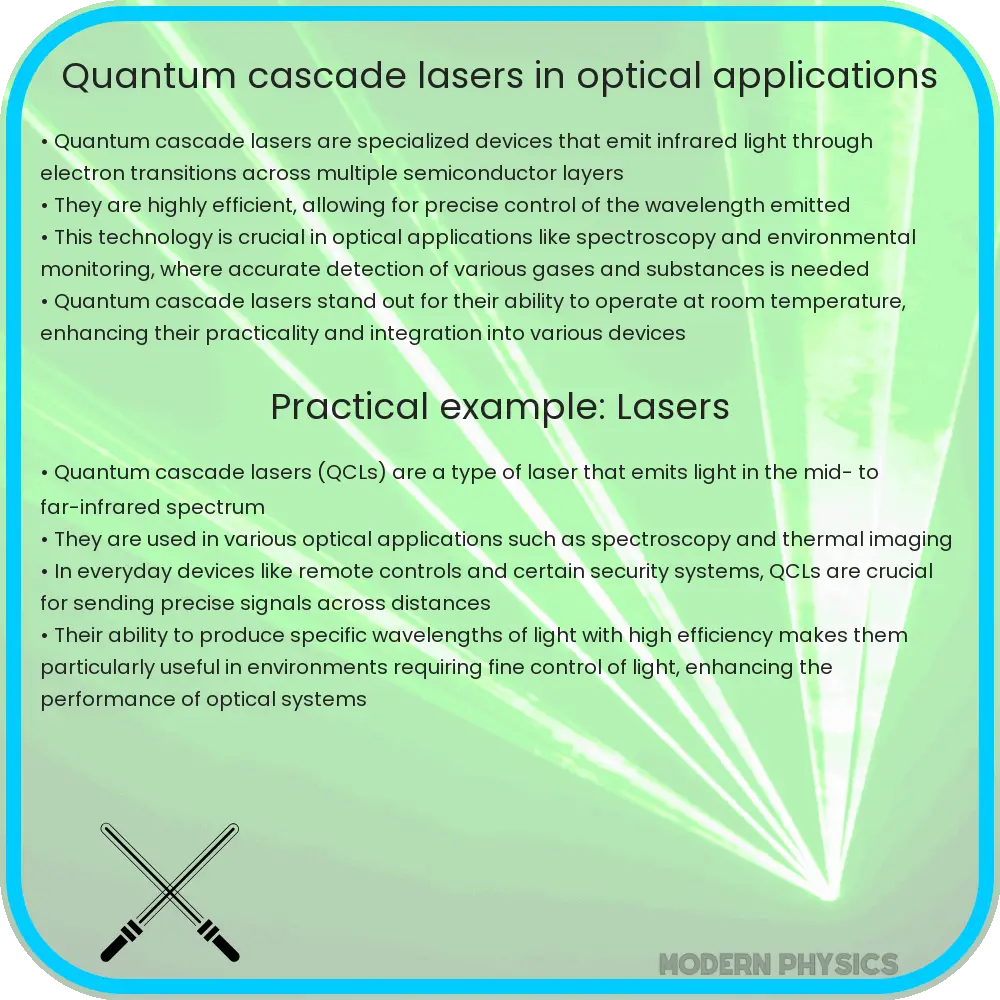
Quantum Cascade Lasers (QCLs) represent a significant advancement in laser technology, emphasizing precision, efficiency, and innovation. Unlike conventional lasers, which rely on the electronic transitions between different energy levels of atoms or molecules, QCLs function based on intersubband transitions within the quantum wells of a semiconductor structure. This unique mechanism enables them to operate at mid-infrared to terahertz frequencies, opening up new avenues for various applications.
Core Principles and Operation
The heart of a Quantum Cascade Laser lies in its active region, which consists of a series of quantum wells and barriers, meticulously engineered at the nanoscale. Electrons traverse through this layered structure, emitting photons at each step, a process facilitated by the cascade effect. This design allows QCLs to achieve high power output and efficiency, as the electron can emit multiple photons during its passage through the active layers.
Key Advantages of QCLs
- Precision: QCLs offer exceptional spectral purity and tunability, making them ideal for precision applications such as spectroscopic sensing, where accurate detection of chemical signatures is crucial.
- Efficiency: These lasers are designed for high quantum efficiency, meaning a larger proportion of electrical energy is converted into laser light, reducing energy consumption.
- Versatility: The ability to operate across a wide range of temperatures and wavelengths makes QCLs adaptable to various environments and applications.
Applications of Quantum Cascade Lasers
Due to their unique properties, QCLs have found applications in a multitude of fields. They are pivotal in environmental monitoring, enabling the detection of pollutants and greenhouse gases with high precision. In healthcare, QCLs contribute to non-invasive medical diagnostics, offering new methodologies in breath analysis and tissue examination. Additionally, their high-resolution capabilities are invaluable in security and defense for explosive or hazardous chemical detection.
Understanding the principles and advantages of Quantum Cascade Lasers opens the door to appreciating their impact on technology and innovation. Their precision, efficiency, and versatility make them a cornerstone in the advancement of modern laser applications.
Technological Innovations and Future Prospects
Quantum Cascade Lasers are at the forefront of technological innovation, constantly evolving to meet the demands of modern applications. Advancements in QCL technology have led to the development of smaller, more portable devices, expanding their utility beyond laboratory settings into field applications. Furthermore, ongoing research aims to enhance the performance of QCLs, focusing on increasing their power output, efficiency, and wavelength range, which could unlock new applications in various industries.
Challenges and Solutions
Despite their numerous advantages, QCLs face certain challenges. The complexity of their design and the need for precise temperature control can increase the cost and complexity of these laser systems. However, advancements in semiconductor fabrication and thermal management technologies are addressing these issues, making QCLs more accessible and practical for a broader range of applications. Additionally, ongoing research is dedicated to optimizing the quantum well structures and improving the overall design to enhance the lasers’ performance and reliability.
Environmental and Economic Impact
Quantum Cascade Lasers have a significant impact not only technologically but also environmentally and economically. Their ability to detect and analyze various gases with high precision makes them invaluable tools in combating pollution and climate change. By enabling efficient monitoring and management of environmental pollutants, QCLs contribute to the development of more sustainable practices. Economically, the increased efficiency and precision of QCLs can lead to cost savings in industrial processes, medical diagnostics, and security measures, showcasing their potential to drive innovation and growth in multiple sectors.
Conclusion
In conclusion, Quantum Cascade Lasers are a paradigm of precision, efficiency, and innovation in the field of laser technology. With their unique operating principles and diverse applications, they have significantly contributed to advancements in environmental monitoring, healthcare, security, and beyond. Despite facing certain challenges, continuous improvements and research are paving the way for more accessible, powerful, and versatile QCLs. As technology progresses, Quantum Cascade Lasers are set to play an increasingly vital role in shaping the future of various industries, highlighting the importance of investing in and understanding this cutting-edge technology.