
Explore the intriguing world of pulsars and their role in understanding relativity, gravity, time warps, and gravitational waves in astrophysics.
Pulsars: Beacons in the Cosmos
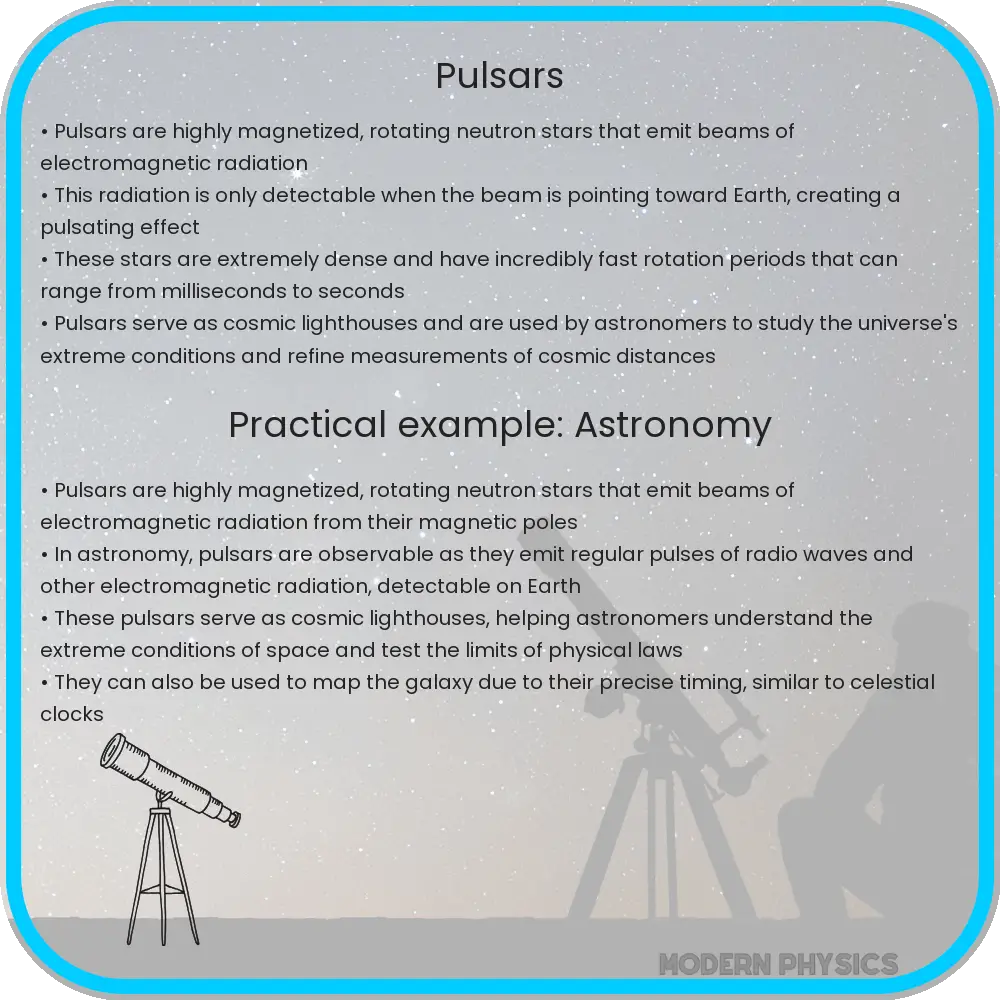
Among the most fascinating phenomena in the universe are pulsars, rapidly spinning neutron stars that emit beams of electromagnetic radiation. These celestial objects, remnants of massive stars that have undergone supernova explosions, are not just exotic in their composition but also serve as laboratories for testing the limits of relativity and understanding the nature of gravity and time warps.
Understanding Pulsars
Pulsars are essentially neutron stars, which are the dense cores left behind after a supernova. They pack about 1.4 times the mass of our Sun into a sphere the size of a city, resulting in incredibly dense matter. A teaspoon of pulsar material would weigh billions of tons! Pulsars are named for their pulsating nature: as they rotate, their magnetic poles, emitting beams of radiation, sweep across the Earth, creating a lighthouse-like effect that is observed as pulses.
Relativity and Pulsars
Albert Einstein’s theory of General Relativity, which describes gravity as the warping of spacetime by mass and energy, finds a testing ground in pulsars. The extreme gravity of these dense objects provides an ideal environment to observe relativistic effects, such as gravitational redshift and time dilation. Pulsars in binary systems, especially those orbiting another neutron star or a black hole, allow astrophysicists to study these phenomena in detail.
Gravity’s Laboratory
The intense gravitational field of pulsars has profound effects on their surroundings and on our observations of them. For instance, the gravitational pull is so strong that it can significantly bend the path of light around the star. This bending of light, predicted by relativity, has been observed in several pulsars. Moreover, pulsars with a companion star offer a unique opportunity to study the effects of gravity in a high-energy context, including the potential emission of gravitational waves.
Time Warps and Pulsars
Time behaves differently in the strong gravitational field of a pulsar, a phenomenon known as time dilation. According to Einstein’s theory, time slows down near a massive object. This effect, while minute in most circumstances, becomes significant around pulsars. Precision timing of pulsar signals allows scientists to measure this time warping effect, contributing valuable data to test the predictions of relativity.
In summary, pulsars are not just extraordinary cosmic beacons but also crucial tools in probing the fundamental laws of physics. Their study illuminates the intricacies of gravity, time, and the very fabric of spacetime.
Is this conversation helpful so far?
The Role of Pulsars in Gravitational Wave Astronomy
One of the most groundbreaking areas in astrophysics is gravitational wave astronomy. Pulsars, particularly those in binary systems, play a pivotal role in this field. When two massive objects, like neutron stars or black holes, orbit each other, they can produce ripples in spacetime known as gravitational waves. These waves, first detected directly by LIGO (Laser Interferometer Gravitational-Wave Observatory) in 2015, confirmed a major prediction of Einstein’s General Relativity. Pulsars in binary systems are potential sources of such waves, and their observation could provide deeper insights into the nature of gravity and spacetime.
Pulsars and the Search for Exoplanets
Beyond the realms of gravity and relativity, pulsars also contribute to the search for exoplanets. The first exoplanets were actually discovered orbiting a pulsar, PSR B1257+12, in 1992. The incredibly regular pulsations of pulsars allow for the detection of minute anomalies caused by orbiting bodies, making them effective tools for discovering planets beyond our solar system.
Challenges and Future Prospects
Despite their utility, studying pulsars is not without challenges. Their immense distances and faint signals require highly sensitive equipment and sophisticated data analysis techniques. Future developments in radio astronomy, like the Square Kilometre Array (SKA), promise to revolutionize our understanding of pulsars. This international project aims to build the world’s largest radio telescope, with a collecting area of one square kilometer, providing unprecedented insights into pulsars and the fundamental laws of physics.
Conclusion
In conclusion, pulsars serve as cosmic lighthouses guiding us through the uncharted territories of astrophysics. They are not only fascinating objects in their own right but also invaluable tools for testing the limits of Einstein’s theory of relativity, exploring the nature of gravity and time, and even aiding in the search for exoplanets. As we continue to develop more advanced astronomical instruments, the mysteries unveiled by these spinning neutron stars promise to deepen our understanding of the universe and its fundamental laws. In the grand tapestry of the cosmos, pulsars shine brightly, offering a glimpse into the extraordinary workings of the universe.