
Explore the mystery of Hawking Radiation, a phenomenon linking quantum mechanics and relativity, and its impact on our understanding of black holes.
The Enigma of Hawking Radiation: Uniting Relativity and Quantum Theory
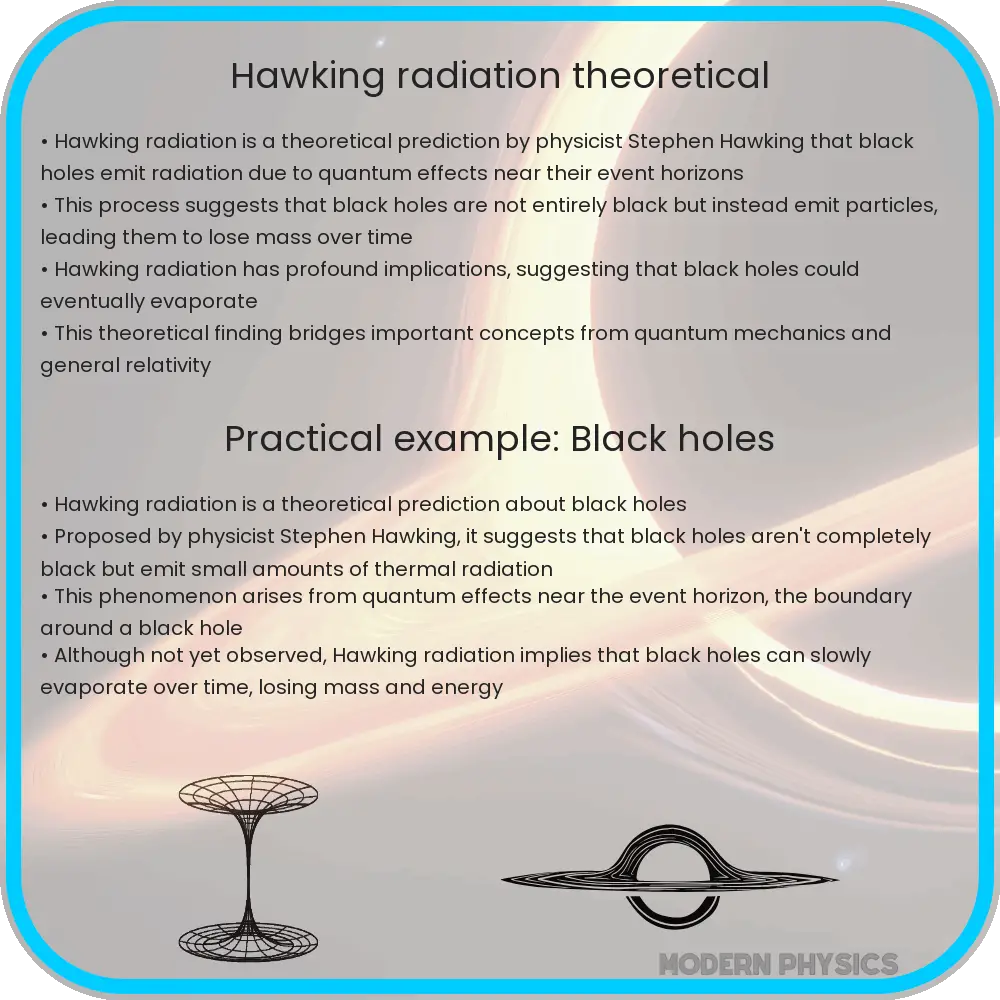
At the intriguing crossroads of quantum mechanics and general relativity lies one of the most fascinating phenomena in theoretical physics: Hawking Radiation. Named after the renowned physicist Stephen Hawking, who first proposed this concept in 1974, Hawking Radiation offers a window into the complex and often paradoxical nature of black holes.
Black holes, those mysterious cosmic entities, have long been envisioned as regions of space where gravity is so overpoweringly strong that nothing, not even light, can escape. This perception aligns with Einstein’s theory of general relativity, which describes how mass warps spacetime. However, Hawking’s groundbreaking work introduced a quantum twist to this narrative, suggesting that black holes are not the perfect absorbers they were once thought to be.
Hawking’s theory revolutionized our understanding by integrating quantum mechanics, the fundamental theory in physics that explains the behavior of particles at the smallest scales. It hinges on the concept of “virtual particle pairs” frequently popping into existence in the vacuum of space, as predicted by quantum theory. Typically, these particles and their antiparticle counterparts annihilate each other almost instantaneously. However, near a black hole’s event horizon, something extraordinary occurs: one particle might fall into the black hole while the other escapes, resulting in what we perceive as radiation emitted from the black hole.
This radiation is not just a theoretical curiosity. It has profound implications for the fate of black holes and the nature of information in the universe. According to Hawking’s theory, black holes can slowly lose mass and energy over time through this radiation, eventually evaporating completely. This process challenges the notion that information entering a black hole is lost forever, a subject of intense debate among physicists.
The concept of Hawking Radiation stands at the confluence of two pillars of modern physics—quantum theory and general relativity. Its existence, still to be directly observed, raises fundamental questions about the nature of black holes, the limits of scientific knowledge, and the ultimate reconciliation of the theories that govern the cosmos.
Delving deeper into this subject, we explore the scientific basis of Hawking Radiation and its implications for our understanding of the universe.
The Scientific Basis and Implications of Hawking Radiation
Understanding Hawking Radiation requires delving into the quantum realm. According to quantum field theory, the vacuum of space is not a complete void but teems with transient ‘virtual particles’ that constantly form and annihilate in pairs. These particles exist fleetingly, borrowing energy from the vacuum to materialize, but must repay this energy quickly by annihilating with their antiparticle counterparts. Near a black hole, however, Hawking theorized that the intense gravitational pull could separate these pairs, with one particle captured by the black hole and the other escaping into space. This escapee appears to an observer as radiation emanating from the black hole, hence the term ‘Hawking Radiation’.
The radiation’s existence has significant implications for our understanding of thermodynamics in extreme environments. It suggests that black holes have a temperature and, by extension, entropy. This concept was a radical departure from the traditional view of black holes as entropy-less entities and has led to the formulation of the black hole information paradox. This paradox revolves around the question of whether information about matter that falls into a black hole is preserved or destroyed, challenging the fundamental principles of quantum mechanics.
Despite its theoretical acceptance, Hawking Radiation remains elusive in observational astrophysics. The primary challenge lies in its extremely weak nature, making it incredibly difficult to detect against the cosmic background. However, advances in observational technology and methods may soon provide indirect evidence or even direct observation of this phenomenon.
Hawking Radiation also points towards a possible resolution of the black hole information paradox. If information is encoded in the radiation, as some theories suggest, it could mean that information is not lost but rather transformed and emitted back into the universe. This concept is a cornerstone in the ongoing quest to unify quantum mechanics and general relativity into a single coherent theory of quantum gravity.
Conclusion
In summary, Hawking Radiation represents more than just a theoretical prediction; it is a crucial bridge between the worlds of quantum mechanics and general relativity. It challenges our understanding of fundamental concepts like entropy, information, and the nature of black holes. While still awaiting direct empirical validation, its implications extend far beyond astrophysics, potentially guiding us towards a new understanding of the universe’s deepest secrets. As research progresses, Hawking Radiation continues to stand as a testament to the enduring power of human curiosity and the unending quest to understand the cosmos.