
Explore the enigmatic world of pulsars and their role in testing general relativity, revealing mysteries of space-time and gravitational waves.
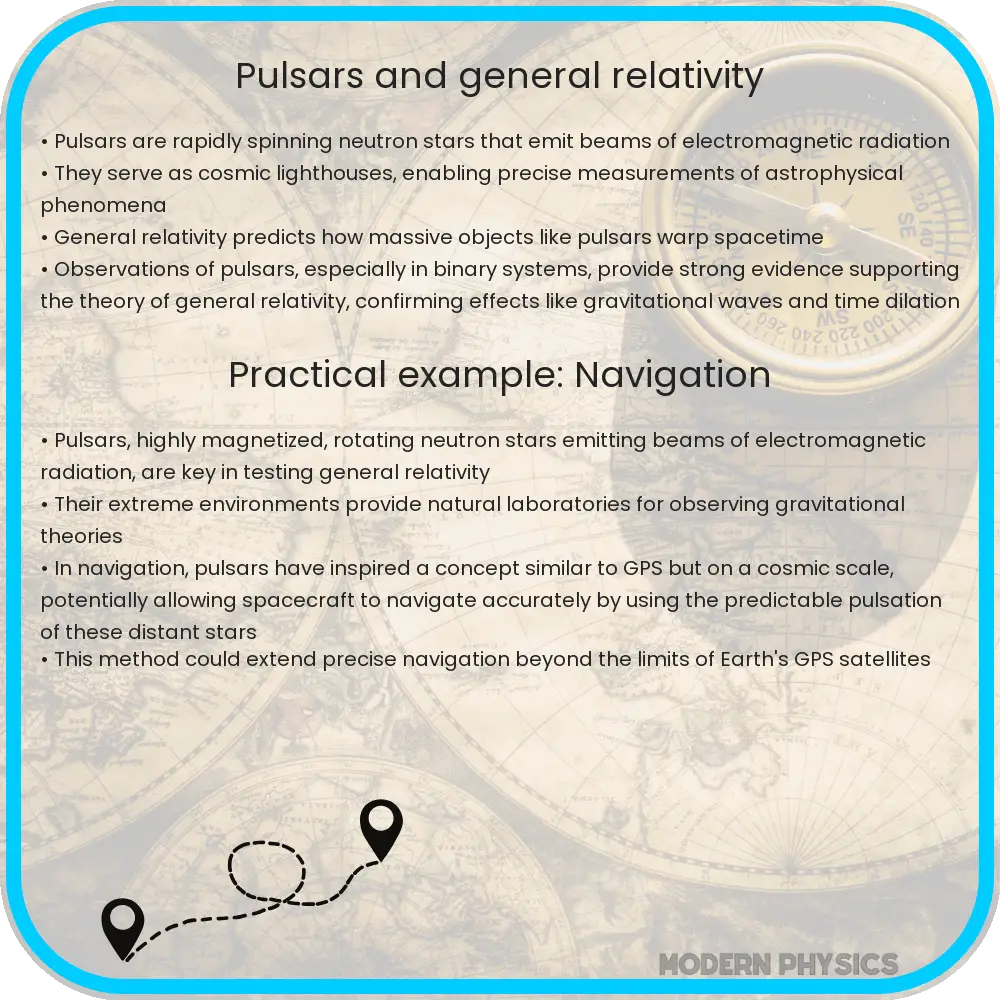
Pulsars: Beacons in the Cosmos
Pulsars, the rapidly spinning neutron stars, are some of the most enigmatic and powerful entities in our universe. Born from the explosive deaths of massive stars, these stellar remnants are not only fascinating in their own right but also serve as natural laboratories for testing the theories of general relativity. In this exploration, we delve into the mysteries of pulsars and their profound implications in understanding space-time.
Unraveling the Nature of Pulsars
Pulsars are essentially neutron stars, the dense cores left behind after a supernova explosion. These stellar remnants are incredibly dense, with a mass greater than that of the Sun compressed into a sphere just tens of kilometers in diameter. What sets pulsars apart is their rapid rotation, often completing a spin in mere milliseconds. This rotation, combined with intense magnetic fields, emits beams of electromagnetic radiation from their magnetic poles. As these beams sweep across Earth, they are observed as pulses of radiation, hence the name ‘pulsar’.
Pulsars and General Relativity
The extreme conditions present in and around pulsars provide an unparalleled testing ground for Einstein’s theory of general relativity. This theory, which describes gravity as the curvature of space-time caused by mass, predicts several phenomena that can be observed in the vicinity of these dense stars. For instance, the strong gravitational fields of pulsars can cause the bending of light, a phenomenon known as gravitational lensing. Moreover, the intense gravity near pulsars can significantly alter the flow of time, a concept known as gravitational time dilation.
Decoding the Signals from Pulsars
The regular pulsations emitted by pulsars make them excellent cosmic clocks. By precisely timing these pulses, astronomers can detect minute changes in a pulsar’s rotation. Such changes can reveal a wealth of information, including the presence of planets orbiting the pulsar, or even subtle effects of gravitational waves as predicted by general relativity. This makes pulsars not only fascinating objects in their own right but also valuable tools for probing the nature of gravity and space-time.
In the upcoming sections, we will explore how the study of pulsars has led to groundbreaking discoveries in astrophysics and how these celestial phenomena continue to challenge and expand our understanding of the universe.
Is this conversation helpful so far?
Probing Space-Time with Pulsars
The study of pulsars has significantly advanced our understanding of space-time. One of the most groundbreaking discoveries is the indirect evidence of gravitational waves. The 1993 Nobel Prize in Physics was awarded to Russell Hulse and Joseph Taylor for their discovery of a binary pulsar system, which exhibited orbital decay consistent with the emission of gravitational waves as predicted by general relativity. This discovery was a monumental validation of Einstein’s theory, providing evidence for these ripples in space-time long before their direct detection in 2015.
Pulsars: Cosmic Navigational Aids
Apart from their scientific importance, pulsars have practical applications. Their consistent pulsations can be used for navigational purposes. Just as mariners once used stars to navigate the seas, future spacecraft could use pulsar signals as a galactic GPS to determine their position in space. This concept has been demonstrated by the X-ray pulsar-based navigation (XNAV) system, which utilizes the predictable timing of X-ray pulses from pulsars to accurately navigate spacecraft.
Challenges and Future Prospects
Despite their utility, studying pulsars is not without challenges. Their signals can be affected by interstellar matter, requiring sophisticated techniques to accurately interpret their pulses. Furthermore, as our understanding of pulsars evolves, they continue to pose new questions about matter under extreme conditions, the nature of gravity, and the evolution of stars. Future telescopes, like the Square Kilometre Array, are expected to discover thousands more pulsars, further enhancing our understanding of these fascinating objects.
Conclusion
Pulsars, once mere curiosities in the sky, have emerged as key players in astrophysics and general relativity. They have provided direct tests of gravitational theories, offered insights into the extreme states of matter, and have even found applications in space navigation. As we continue to decode their signals, pulsars stand as beacons in our quest to understand the cosmos. In their pulses lies not just the echoes of stellar catastrophes but also the keys to unlocking some of the most profound mysteries of space-time.