
Explore the mysteries of neutron stars, their incredible densities, and rapid rotations, revealing the extreme conditions and fundamental physics of the cosmos.
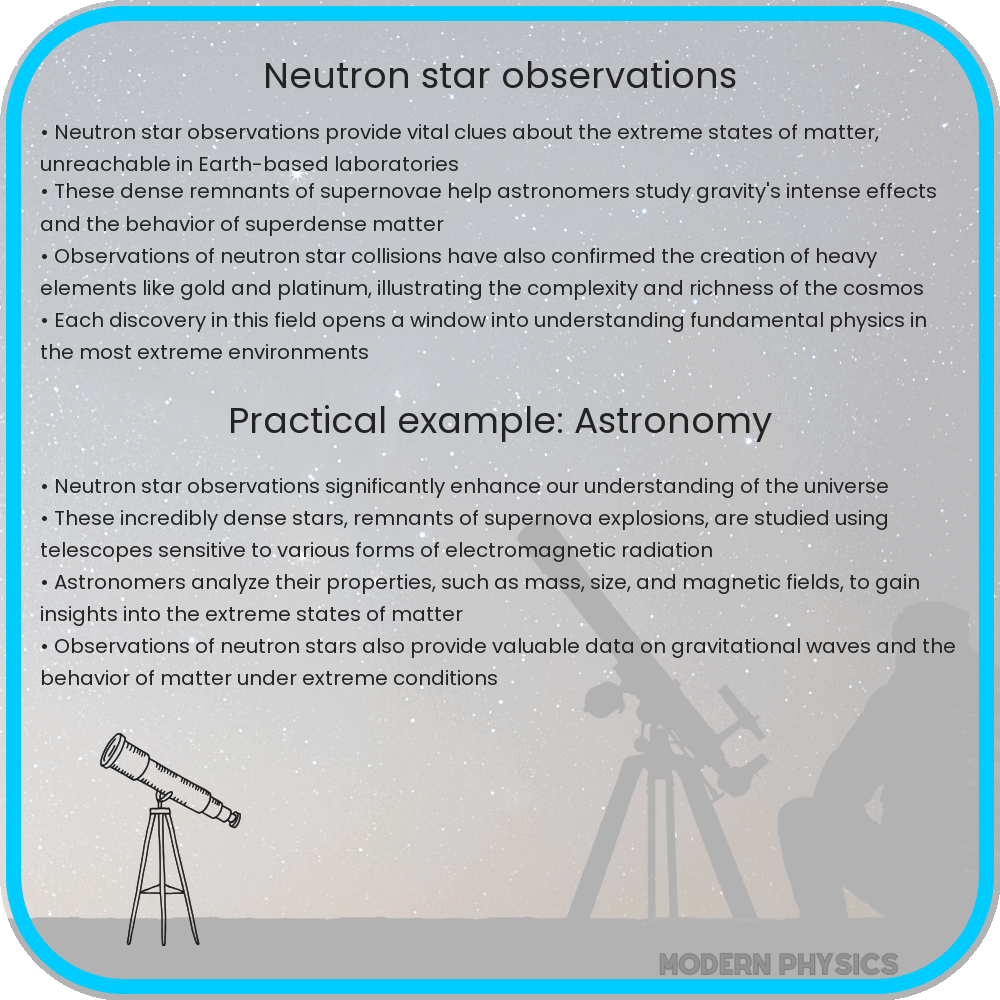
Unveiling the Enigma: Neutron Star Observations
Neutron stars, the dense remnants of massive stars after a supernova explosion, remain one of the universe’s most enigmatic phenomena. These celestial bodies pack a sun’s mass into a city-sized sphere, making them the densest objects known, aside from black holes. Observations and studies of neutron stars provide crucial insights into their mysteries, densities, and rapid rotation rates.
The Enigmatic Nature of Neutron Stars
Neutron stars originate from the gravitational collapse of massive stars that have exhausted their nuclear fuel. This catastrophic event leads to a supernova, leaving behind a core so dense that protons and electrons merge into neutrons. Despite their small size, typically about 20 kilometers in diameter, neutron stars possess gravitational fields billions of times stronger than Earth’s. Their extreme conditions challenge our understanding of physics, combining quantum mechanics, particle physics, and relativity.
The Astonishing Density
The density of neutron stars is almost unfathomable. A sugar-cube-sized amount of neutron-star material would weigh as much as all humanity combined. This incredible density arises from the neutrons being packed so tightly that the material becomes degenerate matter, a state where traditional atomic structures no longer exist. The physics of such conditions is still a subject of intense research and debate.
The Phenomenon of Rapid Rotation
Neutron stars are not only remarkable for their density but also for their rapid rotation rates. Some neutron stars, known as pulsars, emit beams of radiation that sweep through space as the star rotates. Observing these pulses allows astronomers to measure the rotation rates, which can be as fast as hundreds of times per second. This rapid spinning is a relic of the angular momentum of the original star, conserved and amplified as it collapsed into a much smaller object.
Mysteries Unraveled and Unanswered
While observations of neutron stars have answered many questions, they also pose new ones. For instance, the precise mechanism of supernova explosions and the exact state of matter within a neutron star remain largely unknown. Additionally, the recent detection of gravitational waves from neutron star collisions opens new avenues for understanding these dense objects and the universe’s extreme conditions.
Advancements in Neutron Star Research
Recent technological advancements have significantly enhanced our ability to observe and understand neutron stars. High-precision telescopes, both ground-based and in orbit, have allowed astronomers to detect and study these stars in unprecedented detail. The Neutron Star Interior Composition Explorer (NICER) aboard the International Space Station, for instance, provides insights into the internal structure of neutron stars by measuring their X-ray emissions. Such observations help scientists test theories of matter under extreme densities and temperatures.
Impact of Neutron Stars on Astrophysics
The study of neutron stars has profound implications for various areas of astrophysics. By understanding these dense objects, scientists gain insights into the life cycles of stars, the dynamics of supernovae, and the behavior of matter under extreme conditions. Neutron stars also serve as natural laboratories for studying fundamental physics, including theories of gravity and the behavior of subatomic particles at high densities.
Challenges and Future Perspectives
Despite significant progress, the study of neutron stars faces numerous challenges. One of the primary difficulties is the extreme environment surrounding these stars, which can obscure or distort observations. Furthermore, the theoretical models that describe neutron stars involve complex physics that is not yet fully understood. As researchers continue to refine these models and develop new observational techniques, our understanding of neutron stars is expected to grow.
Future missions and telescopes, such as the Square Kilometre Array (SKA), are poised to revolutionize our understanding of neutron stars. These new tools will enable more detailed observations of pulsars and potentially discover new types of neutron stars, further expanding our knowledge of the universe’s extreme conditions.
Conclusion
Neutron stars, with their extreme densities, rapid rotations, and powerful magnetic fields, continue to be at the forefront of astrophysical research. They challenge our understanding of physics, offering a glimpse into the conditions that exist nowhere else in the universe. As observational techniques improve and theoretical models advance, the mysteries of neutron stars gradually unfold, providing deeper insights into the cosmos’s workings. The future of neutron star research promises not only to unveil more about these fascinating objects but also to shed light on the broader mysteries of the universe, from the nature of matter to the fundamental forces that govern reality.