
Exploring the Prandtl-Glauert singularity in aerodynamics, examining its causes, effects, and the mathematical framework surrounding it.
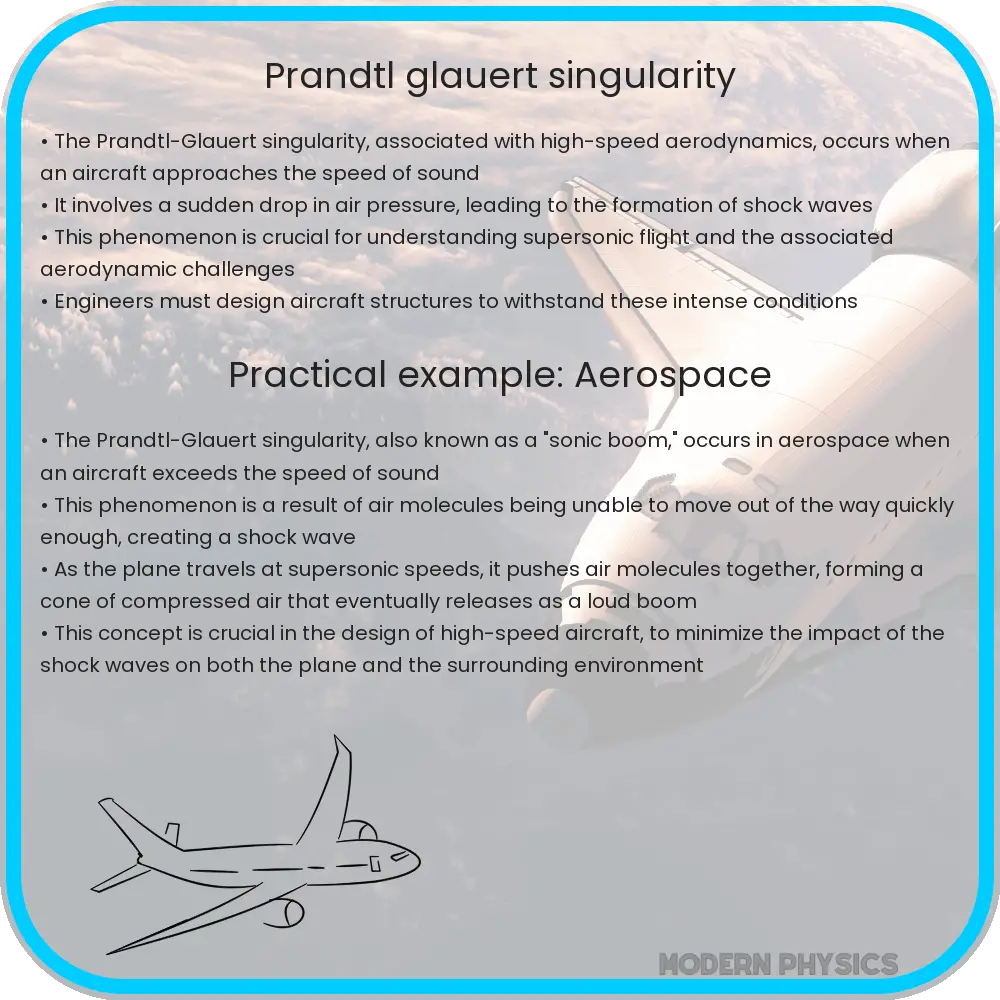
Understanding the Prandtl-Glauert Singularity
The Prandtl-Glauert singularity, often mentioned in the realms of aerodynamics and hydrodynamics, represents a fascinating phenomenon where certain peculiarities arise due to the effects of compressibility in fluid flow around an object. As objects move through a fluid close to the speed of sound, some unique and complex behaviors are observed, which are intrinsically linked to the compressibility effects described by the Prandtl-Glauert rule. This article aims to shed light on the causes, effects, and analytical approaches to understanding this singularity in hydrodynamics.
Causes of the Prandtl-Glauert Singularity
The primary cause of the Prandtl-Glauert singularity is the rapid change in air pressure and density that occurs when an object approaches the speed of sound in a fluid medium, typically air. According to the Prandtl-Glauert theory, as the speed of the object nears the sonic condition, marked by the Mach number (M) approaching 1, where Mach number is defined as:
M = v/a
Here, v is the velocity of the object and a is the speed of sound in the medium.
Under these conditions, the air pressure around the object decreases significantly, leading to a rapid compression of air molecules. This phenomenon is explained through the Prandtl-Glauert transformation, a mathematical tool designed to correct the predictions of aerodynamic coefficients, which were initially based on incompressible flow models.
Effects of the Prandtl-Glauert Singularity
One of the most visually striking effects of the Prandtl-Glauert singularity is the appearance of a visible condensation cloud around the object. This cloud forms due to the abrupt drop in air pressure and temperature around the object, leading to condensation of the moisture in the air. Additionally, the approach to this singularity can have several practical implications in aerodynamics and hydrodynamics, including:
- Shock Waves: As the speed of the object approaches the speed of sound, shock waves can form, which are characterized by sudden changes in pressure, temperature, and air density. These shock waves can cause significant aerodynamic drag and even structural damage to vehicles, such as aircraft.
- Aerodynamic Noise: Increased noise results from the shock waves that radiate away from the object, which can be a concern in populated areas or in the context of noise pollution regulations.
- Control Surface Ineffectiveness: Near the speed of sound, the effectiveness of control surfaces, such as the rudder or ailerons on an aircraft, can be reduced due to changes in the airflow patterns caused by shock waves and expanding boundary layers.
Analysis in Hydrodynamics
Understanding and predicting the Prandtl-Glauert singularity is critical in designing aerodynamic and hydrodynamic vehicles. Engineers use computational fluid dynamics (CFD) simulations extensively to model the complex interactions of the fluid dynamics near the singularity. These simulations help anticipate the formation of shock waves and optimize the shape and materials of the object to minimize adverse effects.
Mathematically, the Prandtl-Glauert rule can be expressed as:
P2 = P1sqrt(1 – M2)
where P1 is the initial pressure and P2 is the modified pressure taking into account the Mach number effects. This equation helps to understand how pressure variations manifest as an object approaches the speed of sound, predicting where singularities might occur and allowing for measures to mitigate potential issues.
Practical Applications and Challenges
The understanding of the Prandtl-Glauert singularity has profound implications in various fields of engineering and science, especially in the design and operation of high-speed vehicles, such as aircraft and spacecraft. Engineers need to carefully consider these effects when designing aircraft fuselages, wings, and propulsion systems:
- Vehicle Design: Aircraft and spacecraft must be designed with materials and structures that can withstand the intense forces and temperature fluctuations associated with nearing or surpassing the speed of sound.
- Route and Flight Planning: Pilots and flight planners must be aware of the speed at which their vehicle approaches the sound barrier to avoid unintended consequences, such as shock waves impacting nearby structures or vehicles.
- Safety Protocols: Understanding the Prandtl-Glauert singularity aids in developing safety protocols that ensure the integrity of the vehicle and safety of the crew and passengers.
Despite these advancements, the dynamic and unpredictable nature of supersonic flight poses ongoing challenges. Real-world testing and continuous refinement of computational models are necessary to enhance safety and efficiency.
Conclusion
The Prandtl-Glauert singularity, representing a key concept in aerodynamics and hydrodynamics, offers both fascinating scientific insight and significant practical challenges. As technology advances, our understanding of this phenomenon continues to evolve, enhancing the safety and performance of high-speed vehicles. By integrating theoretical knowledge with practical engineering, we can continue to push the boundaries of what is possible in aerodynamics and beyond. Moreover, further research and innovation in this area remain crucial for future aerospace achievements and for overcoming the inherent challenges posed by the singularity. Engaging with these complex theoretical concepts not only propels the development of engineering but also enriches our understanding of the natural world.