
Explore the Prandtl-Glauert Singularity in aerodynamics: understanding shock waves, airflow dynamics, and speed limits in high-speed aviation.
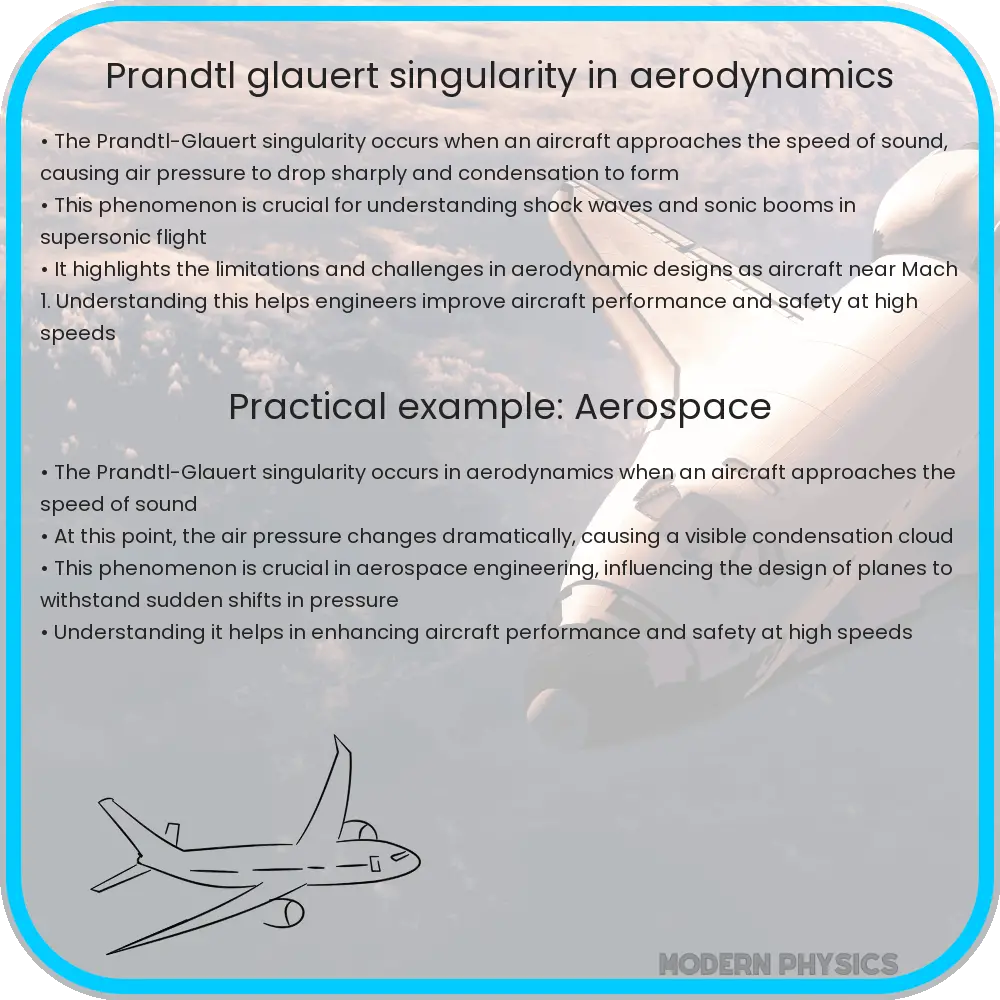
Understanding the Prandtl-Glauert Singularity and Its Implications in Aerospace Engineering
The Prandtl-Glauert Singularity represents a pivotal concept in the field of aerodynamics, particularly relevant to high-speed aircraft design. This phenomenon arises under specific conditions when an aircraft approaches the speed of sound, leading to the formation of shock waves and significant changes in airflow characteristics.
Exploring the Basics of Shock Waves and Airflow
Shock waves are rapid pressure changes in a fluid medium like air, which occur when an object moves through the medium at a speed greater than the sound’s speed in that medium. In the context of aerodynamics, these waves are critical as they significantly alter the airflow around an aircraft’s surfaces. The fundamental understanding of shock waves is integral to predicting and managing the aerodynamic performance and stability of high-speed aircraft.
At speeds close to the sound barrier, air can no longer move out of the way quickly enough, causing a buildup of pressure waves. These waves coalesce into a single, abrupt shock wave, drastically changing the local air pressure and temperature. This shift can lead to a sudden increase in drag and changes in lift characteristics, which are crucial considerations in aircraft design and operation.
Delving into the Prandtl-Glauert Singularity
The Prandtl-Glauert Singularity refers to a theoretical prediction where, at the exact speed of sound, the airflow’s local speed becomes infinite. This prediction emerges from the Prandtl-Glauert transformation, a method used to approximate the effects of compressibility in subsonic and transonic flows. It’s essential to note, however, that this singularity is a mathematical artifact rather than a physically observable phenomenon. In reality, as an aircraft approaches the speed of sound, other physical effects, such as shock wave formation and air viscosity, become significant and prevent the occurrence of infinite speeds.
This concept has profound implications in aerospace engineering, particularly in the design of transonic aircraft, which operate in speed regimes where both subsonic and supersonic flow conditions coexist. Understanding and managing these effects are crucial for ensuring the efficiency, safety, and performance of such aircraft.
Setting Speed Limits: The Role of the Prandtl-Glauert Singularity
The study of the Prandtl-Glauert Singularity aids in defining the operational limits for aircraft at transonic speeds. It underscores the complexities faced when aircraft transition through the sound barrier, necessitating advanced design considerations to mitigate adverse effects like increased drag and potential structural stresses.
Aircraft designers use this knowledge to develop airframes and control systems capable of handling the abrupt changes in aerodynamic forces encountered at these critical speeds. The insights gained from studying the Prandtl-Glauert Singularity have been instrumental in the advancement of modern high-speed aviation technology.
Advanced Applications and Challenges in High-Speed Aviation
In the realm of high-speed aviation, the implications of the Prandtl-Glauert Singularity extend beyond theoretical understanding to practical applications. Aerospace engineers utilize this concept to innovate design strategies for aircraft that operate near or beyond the speed of sound. These strategies include the use of swept wings, which help delay the onset of shock waves, and specialized materials that can withstand the intense aerodynamic heating and pressure changes associated with transonic and supersonic flight.
Another challenge in high-speed flight is the phenomenon of wave drag. This drag results from the formation of shock waves and represents a significant barrier to aircraft efficiency at high speeds. Understanding the Prandtl-Glauert Singularity helps engineers design more aerodynamically efficient shapes, reducing wave drag and enhancing the overall performance of the aircraft.
Impact on Future Aerospace Developments
The study of the Prandtl-Glauert Singularity and associated aerodynamic phenomena is not only crucial for current aircraft design but also paves the way for future advancements in aerospace technology. It has implications for the development of hypersonic vehicles, which travel at speeds much greater than the speed of sound and face even more extreme aerodynamic challenges. The insights gained from understanding shock wave behavior and transonic aerodynamics are fundamental to overcoming these challenges.
Moreover, this knowledge is instrumental in the pursuit of more sustainable and efficient aviation. By reducing drag and optimizing aerodynamic performance, aircraft can achieve greater fuel efficiency, contributing to the reduction of the aviation industry’s environmental impact.
Conclusion
In summary, the Prandtl-Glauert Singularity is a key concept in the field of aerodynamics, offering critical insights into the behavior of airflow and shock waves at high speeds. While it represents a theoretical limit, its study provides practical benefits in aircraft design, particularly in transonic and supersonic regimes. The challenges and solutions it presents continue to drive innovations in aerospace engineering, influencing the development of faster, more efficient, and more capable aircraft. As we look towards the future of aviation, the principles underlying the Prandtl-Glauert Singularity will undoubtedly play a pivotal role in shaping the next generation of high-speed air travel.