
A comprehensive exploration of oscillating airfoil theory, elucidating how the movement of airfoil shapes in fluids influences lift and drag forces, integral to advancements in aerospace and renewable energy sectors.
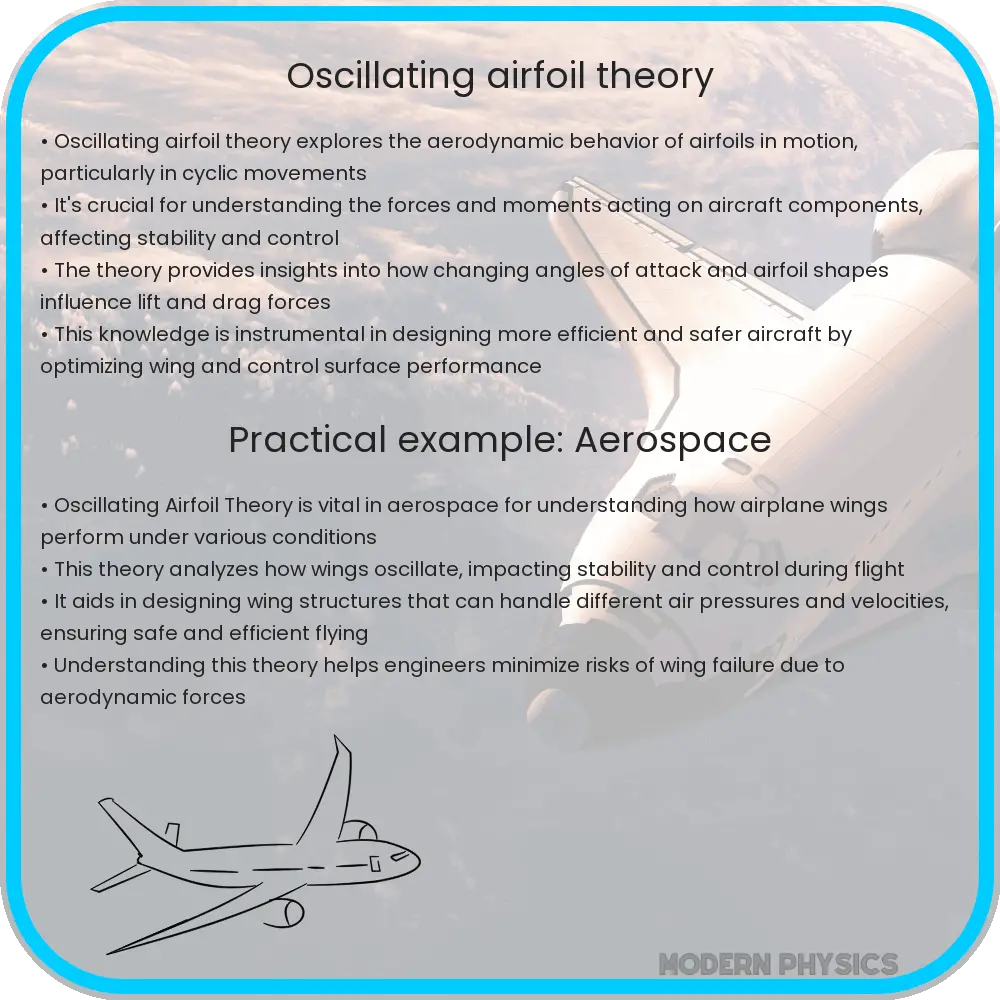
Oscillating Airfoil Theory: Understanding Hydrodynamic Principles
The oscillating airfoil theory is a fascinating topic that bridges the fields of physics and engineering, specifically within hydrodynamics and aerodynamics. This theory explores how the motion of airfoils—components such as blades or wings that have a curved shape—generates forces when they move through a fluid medium like air or water. This exploration is essential for advancing technologies in fields such as renewable energy (wind turbines), aerospace, and even competitive sports like sailing and swimming.
Basics of Oscillating Airfoil Dynamics
An airfoil oscillates when it moves back and forth or rotates within a fluid. The dynamics of this movement are crucial for understanding the lift and drag forces experienced by the airfoil. Lift is the force that acts perpendicular to the direction of flow, and drag acts parallel, opposing the movement. The oscillatory motion can enhance or reduce these forces, depending on the frequency and amplitude of oscillation, as well as the airfoil’s shape and angle of attack.
The fundamental equation describing the forces on an oscillating airfoil in a fluid can be expressed as:
\[ F = \frac{1}{2} * C * \rho * A * V^{2} \]
where:
- F is the force exerted by the fluid on the airfoil.
- C is the coefficient of lift or drag, dependent on the airfoil’s shape and oscillation characteristics.
- ρ (rho) is the density of the fluid.
- A is the area of the airfoil.
- V is the velocity of the fluid relative to the airfoil.
The coefficient \( C \) varies with the angle of attack (defined as the angle between the direction of the fluid flow and the chord of the airfoil) and the oscillation parameters. This variability is typically captured through dynamic fluid simulation studies or empirical testing in wind tunnels or water channels.
Trends in Hydrodynamic Research of Oscillating Airfoils
Recent trends in the study of oscillating airfoils have emphasized enhancing performance and efficiency, particularly in renewable energy applications like wind turbines and tidal energy converters. Researchers are exploring how varying oscillation patterns can maximize energy extraction from natural flows. Additionally, the integration of smart materials into airfoil design is being investigated. These materials can alter their stiffness and damping characteristics in response to changing fluid dynamics, potentially leading to self-optimizing airfoil systems.
Another exciting area of research is the use of bio-inspired design principles. Scientists and engineers study the movements of birds, fish, and marine mammals to understand how nature optimizes oscillation patterns for propulsion and maneuvering. This bio-mimicry approach not only helps improve the design of artificial airfoils but also enriches our understanding of hydrodynamic physics.
Practical Applications and Future Outlook
The practical applications of the oscillating airfoil theory are broad and impactful. In the aerospace industry, understanding and applying this theory helps improve the efficiency and performance of aircraft. By optimizing the oscillation of wing structures, designers can reduce fuel consumption, increase lift, and potentially enhance the maneuverability of aircraft during challenging conditions.
In the field of renewable energy, oscillating airfoils are pivotal in the design of wind turbines and tidal energy converters. By fine-tuning the oscillation parameters, engineers can maximize energy output and extend the lifespan of these devices. This is particularly crucial as the world moves towards more sustainable energy solutions.
The theory is also applied in competitive sports. In swimming, for instance, athletes and coaches analyze the principles of oscillating airfoils to optimize stroke techniques and swimwear designs, aiming to reduce drag and maximize speed and efficiency in the water.
Educational Implications of Airfoil Dynamics
Educationally, the oscillating airfoil theory provides a compelling case study for students in physics and engineering. It encapsulates essential concepts like fluid dynamics, mechanics, and wave motion in a tangible and practical manner. By studying real-world applications, students gain a deeper appreciation and understanding of the theoretical underpinnings of science and engineering, making their education both relevant and engaging.
Furthermore, introducing students to cutting-edge research areas like bio-inspired design and smart materials within the context of oscillating airfoils can ignite interest in specialty fields of study. This not only enhances learning outcomes but also encourages the next generation of scientists and engineers to think innovatively and tackle pressing global challenges.
Conclusion
The oscillating airfoil theory is more than just a topic of academic interest; it is a crucial component of modern engineering and technology with applications that span from aerospace to renewable energy and beyond. As research continues to evolve, the potential for new and innovative applications seems limitless. With ongoing advancements in material science and computational fluid dynamics, the future of oscillating airfoil technology is poised to make significant contributions to efficiency and sustainability in various sectors. For enthusiasts, students, and professionals alike, the journey into the intricate world of hydrodynamic principles represents a promising frontier in both education and practical application.
Understanding and harnessing the power of oscillating airfoils not only propels us forward in technology and energy but also deepens our connection to the natural world, illustrating how nature’s designs can inspire revolutionary innovations in science and engineering.