
Explore the transformative impact of nanocomposites in material science, enhancing strength, durability, and conductivity across industries.
Understanding Nanocomposites: A Leap in Material Science
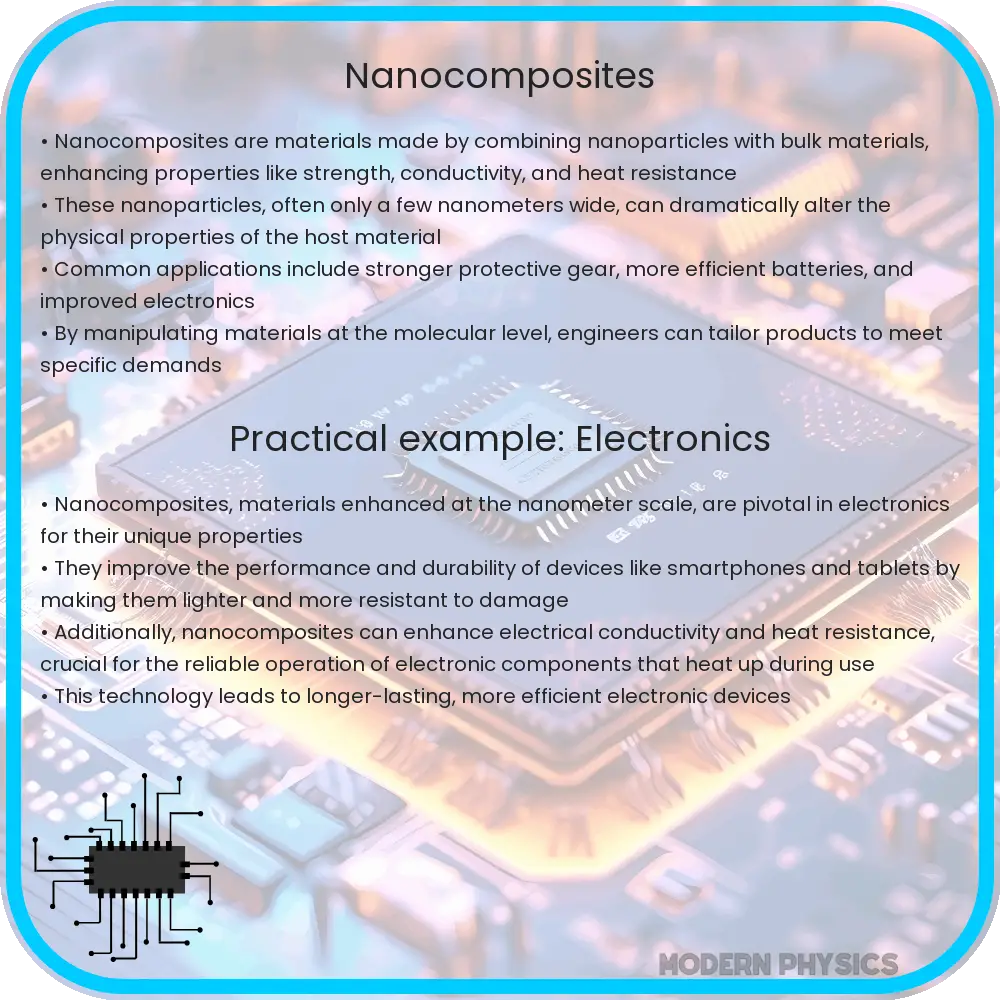
Nanocomposites are materials that combine nanoparticles with bulk matrices, such as polymers, metals, or ceramics. The addition of nanoparticles to a traditional material typically results in the enhancement of properties like strength, durability, and conductivity. This transformative approach in material science has opened new avenues in engineering and technology, rendering applications more efficient and effective across various industries.
Why Nanocomposites?
The unique aspect of nanocomposites lies in their structure. The nanoparticles—ranging from one to 100 nanometers in size—act as fillers that interact at the molecular or atomic levels with their surrounding matrix. This interaction significantly influences the physical, chemical, and mechanical properties of the composites, often exceeding the capabilities of their base materials.
- Enhanced Mechanical Strength: Nanocomposites are renowned for their improved tensile strength, resistance to breakage, and deformation under stress.
- Increased Durability: These materials exhibit superior durability, able to withstand harsh environments and resist wear and tear over extended periods.
- Improved Electrical and Thermal Conductivity: With nanoparticles acting as conduits, nanocomposites can achieve higher levels of electrical and thermal conductivity compared to their traditional counterparts.
How Nanocomposites Work
At the nanoscale, the high surface area to volume ratio of nanoparticles provides a massive boundary area for interactions with the base matrix. This large interface area is critical in determining the enhanced properties of the composite. For instance, when nanoparticles such as carbon nanotubes or graphene are added to polymers or metals, they create networks that can effectively transfer load, enhance conductivity, and resist environmental breakdown.
Applications Across Industries
Nanocomposites have found applications in a wide range of sectors:
- Aerospace: Lightweight yet strong composites can lead to significant improvements in fuel efficiency and structural integrity of aircraft.
- Automotive: High-performance materials enable lighter, stronger, and more durable components, contributing to overall vehicle safety and performance.
- Electronics: Enhanced electrical properties make nanocomposites ideal for developing small, highly efficient electronic components.
- Energy: In solar panels and fuel cells, nanocomposites contribute to higher efficiency and longer service life.
The benefits of nanocomposites are clear, making them a focal point in advanced material research and product development. The ongoing exploration of new nanoparticulate systems and their synergies with various matrices stands to further revolutionize the capabilities of engineering materials.
The Role of Nanoparticles in Enhancing Properties
Understanding the role of nanoparticles in property enhancement involves examining their interactions at a microscopic level. For example, adding silica nanoparticles to a polymer can significantly increase its mechanical properties. Similarly, introducing carbon nanotubes not only improves electrical and thermal conductivity but also adds to the material’s mechanical strength due to their exceptional aspect ratio and inherent strength.
Further analysis of these interactions and their effects on the composite material can unearth new potentials in various applications—ranging from construction to nanoelectronics.
Challenges and Future Perspectives
While nanocomposites offer substantial improvements over conventional materials, their development and implementation come with challenges. One major issue is the uniform distribution of nanoparticles within the matrix, which is crucial for achieving the desired enhancements in properties. Additionally, the production costs of nanocomposites can be high, limiting their accessibility and widespread use.
Future research in nanocomposite technology aims to address these hurdles by developing more cost-effective manufacturing techniques and improving the compatibility of nanoparticles with different matrices. Progress in this area could lead to broader commercial applications and further innovation in industries like biomedicine and environmental engineering.
Sustainability and Environmental Impact
Another important aspect of nanocomposite technology is its potential to contribute to sustainability. By enhancing material efficiency and lifespan, nanocomposites can reduce waste and energy consumption. Furthermore, research is also focusing on the development of biodegradable nanocomposites, which can offer environmentally friendly alternatives to traditional materials.
However, concerns about the toxicity of nanoparticles and their impact on health and the environment are also pertinent. It is crucial that nanocomposite production adheres to strict health and safety regulations to mitigate any potential risks associated with nanoparticle exposure.
Conclusion
The integration of nanoparticles into traditional materials to form nanocomposites represents a significant advancement in material science. These materials offer enhanced physical, chemical, and mechanical properties that can transform industries, from aerospace to electronics. As research continues, the challenges of cost and distribution are being addressed, paving the way for more widespread and sustainable applications. Meanwhile, understanding and mitigating the environmental impact of nanoparticles remains a critical focus. As nanotechnologies evolve, their potential to drive future innovations continues to grow, promising a new era of engineering solutions that are more robust, efficient, and environmentally responsible.