
Polymer Electrolyte Membranes (PEMs) are crucial for enhancing the efficiency and durability of fuel cells and electrolyzers by conducting ions while blocking electrons.
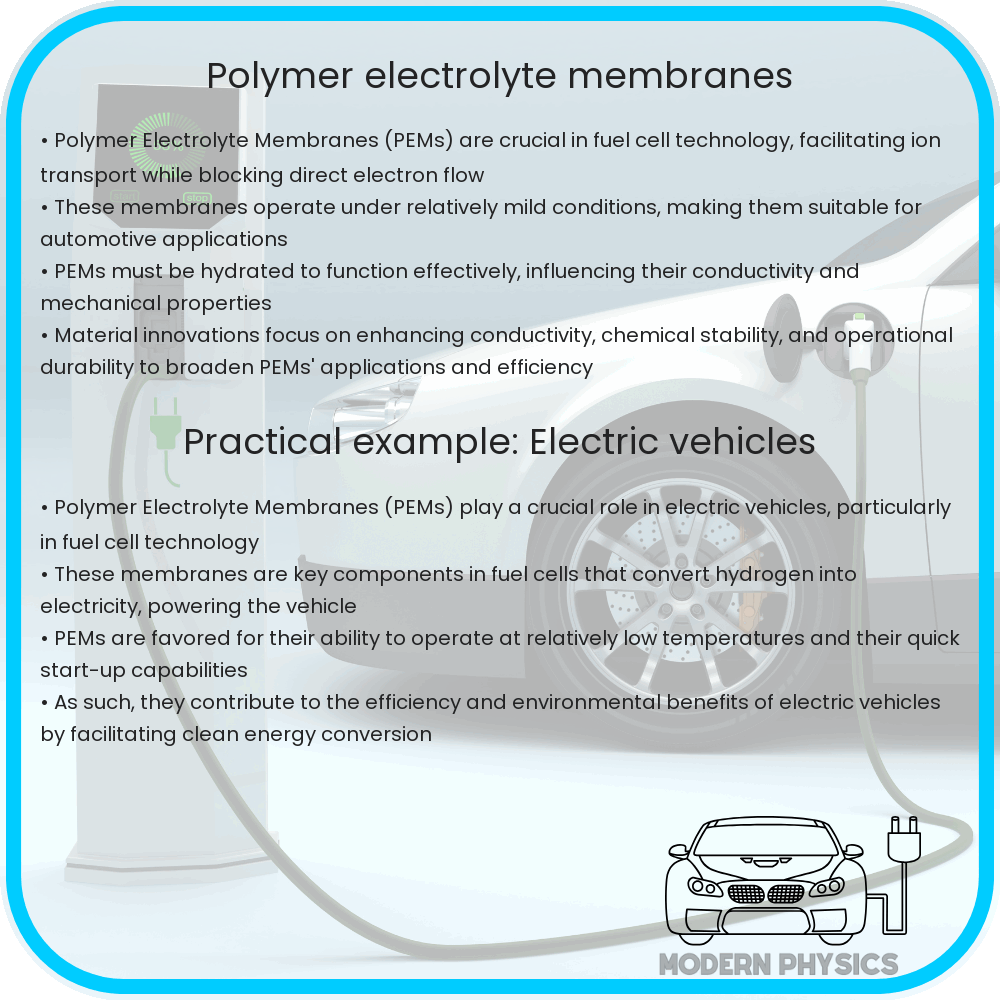
Polymer Electrolyte Membranes: Driving Efficiency and Durability in Modern Technologies
Polymer Electrolyte Membranes (PEMs) are at the forefront of materials technology, providing critical components for various energy conversion devices, most notably fuel cells and electrolyzers. Their ability to conduct ions while maintaining electrical insulation makes them integral to the operation and efficiency of these devices. This article delves into the characteristics of PEMs that contribute to their efficiency and durability, while also looking at recent innovations in the field.
Understanding Polymer Electrolyte Membranes
At its core, a Polymer Electrolyte Membrane is composed of a polymer film that is designed to conduct positive ions (cations) and block electrons. This selective transport is essential for preventing electrical short circuits while allowing chemical reactions to take place within the cell. The most commonly used polymer in PEMs in the context of fuel cells is Nafion, known for its excellent chemical stability and mechanical strength.
Efficiency of PEMs in Fuel Cells
The efficiency of PEMs is largely determined by their ionic conductivity and gas impermeability. High ionic conductivity ensures that ions can move freely through the membrane, contributing to an enhanced reaction rate at the electrodes. Consequently, the overall efficiency of the fuel cell increases, as more energy is converted from the chemical reaction into electrical energy with less heat loss.
To quantify, the ionic conductivity of PEMs can be expressed as σ (S/cm), which typically ranges from 0.01 S/cm to 0.1 S/cm under fully hydrated conditions. Optimization of membrane thickness and hydration levels can significantly improve this value, directly boosting fuel cell efficiency.
Durability Challenges and Solutions
Despite their advantages, PEMs face significant durability challenges over prolonged operational periods. These include chemical degradation, mechanical stress, and thermal instability, all of which can lead to reduced performance or failure of the fuel cell.
Chemical degradation is primarily caused by the strong oxidative environment created during the operation of fuel cells. This can break down the polymer chains in the membrane, resulting in decreased ionic conductivity and mechanical integrity. To combat this, researchers have developed PEMs with increased chemical cross-linking within the polymer structure or by incorporating hydrocarbon-based polymers that provide enhanced oxidative resistance.
Mechanical stress results from the swelling and shrinking of the membrane as it undergoes hydration and dehydration cycles, typically during the start-up and shut-down phases of fuel cell operation. Advances in materials engineering have led to the development of reinforced membranes that maintain stability under these fluctuating conditions, thus extending the operational life of the fuel cells.
Innovative Approaches to Improving PEMs
Recent technological advancements have focused on developing PEMs that can operate at higher temperatures and low humidity conditions. These conditions challenge traditional Nafion membranes, which require high humidity to maintain their ionic conductivity. New materials such as polybenzimidazole (PBI) infused with phosphoric acid have emerged, which allow operation at temperatures up to 200°C and at lower relative humidity.
Moreover, efforts in nano-engineering have facilitated the creation of composite membranes. These membranes incorporate nano-sized fillers like silica or titanium dioxide, which enhance properties like thermal stability, mechanical strength, and ionic conductivity. This nano-composite approach has opened new possibilities for PEMs in broader applications, extending beyond traditional uses in fuel cells.
These efforts illustrate a promising path toward making PEM-based devices not only more efficient but also more adaptable to varied operating environments. Continued research and development in this area are likely to yield further significant improvements, potentially revolutionizing energy systems worldwide.
Applications of Polymer Electrolyte Membranes in Renewable Energy
PEMs play a pivotal role in the realm of renewable energy, particularly in integrating and managing energy storage and conversion. In solar and wind energy systems, PEM electrolyzers can be used to produce hydrogen during peak energy production periods. This hydrogen can then be stored and later converted back into electricity via fuel cells during periods of low energy production, thus ensuring a stable energy supply.
The use of PEMs in these systems highlights their importance in facilitating a transition to more sustainable energy practices. Additionally, PEMs enhance the scalability of renewable energy solutions by enabling modular setups, where multiple small-scale devices are used to meet varied demand levels efficiently.
Economic and Environmental Impact of PEMs
The deployment of PEM technology in energy systems not only boosts performance efficiency but also contributes to economic sustainability. As production costs decrease and technological maturity increases, PEMs are becoming more accessible and are significantly reducing the operational costs of energy devices. This economic advantage is crucial for the broader adoption of clean energy technologies.
Environmentally, PEMs contribute to reducing the carbon footprint of energy systems. By improving the efficiency and lifetime of fuel cells and electrolyzers, they decrease the overall energy consumption and emissions compared to traditional energy conversion methods. Furthermore, as PEMs promote the use of hydrogen, they support the global move towards decarbonization in various sectors, including transportation and industrial processes.
Conclusion
Polymer Electrolyte Membranes represent a cornerstone technology in modern energy systems, crucial for the efficient operation of devices like fuel cells and electrolyzers. Through consistent advancements in materials science and engineering, PEMs are overcoming challenges related to durability and operating conditions, thereby broadening their applications within various sectors.
By improving both the efficiency and scalability of renewable energy technologies, PEMs are playing an essential role in shaping a sustainable energy future. The continual research and development in this field are not only enhancing the performance of these membranes but also ensuring their economic and environmental benefits are maximized. The promising developments in PEM technology underscore its importance in transitioning to an era of cleaner, more reliable energy systems globally.