
Explore the formation, stability, and diverse applications of polyelectrolyte complexes, their role in biomedicine, and future prospects in material science.
Polyelectrolyte Complexes: An Overview
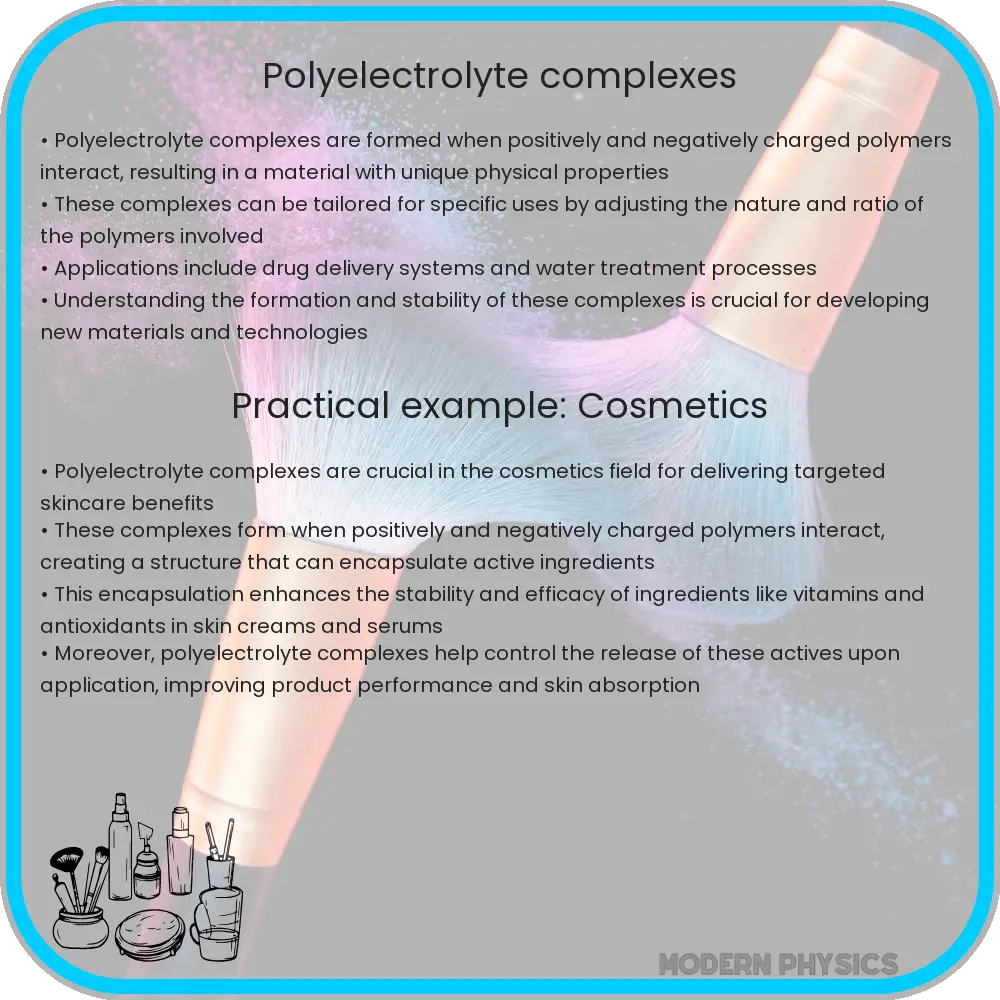
Polyelectrolyte complexes (PECs) are formed by the self-assembly of oppositely charged polyelectrolytes in aqueous solutions. This unique interaction results in a variety of structures with distinct physicochemical properties. Polyelectrolytes, polymers that carry multiple ionic or charged groups, are pivotal in creating these complexes. The formation of PECs is primarily driven by electrostatic attraction between the charged segments of these macromolecules, which can lead to either soluble complexes or insoluble precipitates depending on the conditions and types of polyelectrolytes involved.
Stability of Polyelectrolyte Complexes
The stability of polyelectrolyte complexes is influenced by several factors including the molecular weight of the polyelectrolytes, the charge density, pH, ionic strength of the solution, and the presence of counterions. Environmental conditions play a significant role in the stability; for instance, changes in pH can alter the charge of the polyelectrolytes and therefore affect the overall stability of the PECs. Additionally, the ratio of the oppositely charged polyelectrolytes contributes to the formation of either more stable or transient complexes.
Formation Mechanisms
The formation of polyelectrolyte complexes occurs through a process known as ‘layer-by-layer’ (LbL) assembly. This involves the sequential deposition of oppositely charged polyelectrolytes onto a substrate, leading to the buildup of a multilayered structure. The driving force behind this assembly is mainly the electrostatic interaction between the layers. However, hydrogen bonding, hydrophobic interactions, and van der Waals forces can also contribute to the formation and stabilization of the layers. The LbL technique allows for precise control over the thickness and composition of the PEC layers, enabling the creation of tailored materials for specific applications.
Applications of Polyelectrolyte Complexes
PECs find applications in a wide range of fields including biomedicine, wastewater treatment, and food packaging. In the biomedical sector, they are used for drug delivery systems, tissue engineering, and as bioadhesives. The ability to control the release rate of drugs and to engineer biocompatible and biodegradable systems makes PECs particularly attractive in this area. In environmental applications, polyelectrolyte complexes can be utilized in the removal of pollutants from wastewater, acting as flocculants to aggregate and precipitate contaminants. Furthermore, in the food industry, PECs serve as edible coatings to enhance the shelf life and preserve the quality of fresh produce.
Advanced Research and Future Prospects
Recent advances in the field of polyelectrolyte complexes have opened new horizons for their application. Innovative research is being conducted to enhance the functional properties of PECs, such as improving their thermal stability, mechanical strength, and biodegradability. One area of significant interest is the development of smart PECs that can respond to environmental stimuli such as temperature, pH, and ionic strength, paving the way for their use in targeted drug delivery and self-healing materials.
Moreover, the exploration of sustainable and biobased polyelectrolytes for the formation of eco-friendly complexes is gaining momentum. This aligns with the growing global emphasis on green chemistry and the reduction of environmental footprints. The integration of nanotechnology with PECs, creating nanostructured polyelectrolyte complexes, has also shown promising applications in various fields, including catalysis, sensing, and energy storage.
Challenges and Considerations
Despite their vast potential, the development and application of polyelectrolyte complexes are not without challenges. The complexity of interactions between polyelectrolytes and the influence of environmental factors require a deep understanding to predict and control the behavior of PECs accurately. Additionally, issues related to scalability, reproducibility, and the long-term stability of these materials need to be addressed to facilitate their commercial application. Regulatory hurdles, particularly in biomedical applications, also pose significant challenges that need to be overcome.
Conclusion
Polyelectrolyte complexes represent a fascinating area of research with a broad spectrum of potential applications across various industries. Their unique properties, such as tunable functionality, responsiveness to environmental stimuli, and potential for biocompatibility, make them particularly appealing for innovative applications. However, realizing their full potential requires overcoming existing challenges related to their complex nature and external environmental factors. As research continues to advance, and as solutions to these challenges are developed, the role of PECs in science and technology is expected to grow significantly. The future of polyelectrolyte complexes looks promising, offering new opportunities for sustainable and advanced materials in the years to come.