
Explore the fascinating world of opaline photonic structures: their fabrication, applications, and theory, revolutionizing light manipulation and technology.
Introduction to Opaline Photonic Structures
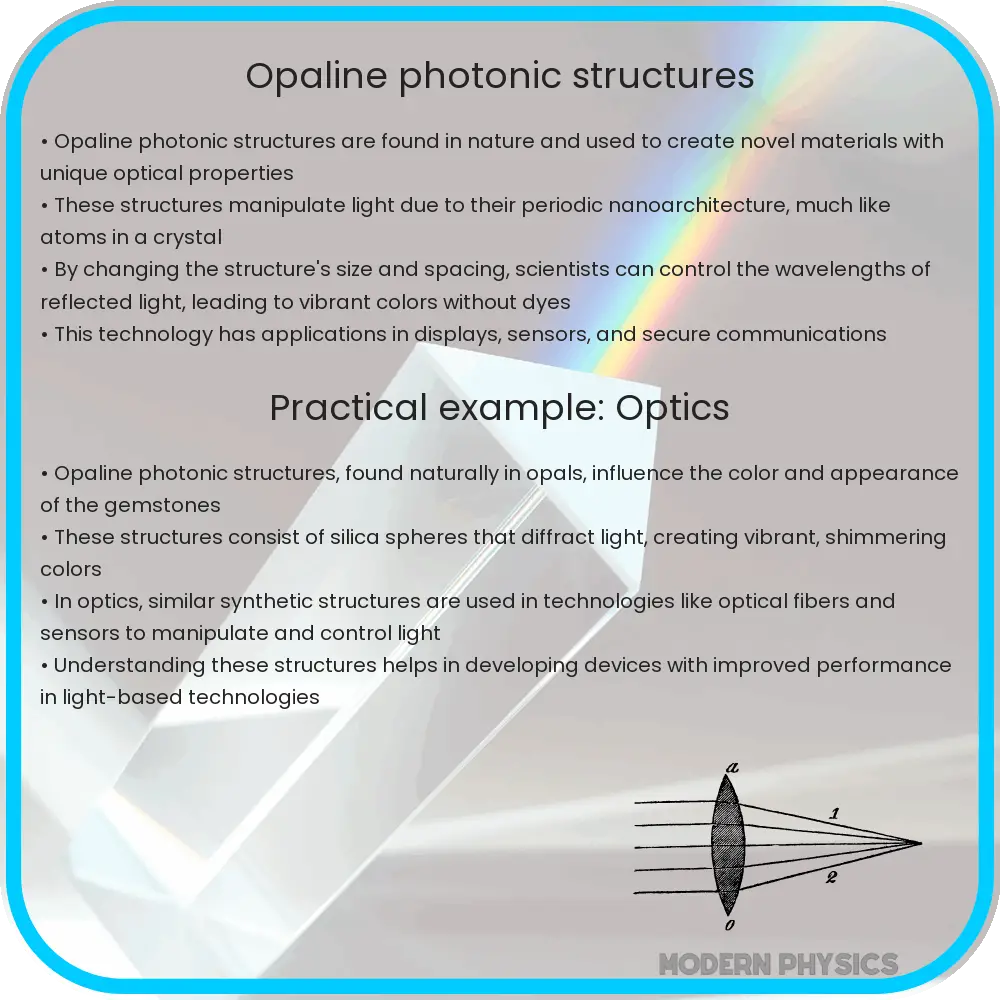
Opaline Photonic Structures, inspired by the natural formation found in opals, have captivated the scientific community with their unique light manipulation capabilities. These structures are artificial materials engineered to affect the motion of photons, creating what is known as a photonic band gap. This property allows them to control the flow of light in a manner that conventional materials cannot achieve. The fabrication, applications, and theoretical understanding of these structures have opened new horizons in the field of photonics.
Fabrication Techniques
The fabrication of opaline photonic structures involves several sophisticated techniques, aiming to replicate the precise and regular patterns found in natural opals. One of the most common methods is the self-assembly of monodisperse microspheres, which form a close-packed structure resembling the layers seen in natural opal. Other techniques include lithography, where light or electrons are used to etch patterns onto a material, and direct laser writing, which involves the use of focused laser beams to create the three-dimensional structures required for manipulating light.
Applications in Various Fields
Opaline photonic structures have found applications across a broad spectrum of fields. In telecommunications, they are used to create more efficient and faster optical components such as waveguides and filters. In the realm of sensors, these structures enable the detection of minute changes in the environment, making them invaluable for chemical and biological detection. Additionally, their unique light-manipulating properties have led to innovative developments in display technology, offering brighter and more vivid colors without the need for dyes or pigments.
Theoretical Foundations
The theoretical underpinnings of opaline photonic structures stem from the principles of photonic band gap engineering. By manipulating the size, spacing, and composition of the structures, researchers can control the propagation of light within these materials. The theory is grounded in Maxwell’s equations, which describe how electromagnetic waves behave, combined with solid-state physics concepts to understand how light interacts with periodic structures.
Challenges and Future Directions
Despite the promising advancements, the fabrication and implementation of opaline photonic structures face several challenges. Precise control over the structures’ geometry and defects is crucial, as even minor imperfections can significantly affect their optical properties. Additionally, scaling up the production while maintaining consistency and quality remains a significant hurdle. However, ongoing research is focused on overcoming these challenges through innovative fabrication techniques and materials science advancements.
Integration with Other Technologies
Opaline photonic structures are increasingly being integrated with other nanotechnologies and materials, such as quantum dots and graphene. This integration is paving the way for new hybrid devices with enhanced functionalities, such as ultra-sensitive sensors and high-efficiency solar cells. Moreover, the combination of opaline photonic structures with flexible substrates is opening up possibilities for wearable photonics, bringing futuristic concepts into reality.
Environmental Impact and Sustainability
The environmental impact and sustainability of opaline photonic structures are also areas of active research. Scientists are exploring eco-friendly materials and green manufacturing processes to reduce the ecological footprint of these technologies. By addressing these environmental concerns, the field aims to not only advance technologically but also contribute positively to sustainable development.
Conclusion
Opaline photonic structures represent a fascinating convergence of nature’s patterns and human ingenuity. With their unique ability to control and manipulate light, they hold the promise of revolutionizing various technological fields, from telecommunications to environmental sensing. Despite the challenges in fabrication and scalability, the ongoing research and development in this area are leading to innovative solutions and applications. As we continue to explore the potential of these structures, their integration with other technologies and commitment to sustainability, opaline photonic structures are set to play a pivotal role in the future of materials science and engineering.