
Explore the fascinating world of exciton-polaritons within microcavities, their unique quantum states, and interactions, bridging the gap between light and matter.
Understanding Exciton-Polaritons in Microcavities
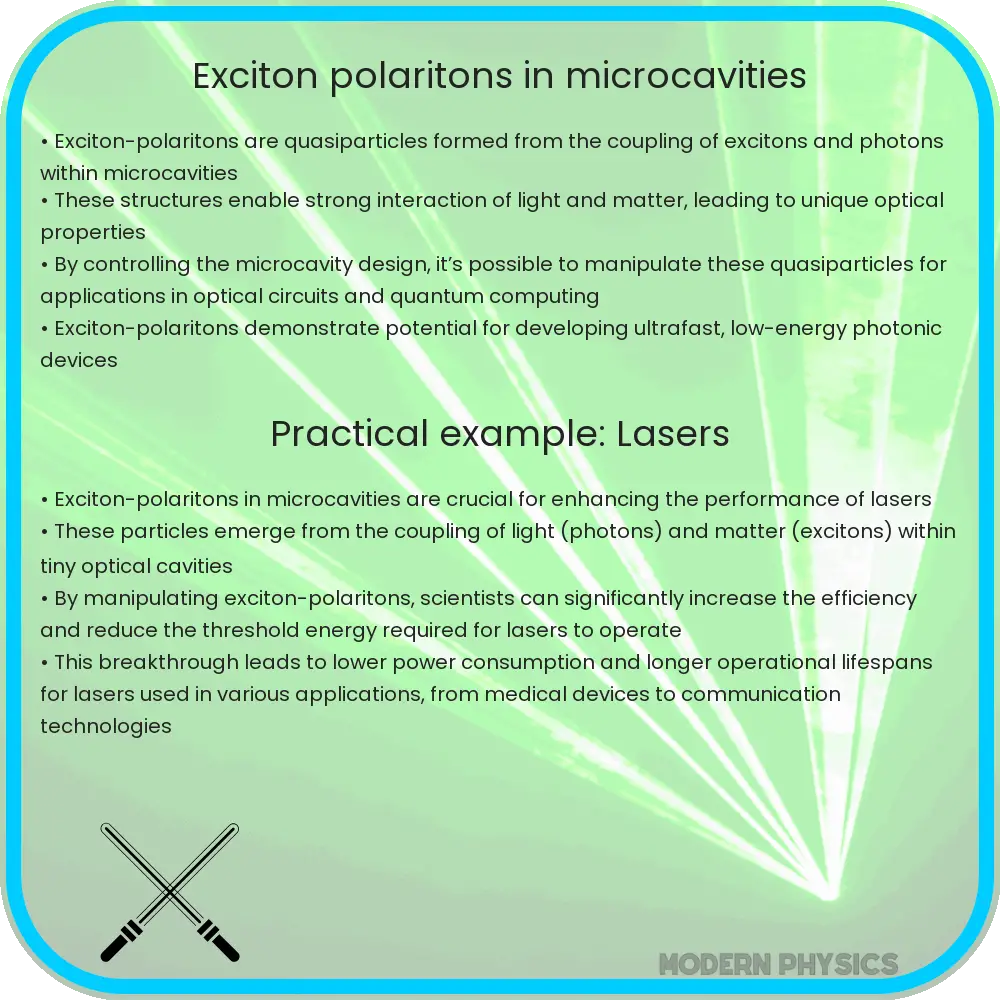
Exciton-polaritons represent a fascinating quantum state of matter that emerges at the interface of light and matter interactions. These quasiparticles are formed when excitons, which are bound pairs of electrons and holes, strongly couple with photons within optical microcavities. The unique properties of exciton-polaritons arise from their dual nature, blending the characteristics of light (photons) with those of matter (excitons), leading to novel phenomena and potential applications in quantum technologies.
Formation and Properties of Exciton-Polaritons
The birthplace of exciton-polaritons is within the microcavities—extremely thin layers sandwiched between two mirrors that reflect photons back and forth. This setup creates a standing wave of light that interacts with the excitons in the semiconductor material inside the cavity. When the interaction is strong enough, and the energies of the excitons and photons match, the exciton-polariton quasiparticles are born. This regime of strong coupling leads to the splitting of energy levels into upper and lower polariton branches, a hallmark feature observable in the emission spectrum of such systems.
Quantum States and Interactions
Exciton-polaritons possess unique quantum states that enable intriguing interactions. Being part-light and part-matter allows these quasiparticles to have extremely low effective masses and to travel across the microcavity with minimal scattering. Furthermore, their matter component endows them with strong nonlinear interactions, facilitating the formation of exotic states of matter such as polariton condensates and polariton lattices. These features open up pathways for investigating Bose-Einstein condensation at relatively high temperatures and for exploring complex many-body quantum phenomena in a solid-state platform.
The Role of Microcavities
Microcavities play a crucial role in the physics of exciton-polaritons, as the design and quality of these optical resonators determine the efficiency of light-matter coupling. Advances in microfabrication techniques have led to the development of high-quality microcavities with very low loss rates, enabling the observation of strong coupling regimes and the study of polariton dynamics over extended periods. The ability to engineer the dispersion of polaritons through microcavity design also allows for the manipulation of their quantum states and interactions, paving the way for novel optoelectronic devices and quantum information systems.
Exciton-Polaritons: Bridging Light and Matter
Exciton-polaritons represent a fascinating frontier in quantum physics, embodying the hybrid states that emerge when light interacts with matter at the quantum level. These quasi-particles are produced within microcavities, where confined photons couple with excitons—bound states of electrons and holes. This interaction leads to the creation of exciton-polaritons, entities that possess both the properties of light (photons) and matter (excitons), enabling studies and applications that were previously unimaginable in the realms of quantum optics and condensed matter physics.
Understanding Microcavities
Microcavities are the cradle of exciton-polaritons. These are structures designed to trap light in a very small volume, enhancing the interaction between light and matter. By confining photons within layers of semiconductor materials, these cavities allow for the efficient coupling of light with excitons, facilitating the formation of exciton-polaritons. The quality of these microcavities is paramount, as it determines the strength of the coupling and the properties of the resulting quasi-particles.
Quantum States and Interactions
The quantum states of exciton-polaritons are characterized by their unique dispersion relations, which describe the relationship between their energy and momentum. Unlike ordinary photons or excitons, exciton-polaritons exhibit a nonlinear dispersion relation, leading to intriguing phenomena such as Bose-Einstein condensation at relatively high temperatures. This quantum coherence opens the door to exploring complex quantum states and interactions, paving the way for advancements in quantum computing and nonlinear optics.
Exciton-Polariton Interactions and Applications
Exciton-polaritons interact with each other and with their environment, leading to a variety of phenomena such as superfluidity, vortices, and solitons. These interactions are governed by their composite nature, enabling the manipulation of light-matter states for innovative applications. In the realm of optoelectronics, exciton-polaritons offer promising avenues for developing ultrafast, low-threshold lasers, and highly sensitive photodetectors. Moreover, their unique properties are being explored for quantum simulation and information processing, heralding a new era of quantum technologies.
Conclusion
The exploration of exciton-polaritons within microcavities unveils a rich landscape of quantum states and interactions, bridging the gap between light and matter in unprecedented ways. As research in this field progresses, the potential for groundbreaking technologies based on these quantum hybrid states becomes increasingly tangible. From revolutionizing optoelectronics to paving the way for quantum computing, exciton-polaritons stand at the forefront of quantum and condensed matter physics, promising to transform our understanding and manipulation of the quantum world.