
Explore the fascinating world of polaritons in solids, their quantum states, coupling mechanisms, and innovative applications in modern technology.
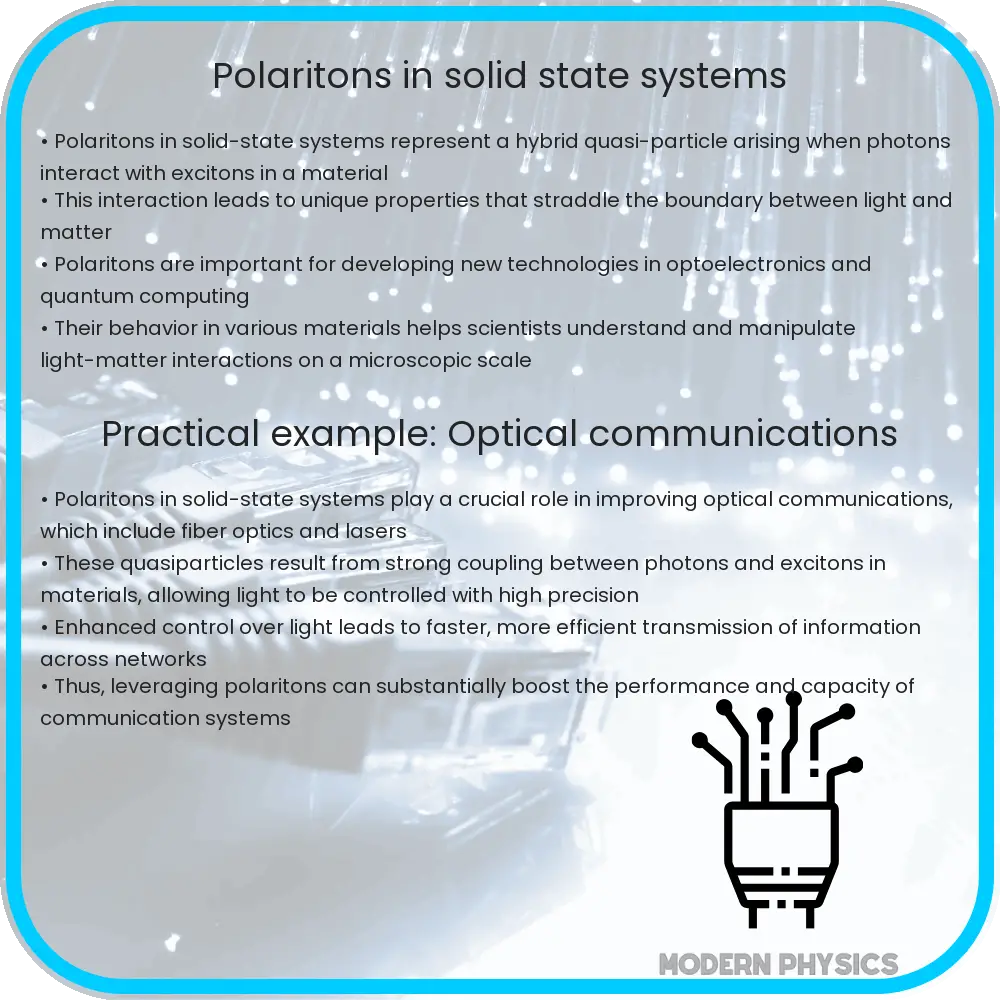
Understanding Polaritons in Solids
Polaritons are quasiparticles arising from the strong coupling between electromagnetic waves and an electric or magnetic dipole-carrying excitation in solids. They play a crucial role in the realm of quantum optics and materials science, offering insights into the fundamental interactions between light and matter. This interaction leads to the formation of hybrid light-matter states that exhibit unique properties, distinguishing polaritons from their constituent parts.
Quantum States of Polaritons
Polaritons manifest in various forms, such as phonon-polaritons, exciton-polaritons, and plasmon-polaritons, depending on the nature of the matter wave they couple with. Exciton-polaritons, for example, result from the coupling of photons with excitons (bound states of an electron and a hole) in semiconductor microcavities. These mixed states are characterized by quantum superposition, leading to peculiar quantum behaviors such as Bose-Einstein condensation at relatively high temperatures compared to other quantum systems.
Coupling Mechanisms and Their Implications
The strength of the coupling between light and matter waves is a critical factor in polariton behavior, determining the extent of the hybridization of the states. This coupling is quantified by the Rabi splitting energy, which is observable as a splitting in the absorption or emission spectra of the material. Strong coupling leads to the formation of distinct upper and lower polariton branches in the dispersion relation, enabling the exploration of new quantum phenomena.
Applications of Polaritons in Advanced Technologies
Polaritons hold promise for a range of technological applications, leveraging their unique properties for advancements in optoelectronics, quantum computing, and sensor technology. Their ability to enhance light-matter interaction at the nanoscale facilitates the development of ultra-fast optical switches and modulators. Moreover, the coherent nature of polariton condensates paves the way for the realization of polaritonic devices with high coherence, offering new opportunities in the field of quantum information processing.
- Photonic Devices: The manipulation of light at the quantum level with polaritons enables the creation of highly efficient lasers, LEDs, and photonic circuits.
- Quantum Computing: Exploiting the quantum states of polaritons could lead to the development of quantum bits (qubits) for quantum computing, offering faster processing speeds and enhanced security.
- Sensing and Imaging: Polariton-based sensors could achieve unprecedented sensitivity, benefiting medical imaging and environmental monitoring.
Polaritons in Solids: Bridging Light and Matter
Polaritons represent an intriguing quantum state that emerges at the intersection of light and matter. These quasiparticles are the result of strong coupling between photons and excitons—the bound states of electrons and holes in a semiconductor. The hybrid nature of polaritons allows them to exhibit both the coherent properties of light and the interacting properties of matter, making them a subject of intense research in the field of condensed matter physics and quantum optics.
Understanding Strong Coupling and Polariton Formation
Strong coupling occurs when the interaction between two quantum systems leads to the splitting of their energy levels, known as Rabi splitting. In the context of polaritons, this phenomenon takes place when the coupling strength between the exciton and the photon surpasses the decay rates of both individual particles. The resulting mixed states are termed as upper and lower polaritons, which exhibit distinct energy dispersions and are separated by a gap indicative of the coupling strength.
Applications of Polaritons
The unique properties of polaritons have paved the way for novel applications in various domains. One of the most promising areas is the development of ultrafast and low-threshold polariton lasers, which operate on the principle of stimulated scattering into the lower polariton state, thereby achieving lasing without population inversion. Additionally, polaritons have been exploited in the creation of Bose-Einstein condensates at comparatively high temperatures, offering a new platform for exploring quantum fluid dynamics in a solid-state system. Furthermore, the strong nonlinear interactions among polaritons make them suitable candidates for developing optical circuits and quantum computing components, where information can be processed and transferred at the speed of light with minimal energy consumption.
Conclusion
The exploration of polaritons in solids unveils a fascinating realm where light and matter coalesce, offering profound insights into quantum mechanics and material science. As research advances, the manipulation and control of polariton states continue to unlock revolutionary technological applications, ranging from next-generation lasers and photonic devices to quantum information processing. The interdisciplinary nature of polariton research underscores the collaborative efforts required to further understand and harness these quasiparticles, promising a future where the boundaries between light and matter blur, leading to the emergence of innovative quantum technologies.