
Photorefractive optics merges light manipulation and material properties for innovative data storage and imaging, changing refractive indexes for efficient solutions.
Photorefractive Optics: Data Storage, Efficiency & Innovation
Photorefractive optics is an intriguing and advanced field that merges the properties of materials with the manipulation of light to create innovative solutions for data storage, imaging, and various optical applications. In this article, we’ll explore what photorefractive materials are, how they contribute to efficient data storage, and the cutting-edge innovations driving this technology forward.
What is Photorefractive Optics?
Photorefractive optics involves materials that alter their refractive index in response to light exposure. This means when light hits these materials, their optical properties change, making them useful for various applications like holography, adaptive optics, and data storage.
How Photorefractive Materials Work
Photorefractive materials possess the unique ability to change their refractive index through the movement of electrons and charge carriers. Here’s a simplified explanation:
- Exposure: When a photorefractive material is exposed to light, photons excite electrons within the material.
- Charge Migration: These excited electrons move to different regions within the material, creating regions of varied charge concentration.
- Refractive Index Change: The movement of these charges alters the material’s refractive index, creating a pattern that corresponds to the light intensity.
Data Storage with Photorefractive Materials
One of the most promising applications of photorefractive optics is in data storage. Here are some ways they are utilized:
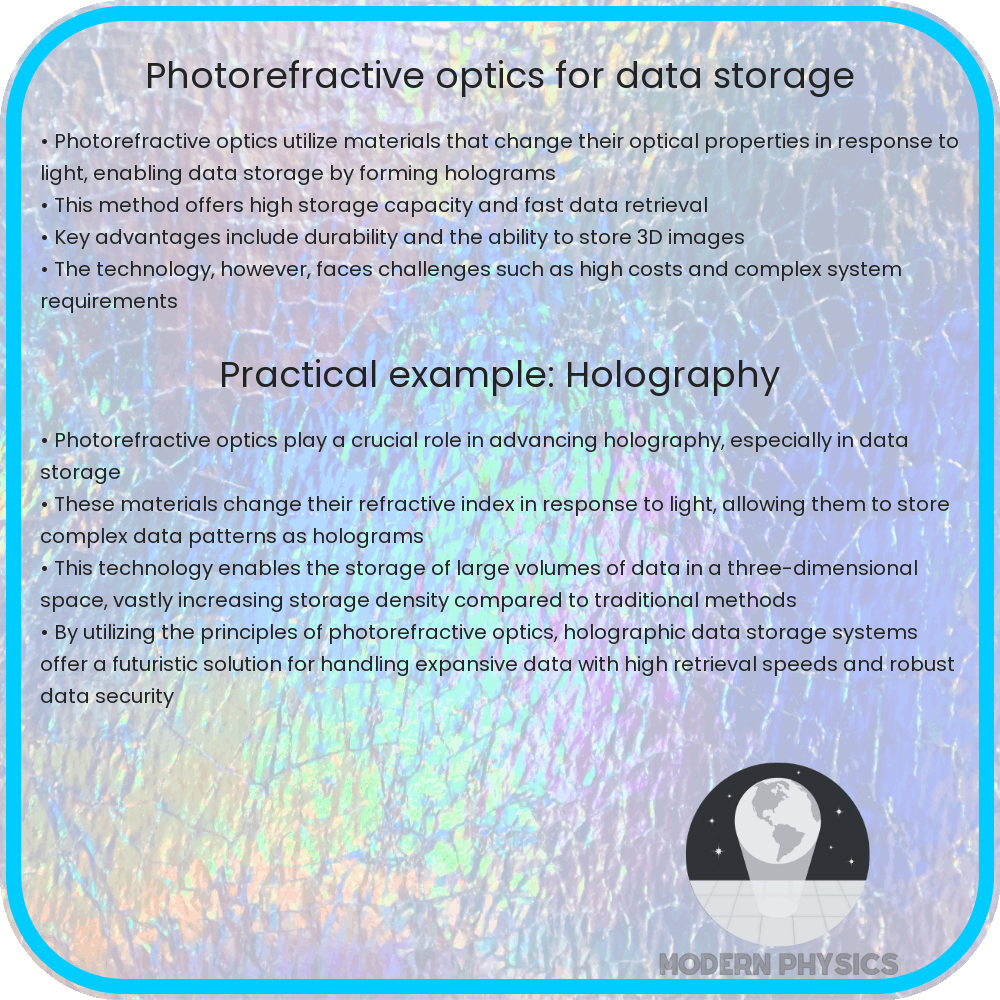
- Holographic Data Storage: By recording data as holograms within photorefractive materials, large amounts of information can be stored in three-dimensional patterns. This results in higher storage densities compared to traditional two-dimensional methods.
- Fast Access and Retrieval: The data can be accessed and retrieved quickly, making it an efficient storage solution for applications requiring speed and high volume, such as big data and cloud storage.
Efficiency in Photorefractive Data Storage
Photorefractive materials offer several efficiency advantages:
- High Storage Capacity: The ability to store data in three dimensions allows for significantly greater storage capacity on a single medium.
- Fast Read and Write Speeds: The nature of photorefractive changes enables rapid recording and reading of data, which is beneficial for applications needing real-time access.
- Durability: Photorefractive materials tend to be more durable than traditional storage media, reducing the risk of data loss over time.
Innovations in Photorefractive Optics
As technology advances, so does the innovation in photorefractive optics. Current research and development are focusing on several exciting areas:
- Materials Development: Scientists are continuously working on developing new photorefractive materials that offer better performance, higher sensitivity to light, and greater stability.
- Integrated Systems: Integration of photorefractive materials with other optical components, such as waveguides and modulators, is paving the way for more compact and efficient optical systems.
- Applications Beyond Storage: Beyond data storage, photorefractive optics are being explored for use in adaptive optics, where they can help improve image quality in telescopes and microscopes by compensating for distortions.
Challenges and Limitations
Despite their advantages, photorefractive materials face certain challenges that can affect their application and development:
- Sensitivity to Environmental Factors: Changes in temperature, humidity, and other environmental conditions can impact the stability and performance of photorefractive materials, requiring careful control during use.
- Complex Manufacturing Processes: The production of high-quality photorefractive materials often involves complex and costly manufacturing processes, which can be a barrier to widespread adoption.
- Limited Material Choices: Although research is ongoing, the range of materials known to exhibit photorefractive properties is still relatively limited, potentially constraining the versatility and optimization of photorefractive applications.
Future Directions
The future of photorefractive optics holds significant promise, with ongoing research and technological advancements driving the field forward. Key areas of focus include:
- Enhanced Material Properties: Developing new materials with improved photorefractive properties, such as higher sensitivity and faster response times, to expand their practical applications.
- Miniaturization: Creating more compact and integrated photorefractive systems for use in portable and wearable devices, potentially transforming personal electronics and communication technologies.
- Multi-functional Systems: Combining photorefractive materials with other technologies, such as machine learning and artificial intelligence, to create smart optical systems capable of adaptive performance and self-optimization.
Conclusion
Photorefractive optics represents a fascinating intersection of material science and optical engineering, offering innovative solutions for data storage and beyond. With their capacity for high storage density, fast read/write speeds, and exceptional durability, photorefractive materials stand to revolutionize how we manage and utilize information.
Furthermore, as research continues to enhance the properties and expand the applications of these materials, we can expect photorefractive optics to play an increasingly pivotal role in various high-tech fields, from telecommunications to adaptive imaging systems. Despite the current challenges, the potential of photorefractive optics is vast, promising a future where optical technologies are more efficient, reliable, and versatile than ever before.