
Explore the world of Photonics Crystal Waveguides: their principles, advantages, applications, challenges, and future potential in optical tech.
Understanding Photonics Crystal Waveguides
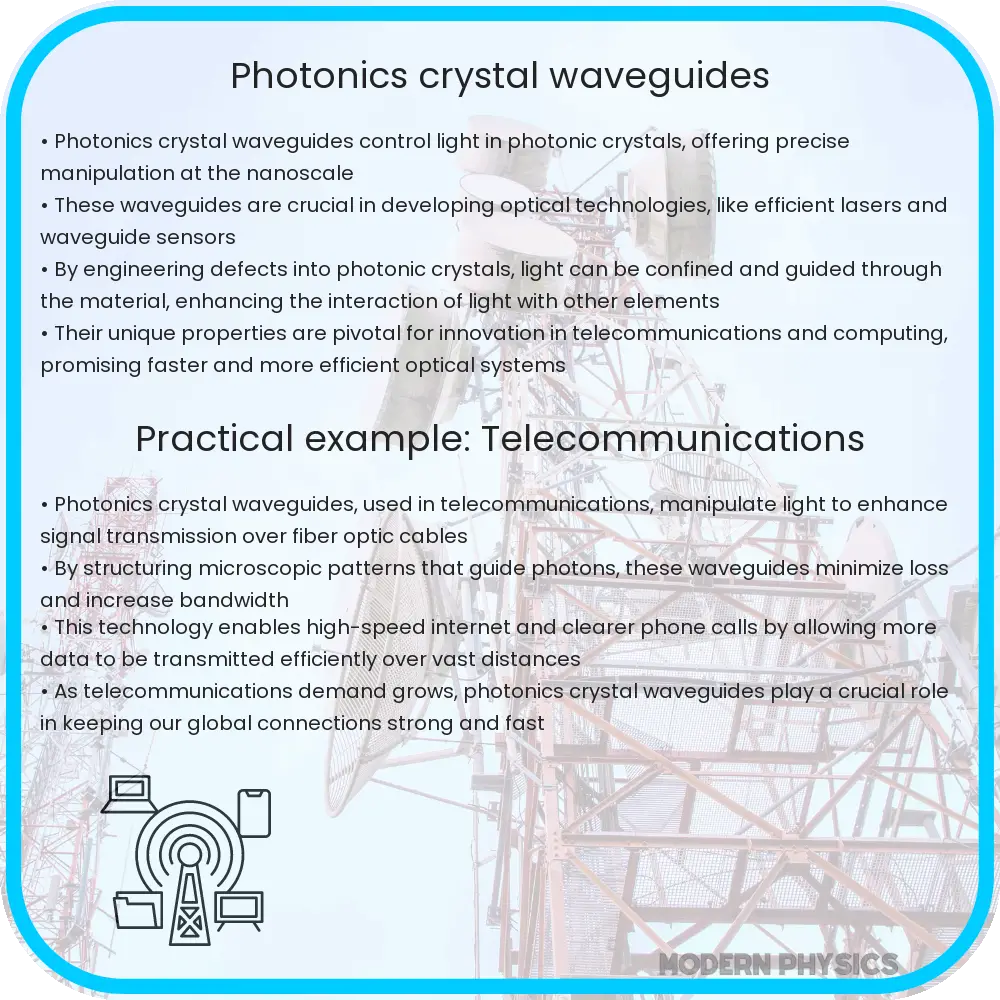
Photonics crystal waveguides represent a significant advancement in the field of optical technology. These structures manipulate light in unique ways, offering high precision, efficiency, and remarkable speed in data transmission. At their core, photonics crystal waveguides are composed of periodic dielectric materials which affect the propagation of light through photonic band gaps. This article delves into the mechanics, applications, and future potential of these innovative waveguides.
Principles of Operation
The operation of photonics crystal waveguides is grounded in the concept of photonic band gaps. These are frequency ranges in which light cannot propagate through the crystal. By introducing defects into the otherwise perfect periodic structure of the crystal, specific modes of light can be guided along desired paths. This principle is akin to how electronic semiconductors control the flow of electrons, but instead, it manipulates photons, the fundamental particles of light.
Material Composition
Common materials used in the construction of photonics crystal waveguides include silicon (Si), gallium arsenide (GaAs), and indium phosphide (InP). These materials are chosen for their optical properties, including their refractive indices, which play a crucial role in the formation of photonic band gaps. Silicon, in particular, is favored for its compatibility with existing semiconductor fabrication technologies.
Advantages over Traditional Waveguides
Compared to conventional optical waveguides, photonics crystal waveguides offer several advantages:
- Precise Control of Light: The ability to engineer band gaps allows for unparalleled control over the propagation of light, enabling the creation of highly efficient optical circuits.
- Miniaturization: These waveguides can be made significantly smaller than traditional waveguides, facilitating integration into compact optical devices.
- High-Speed Data Transmission: The efficient guiding of light allows for rapid data transmission, crucial for modern telecommunications and computing.
Applications in Modern Technology
Photonics crystal waveguides find applications in a variety of fields:
- Telecommunications: Enhancing the speed and efficiency of optical communication systems.
- Sensors: Used in highly sensitive detectors for biomedical and environmental monitoring.
- Computing: Enabling the development of optical computing devices, promising faster and more energy-efficient computation.
As research progresses, the potential applications of photonics crystal waveguides continue to expand, paving the way for revolutionary advancements in various technological domains.
Challenges and Future Directions
Despite their numerous advantages, photonics crystal waveguides face several challenges. One of the primary concerns is the manufacturing complexity. Fabricating these structures requires precise control over material properties at a nano-scale level, which can be expensive and technically demanding. Additionally, integrating these waveguides into existing systems poses compatibility challenges, particularly in terms of connecting them with traditional optical components.
Future research is directed towards overcoming these challenges. Efforts are being made to simplify the fabrication process, potentially using new materials or advanced manufacturing techniques like 3D printing. Moreover, scientists are exploring ways to enhance the compatibility of photonics crystal waveguides with other components, aiming for seamless integration into a wide range of optical systems.
Environmental Impact and Sustainability
An important aspect of photonics crystal waveguides is their environmental impact. Compared to electronic counterparts, these optical devices consume significantly less power, contributing to energy efficiency in communication and computing technologies. This feature aligns with global efforts towards sustainability and reducing carbon footprints in technology sectors.
Conclusion
Photonics crystal waveguides mark a transformative phase in optical technology. Their ability to manipulate light with high precision and efficiency opens a multitude of possibilities in telecommunications, computing, and sensing. The unique advantages of these waveguides, such as miniaturization, high-speed data transmission, and precise light control, position them as a cornerstone for future optical innovations.
While challenges in fabrication and integration persist, ongoing research and technological advancements are likely to address these hurdles. As we move forward, photonics crystal waveguides are expected to play a pivotal role in shaping a more efficient, sustainable, and technologically advanced future. Their development not only signifies a leap in optical science but also underscores the importance of pursuing innovations that harmonize technological growth with environmental sustainability.