
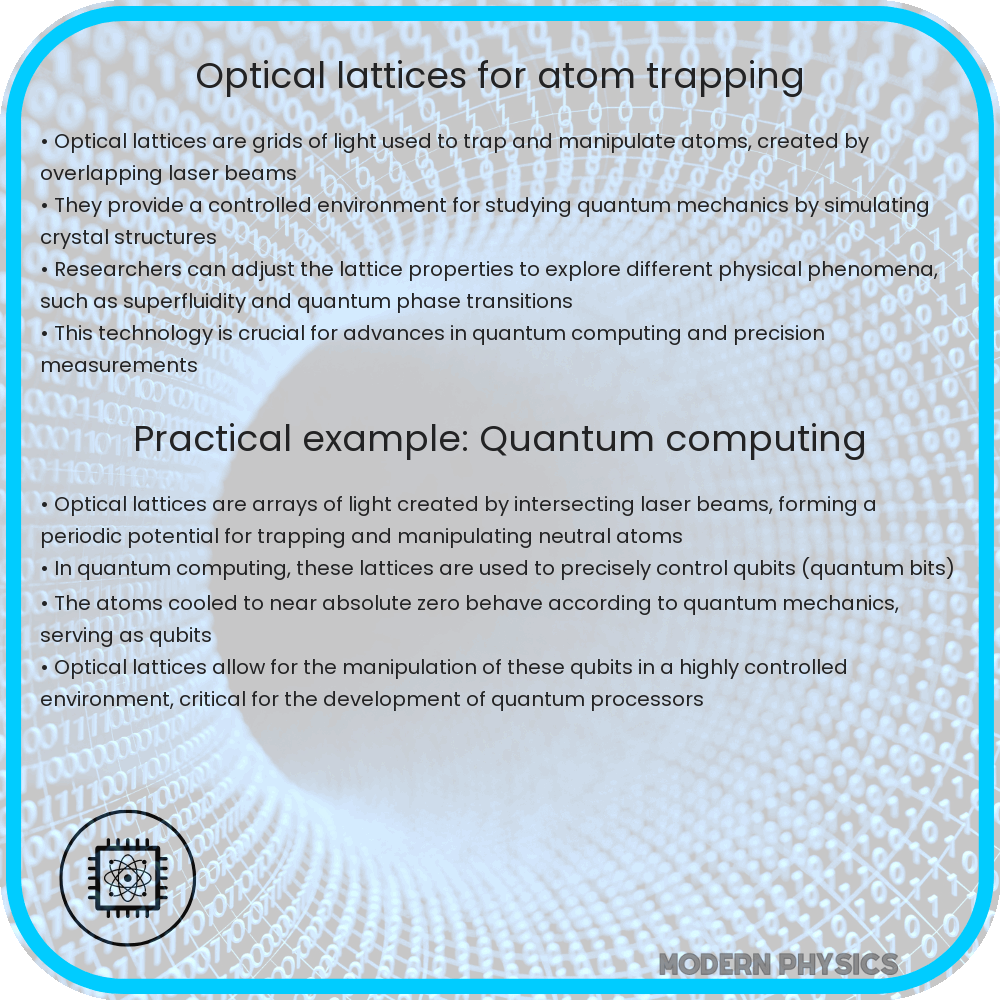
Optical lattices are periodic potential landscapes formed by intersecting laser beams to trap and manipulate atoms with high precision for advancements in quantum mechanics and computing.
Understanding Optical Lattices in Atom Trapping
Optical lattices are a fascinating application of physics in the field of quantum optics, providing a way to trap and manipulate atoms with remarkable precision. These structures are created using intersecting laser beams, which generate a periodic potential landscape for neutral atoms. This technology is not only pivotal for advancements in quantum computing but also plays a crucial role in the exploration of quantum mechanics on a macroscopic scale.
How Optical Lattices Are Formed
To form an optical lattice, multiple laser beams are overlaid, commonly in a crisscross pattern. When these coherent light sources intersect, they create standing wave patterns. Atoms are then trapped in the minima or maxima of these standing waves, depending on whether the atoms are attracted to areas of high or low light intensity. This phenomenon depends on the atomic properties and the specific configuration of the laser beams.
Precision and Control in Optical Lattices
The precision of optical lattices resides in the ability to control the properties of the light, such as its wavelength, phase, and polarization. Adjusting these properties allows scientists to tailor the properties of the lattice, such as the depth and spacing of the potential wells, with extraordinary accuracy. This precise control makes optical lattices a powerful tool for studying a wide range of phenomena, from fundamental aspects of quantum mechanics to applications in quantum simulation.
Applications in Quantum Optics
One of the most exciting applications of optical lattices is in the field of quantum optics, where they are used to manipulate and measure quantum states of matter. Optical lattices can be used to create highly controlled environments for atoms, enabling the study of quantum entanglement, superposition, and interference, all of which are fundamental concepts in quantum mechanics.
Such controlled environments are also perfect for simulating other quantum systems, which can provide insights into the behavior of more complex systems that are otherwise challenging to study directly. For example, optical lattices can mimic the behavior of electrons in various types of materials, allowing researchers to explore new states of matter and potentially develop new materials and technologies.
Improving Quantum Computing
Optical lattices are also central to the development of quantum computing. Atoms trapped in optical lattices can act as qubits, the basic units of quantum information, which are analogous to the bits used in classical computing. The precise control offered by optical lattices allows for the manipulation of quantum states with high fidelity, which is essential for the realization of quantum algorithms and the construction of quantum computers.
Furthermore, the ability to arrange atoms in highly ordered arrays and control their interactions precisely opens up possibilities for studying many-body quantum physics. This is crucial for understanding and designing the quantum processors of the future.
- Formation and control of optical lattices
- Quantum simulations using optical lattices
- Quantum computing advancements through precise atom manipulation
As we continue to explore these intricate systems, optical lattices serve as a bridge between theoretical quantum mechanics and practical technological applications, embodying the incredible control and precision that modern physics offers.
Challenges and Future Prospects
Despite the numerous advances, optical lattices also present challenges. One significant issue is the decoherence of quantum states due to interactions with the environment, which can undermine the stability and fidelity of quantum simulations and computing. Researchers are continually exploring methods to isolate and protect these systems from external influences to maintain coherence over longer periods.
Another challenge lies in scaling up these systems. While manipulating a few atoms in an optical lattice is feasible, increasing the number of atoms while maintaining precise control and minimal error rates poses a daunting challenge. This scalability is crucial for the practical implementation of quantum computing and needs further exploration and innovation.
The future of optical lattices is promising, with ongoing research aimed at overcoming these obstacles. Innovations in laser technology, error correction methods, and quantum state detection are expected to enhance the capabilities and robustness of optical lattices. As these technologies mature, we can anticipate more powerful and reliable quantum systems emerging from this groundwork.
Conclusion
Optical lattices represent a groundbreaking integration of physics and engineering, offering profound insights into the quantum world while unlocking potential for revolutionary technologies in computing and beyond. Their ability to trap and manipulate atoms with unparalleled precision paves the way for advances in quantum computing, the exploration of quantum mechanical phenomena, and the development of new quantum materials.
As researchers continue to refine the techniques and technologies associated with optical lattices, each step forward brings us closer to fully harnessing the power of quantum mechanics. Yet, with every application and experiment, optical lattices not only expand our understanding of the universe but also exemplify the rich interplay between theoretical principles and practical applications in modern science.
In summary, while challenges remain, the pursuit of deeper knowledge and more sophisticated applications of optical lattices is a vivid area of research that holds the promise of transforming our technological landscape. The journey of optical lattices from a theoretical concept to a cornerstone of quantum technology illustrates the remarkable potential of combining physics and engineering to explore and manipulate the fundamental building blocks of nature.