
Explore how Photonic Crystals revolutionize optics by controlling light waves, enhancing solar cells, improving telecommunications, and more.
Exploring the World of Photonic Crystals: A Leap into the Future of Optics and Wave Control
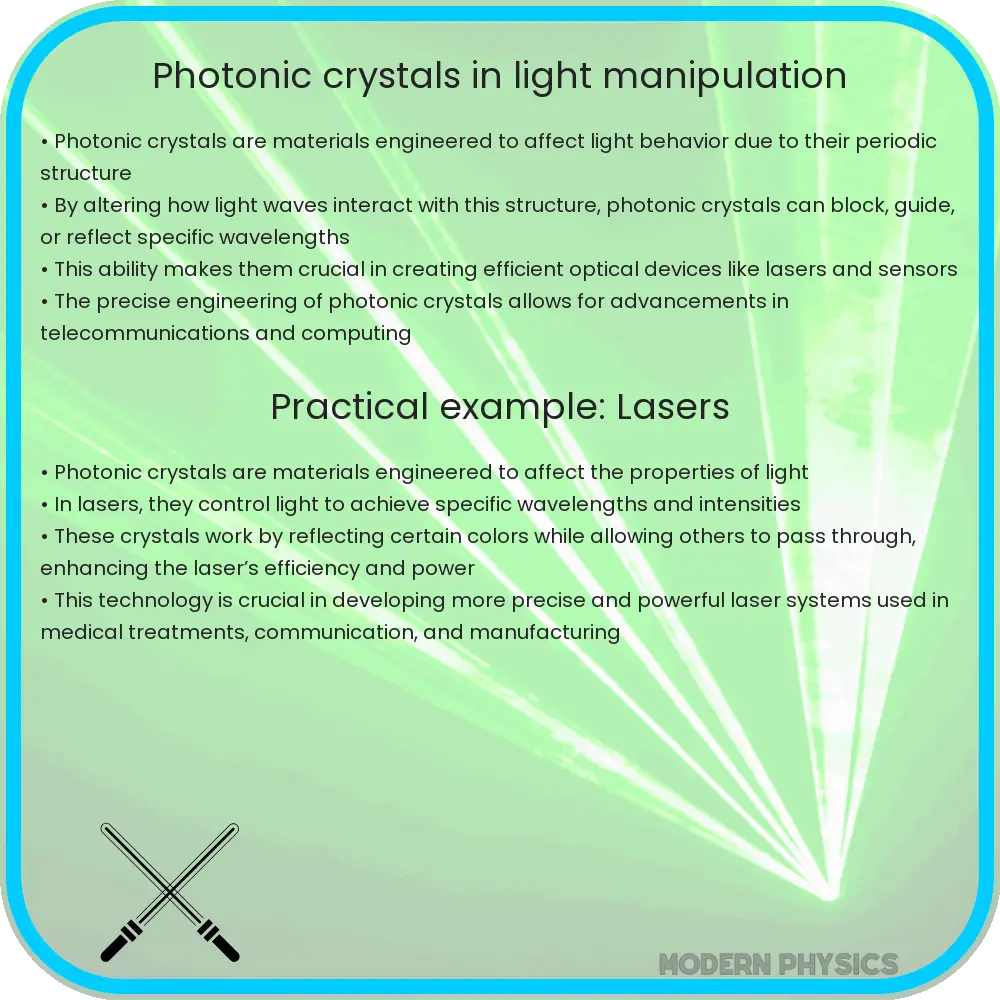
Photonic Crystals (PhCs) represent a groundbreaking innovation in the field of optics, offering unprecedented control over light waves. These materials are structured to affect the properties of photons, making them a key component in the advancement of optical technologies. Their unique ability to manipulate light at the nanoscale opens up a myriad of applications, from improving optical fibers to creating more efficient solar cells.
At the core of Photonic Crystals is their periodic dielectric structure, which allows them to affect the photonic band gap in a similar manner to how semiconductor materials influence electrons. This phenomenon enables PhCs to block, guide, or enhance light waves within specific frequency ranges, thereby allowing precise control over light propagation. The implications for this are vast, offering potential breakthroughs in telecommunications, medical imaging, and even quantum computing.
Understanding the Mechanism Behind Photonic Crystals
The magic of Photonic Crystals lies in their ability to create a photonic band gap. This gap prevents the propagation of certain wavelengths of light, effectively allowing the material to control the flow of light through it. By designing the periodic structure of these crystals at a scale comparable to the wavelength of light (approximately 400-700 nm for visible light), scientists can dictate which wavelengths are allowed through and which are not. This selective transmission is what makes PhCs so valuable in optical devices.
The fabrication of Photonic Crystals involves sophisticated techniques, including lithography and self-assembly, to achieve the required precision and periodicity. These methods allow for the creation of PhCs with specific optical properties tailored to a wide range of applications. From enhancing the efficiency of LEDs and lasers to developing sensors with unprecedented sensitivity, the potential of Photonic Crystals is only beginning to be unlocked.
One of the most exciting prospects of Photonic Crystals is their application in creating “slow light”. By modifying the speed at which light travels through these materials, researchers can improve the performance of optical devices, enhancing data storage and processing capabilities. This aspect of PhCs is particularly promising for the development of future computing technologies, where speed and efficiency are paramount.
In conclusion, Photonic Crystals are at the forefront of optical research and development, promising to revolutionize the way we control and utilize light. With ongoing advancements in fabrication techniques and a deeper understanding of their properties, the possibilities for innovation and application are boundless.
Advancements and Applications: The Broad Horizon of Photonic Crystals
The exploration of Photonic Crystals (PhCs) has led to significant advancements in various fields, pushing the boundaries of what is possible with light manipulation. Among the most promising applications is the development of highly efficient solar panels. By integrating PhCs into solar cell designs, researchers aim to significantly increase light absorption and conversion efficiency, potentially transforming the landscape of renewable energy.
In the realm of telecommunications, PhCs are paving the way for faster and more reliable data transmission. The ability to control light with such precision enables the creation of photonic crystal fibers, which offer much lower loss and higher bandwidth than traditional optical fibers. This could lead to the development of ultra-fast internet speeds, capable of handling the increasing demand for data in our digital age.
Moreover, the unique properties of Photonic Crystals are being harnessed in the field of sensing and imaging technologies. By manipulating light at the nanoscale, PhCs can be used to create sensors with the ability to detect single molecules, offering new tools for medical diagnostics, environmental monitoring, and security applications. Their application in imaging techniques also promises to provide unprecedented resolution, opening new doors in scientific research and medical diagnostics.
Challenges and Future Directions
Despite their vast potential, the implementation of Photonic Crystals faces several challenges. The precise fabrication of PhCs requires advanced techniques and materials, often making the process costly and complex. Moreover, integrating these materials into existing technologies and systems poses its own set of challenges, requiring innovative approaches and interdisciplinary collaboration.
Future research in the field of Photonic Crystals is likely to focus on overcoming these hurdles, exploring new fabrication methods, and discovering novel materials that can enhance the properties of PhCs. As our understanding of these materials grows, so too will their applications, potentially leading to breakthroughs in areas such as quantum computing, where the control of light at the quantum level could open up entirely new paradigms of computing power and efficiency.
Conclusion
Photonic Crystals stand at the cutting edge of optical science, offering a window into a future where the control of light can lead to technological advancements previously thought impossible. From enhancing renewable energy sources to revolutionizing telecommunications and beyond, PhCs hold the key to a myriad of applications that could shape the future of society. Despite the challenges that lie ahead, the potential of Photonic Crystals to transform our technological landscape is undeniable. As research and development in this field continue to advance, we can expect to see a new era of innovation, powered by the remarkable properties of these extraordinary materials.