
Explore Photonic Bandgap Fibers: advanced technology enhancing light transmission & control in optics, ideal for telecom, sensing, and lasers.
Understanding Photonic Bandgap Fiber Technology
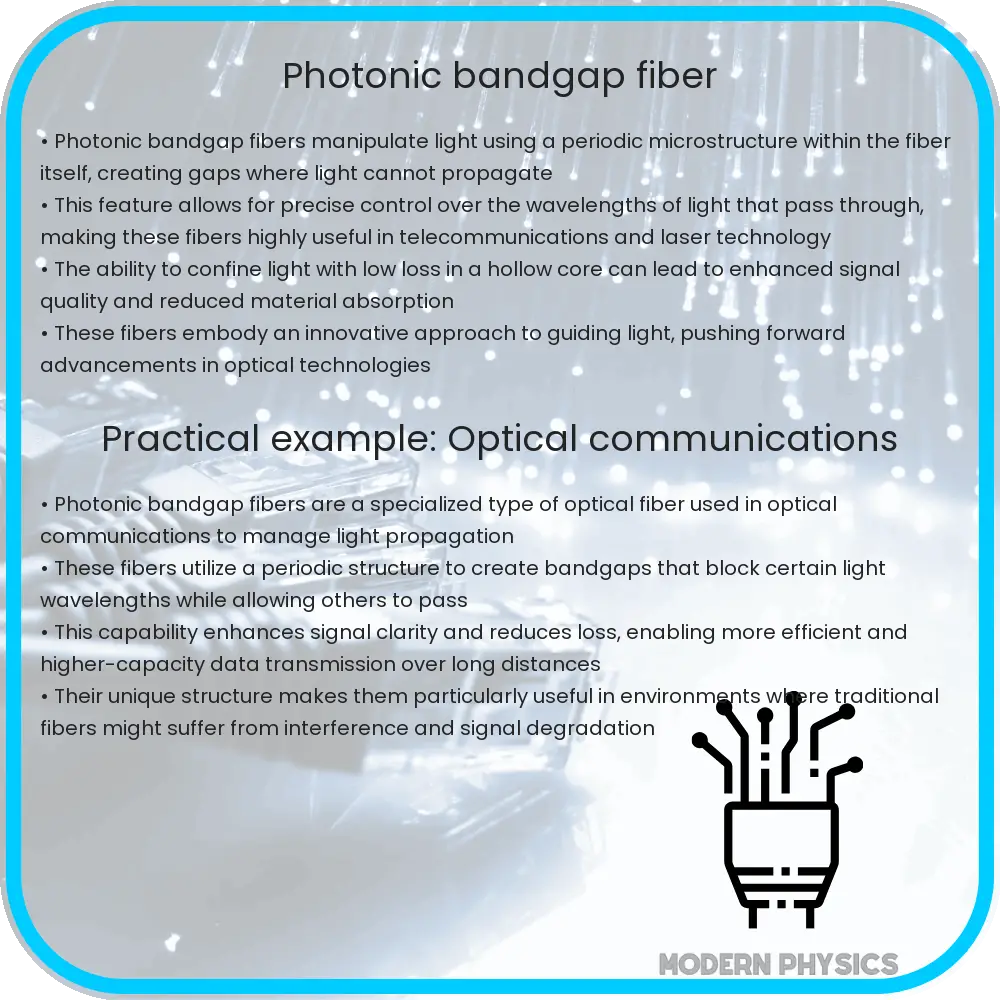
Photonic Bandgap Fibers (PBFs) represent a significant advancement in fiber optics technology, offering unprecedented control and enhancement of light transmission. These fibers function by employing a photonic bandgap structure to manipulate the propagation of light, making them highly beneficial for a wide range of applications in telecommunications, sensing, and laser systems.
Principles of Photonic Bandgap Fibers
At the heart of PBF technology lies the principle of photonic bandgaps. These are frequency ranges in which light cannot propagate through the fiber. The structure of the fiber, usually consisting of a periodic array of air holes in a dielectric medium, creates these bandgaps. By adjusting the periodic structure, PBFs can be engineered to have specific bandgaps, thus controlling which wavelengths of light can pass through the fiber.
Enhanced Transmission Capabilities
One of the key benefits of PBFs is their ability to enhance light transmission in specific wavelengths. By designing the photonic bandgap to align with certain light frequencies, PBFs can effectively channel light with minimal losses. This is particularly beneficial for long-distance communication systems where signal loss is a significant concern.
Control Over Light Properties
Another advantage of PBFs is the level of control they provide over the properties of light. For instance, PBFs can be designed to limit the dispersion of light, which is critical in high-speed data transmission. This ability to manipulate light’s phase, speed, and direction opens up new possibilities in optical computing and precision sensing.
Applications in Various Fields
The unique properties of PBFs have found applications in various domains. In telecommunications, they improve signal clarity and data transmission speeds. In medical imaging and sensing, PBFs aid in creating high-resolution images. Furthermore, their ability to handle high-power light makes them suitable for laser systems and industrial processing.
Overall, Photonic Bandgap Fibers are revolutionizing the field of optics by providing enhanced control and transmission capabilities. Their adaptability and efficiency make them a cornerstone technology for future advancements in optical communications and beyond.
Advanced Features of Photonic Bandgap Fibers
Photonic Bandgap Fibers (PBFs) also offer unique features that set them apart from traditional optical fibers. One such feature is their ability to guide light in air, which leads to lower material absorption and thus lower losses. Additionally, their high damage threshold makes them ideal for transmitting high-power beams, which is crucial in industrial and medical laser applications.
Innovations in Fabrication Techniques
The manufacturing of PBFs has seen significant innovations. Advanced fabrication techniques such as stack-and-draw, sol-gel, and ultraviolet (UV) exposure have enabled the production of fibers with more precise and complex structures. This progress in manufacturing not only improves the quality and performance of PBFs but also expands their potential applications.
Challenges and Future Directions
Despite their advantages, PBFs face challenges, particularly in terms of manufacturing complexity and cost. The precision required in fabricating the photonic bandgap structure makes the process intricate and expensive. Future research is directed towards simplifying the fabrication process and reducing costs, making PBFs more accessible for widespread use.
Another area of focus is the exploration of new materials and designs to further expand the capabilities of PBFs. This includes developing fibers that can operate at new wavelengths, have wider bandgaps, or possess even finer control over light properties.
Conclusion
Photonic Bandgap Fibers stand at the forefront of optical fiber technology, offering unparalleled control and enhancement of light transmission. Their unique ability to manipulate light at the photonic level opens up exciting possibilities in telecommunications, medical technologies, sensing, and high-power laser applications. While challenges in fabrication and cost remain, ongoing advancements in material science and manufacturing techniques are steadily overcoming these hurdles. As research and development in this field continue to progress, PBFs are poised to play a pivotal role in the evolution of optical technologies, paving the way for more efficient, precise, and versatile optical communication and sensing systems. The future of PBFs is not just bright; it’s brilliantly illuminated with the promise of innovation and transformation.