
Explore the precision, speed, and versatility of mode-locked fiber lasers, their applications in various fields, and the future of laser technology.
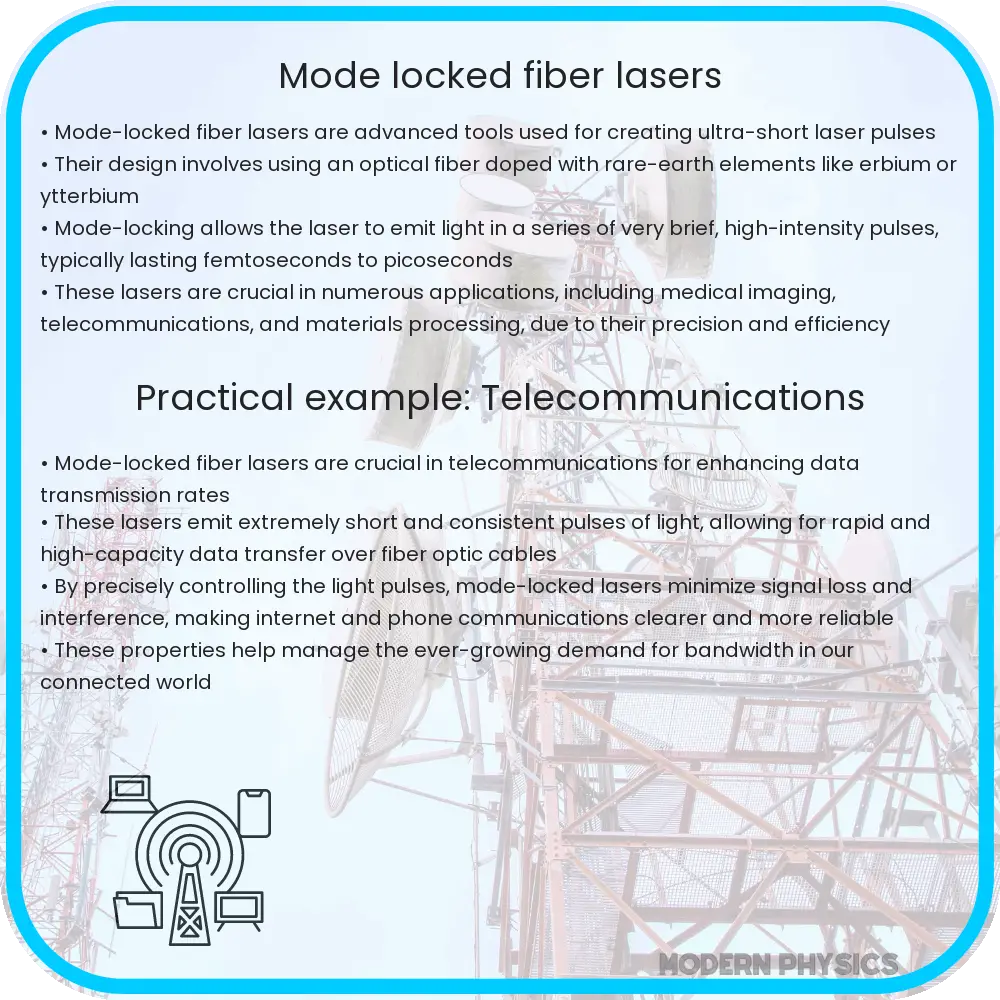
Introduction to Mode-Locked Fiber Lasers
Mode-locked fiber lasers stand at the forefront of laser technology, offering unmatched precision, speed, and versatility across a wide range of applications. These lasers utilize a fiber-based medium to generate ultra-short pulses of light, typically in the picosecond or femtosecond range, through a process known as mode-locking. This technique allows for the simultaneous oscillation of multiple modes of light within the fiber, resulting in a coherent pulse with exceptional peak power and stability.
Key Features and Benefits
The unique properties of mode-locked fiber lasers make them indispensable tools in various fields, including telecommunications, medical procedures, and materials processing. Their high precision and control enable the accurate cutting, drilling, and marking of materials, while their speed and efficiency improve productivity and reduce operational costs. Additionally, the versatility of these lasers allows for their use in a wide array of environments and applications, from industrial manufacturing to scientific research.
- Precision: The ability to produce ultra-short pulses ensures minimal thermal damage to surrounding materials, making these lasers ideal for delicate or precision-focused tasks.
- Speed: Mode-locked fiber lasers can operate at extremely high repetition rates, significantly reducing processing times in applications like micromachining and data transmission.
- Versatility: The wavelength flexibility and the ability to be easily integrated into various setups make these lasers adaptable to numerous applications, from spectroscopy to non-linear imaging.
Operating Principles
The operation of mode-locked fiber lasers is grounded in the principles of optical physics. Mode-locking is achieved either actively, by modulating the intracavity light with an external signal, or passively, by using saturable absorbers that favor the amplification of pulsed light over continuous wave light. This results in the emission of light pulses with durations on the order of femtoseconds (10-15 seconds) to picoseconds (10-12 seconds), offering unparalleled precision for cutting-edge applications.
The versatility of mode-locked fiber lasers is further enhanced by their compact size and the inherent stability of the fiber optic medium, which provides excellent beam quality and reliability over long periods of operation. This makes them an attractive option for both established and emerging technologies, pushing the boundaries of what is possible in precision engineering, biomedical research, and photonics.
Applications of Mode-Locked Fiber Lasers
Mode-locked fiber lasers have found their way into a myriad of applications, underscoring their importance in modern technology and industry. In the medical field, they are used for precision surgeries and dermatological treatments, minimizing damage to healthy tissues. In manufacturing, these lasers are pivotal for creating intricate designs on metals, plastics, and ceramics with high throughput and minimal waste. Furthermore, in telecommunications, they enable ultrafast optical communication systems, enhancing data transmission speeds and reliability.
Advancements and Future Directions
Research and development in mode-locked fiber lasers continue to push the boundaries of their capabilities. Innovations in fiber design, laser configuration, and pulse shaping techniques are expanding their performance and application range. Future directions include the development of more compact and energy-efficient models, as well as the exploration of new wavelength ranges to unlock previously inaccessible applications in science and industry.
- Energy Efficiency: Ongoing improvements aim to reduce the power consumption of these lasers, making them more sustainable and cost-effective for widespread use.
- Compactness: Efforts to miniaturize laser setups without compromising performance are critical for portable and space-constrained applications.
- New Wavelengths: Exploring lasers that operate at unique wavelengths can open up new avenues in medical imaging, environmental monitoring, and beyond.
Conclusion
Mode-locked fiber lasers represent a pinnacle of laser technology, offering a blend of precision, speed, and versatility that is unmatched by other laser types. Their wide range of applications, from industrial manufacturing to telecommunications and medical procedures, highlights their significance in advancing both current and future technologies. As research continues to enhance their capabilities, mode-locked fiber lasers are set to play an even more critical role in shaping the technological landscape, driving innovations that can lead to more efficient, accurate, and sustainable solutions across various fields. The ongoing exploration of new materials, configurations, and operational regimes promises to unlock even greater potential, ensuring that mode-locked fiber lasers remain at the cutting edge of photonics research and application.