
Explore the revolutionary world of quantum imaging, offering unparalleled resolution, speed, and precision, transforming industries from medicine to security.
Quantum Imaging: Revolutionizing High-Resolution, Speed, and Precision
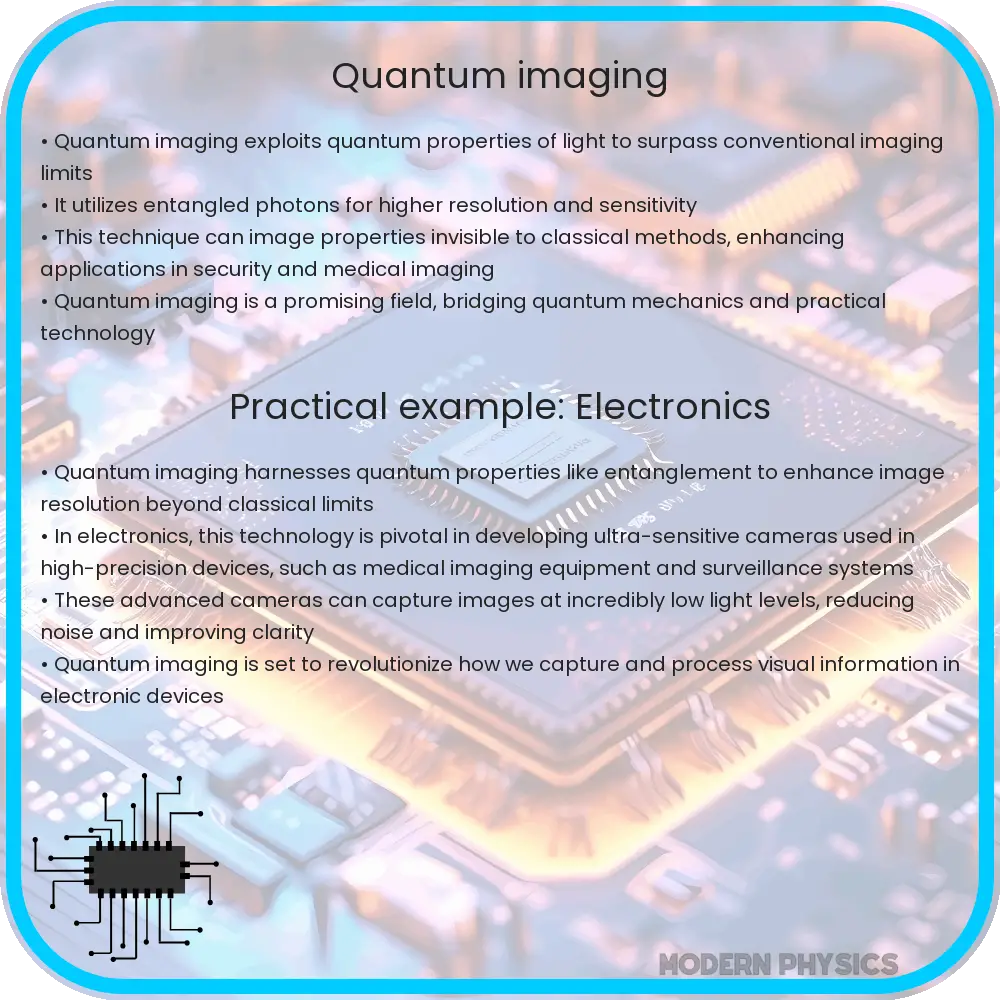
Quantum imaging represents a groundbreaking shift in imaging technology, leveraging the principles of quantum mechanics to achieve unprecedented levels of resolution, speed, and precision. This innovative approach goes beyond traditional imaging methods, offering new possibilities for a wide range of applications from medical diagnostics to security and beyond.
Understanding Quantum Imaging
At its core, quantum imaging exploits the quantum properties of light, such as entanglement and superposition, to capture information about an object or scene. Unlike classical imaging, which relies on the intensity and wavelength of light, quantum imaging utilizes the quantum states of photons, providing a richer set of data that can be used to construct images with higher resolution and accuracy.
Advantages of Quantum Imaging
- High Resolution: Quantum imaging can surpass the diffraction limit of conventional optics, enabling the capture of images at a nanometric scale. This is particularly beneficial for fields like microscopy, where the detailed visualization of sub-cellular structures is crucial.
- Speed: By utilizing entangled photons, quantum imaging techniques can significantly reduce the amount of light needed to form an image. This leads to faster imaging speeds, which is essential for capturing dynamic processes in real time.
- Precision: Quantum imaging offers enhanced precision through its ability to measure light properties more accurately. This includes phase, amplitude, and polarization, allowing for more detailed and informative images.
Applications of Quantum Imaging
Quantum imaging’s unique capabilities open up new avenues in various fields. In medicine, it can lead to more precise and less invasive diagnostic tools, improving patient outcomes. In security, it enables the detection of objects or substances that are otherwise difficult to identify with traditional imaging methods. Additionally, in scientific research, quantum imaging can provide deeper insights into the microscopic and quantum worlds, furthering our understanding of the universe.
This introduction to quantum imaging highlights its transformative potential across industries. By pushing the boundaries of what’s possible in imaging technology, it sets the stage for innovations that could redefine our approach to exploration, diagnosis, and security in the digital age.
Challenges and Future Directions
Despite its remarkable potential, quantum imaging faces several challenges that must be addressed to realize its full capabilities. The complexity of quantum systems and the need for sophisticated detection equipment can limit its accessibility and increase costs. Additionally, integrating quantum imaging technologies into existing systems requires overcoming technical and compatibility hurdles.
Research and development efforts are focused on making quantum imaging more practical and widely available. Advances in photonics, quantum information science, and materials engineering are crucial for enhancing the sensitivity, reliability, and efficiency of quantum imaging systems. As these technologies mature, we can expect quantum imaging to become more integrated into various applications, from advanced telecommunications to quantum computing.
The Role of Quantum Imaging in Innovation
Quantum imaging is not just a novel scientific achievement; it’s a catalyst for innovation. By providing unprecedented imaging capabilities, it encourages the development of new products and services. For instance, in the field of biotechnology, quantum imaging could lead to breakthroughs in understanding cellular processes, potentially revolutionizing drug discovery and disease treatment. In environmental science, it could improve our ability to monitor and analyze ecological changes at a microscopic level, enhancing conservation efforts.
Conclusion
Quantum imaging stands at the confluence of quantum physics and imaging science, marking a significant leap forward in our ability to observe and understand the world around us. With its promise of high-resolution, speed, and precision, it has the potential to revolutionize a wide range of fields, from healthcare and security to scientific research and beyond. While challenges remain in its widespread adoption and integration, the ongoing advancements in quantum technologies suggest a bright future for quantum imaging. As researchers continue to unlock its capabilities, we can anticipate a new era of discovery and innovation, powered by the quantum properties of light. In embracing quantum imaging, we open the door to possibilities once thought to be the realm of science fiction, affirming the role of quantum mechanics as a fundamental driver of future technologies.